




For coffee equipment importers, distributors, and brands, selecting the right commercial coffee grinder manufacturer is a critical business decision.
Many buyers begin their supplier search with one simple question:
"How much does the grinder cost?"
Price is important, but it should never be the only factor.
A commercial coffee grinder is a professional machine designed for continuous daily operation. It may need to handle:
· Hundreds of grinding cycles every day
· Different coffee bean characteristics
· Frequent grind adjustments
· Long working hours in demanding café environments
Therefore, the real value of a supplier is not only the product itself.
A reliable manufacturing partner should provide:
· Stable product quality
· Consistent production capability
· Technical support
· OEM customization
· Long-term supply reliability
For global coffee businesses, choosing the right manufacturer can directly influence:
· Customer satisfaction
· Brand reputation
· After-sales cost
· Market competitiveness
Beyond Price: What Really Defines a Professional Commercial Coffee Grinder Manufacturer?
In today’s global coffee equipment market, many suppliers offer similar-looking products.
Two grinders may appear almost identical from the outside, but their internal design and manufacturing standards can be completely different.
For example, two 74mm flat burr commercial grinders may differ significantly in:
· Motor performance
· Burr quality
· Grinding chamber design
· Heat management
· Assembly precision
· Quality control standards
These differences directly affect:
· Grinding consistency
· Espresso extraction stability
· Product lifespan
· Customer experience
A professional commercial coffee grinder supplier understands that commercial equipment is not only about producing machines.
It is about creating reliable solutions for businesses that depend on daily performance.
1. Evaluate the Manufacturer’s Engineering Capability
Strong Engineering Is the Foundation of Product Reliability
One of the first things buyers should evaluate is whether the supplier has real engineering capability.
A company that only purchases components and assembles products may have limited ability to improve or customize equipment.
A professional coffee grinder manufacturer should have experience in:
· Product structure design
· Grinding system development
· Motor matching
· Thermal management
· Mechanical optimization
· Product improvement
Why Engineering Capability Matters
Different markets have different requirements.
For example:
Specialty Coffee Market
Customers may prioritize:
· Grinding accuracy
· Temperature stability
· Premium appearance
· User experience
Commercial Café Market
Customers usually focus on:
· Reliability
· Productivity
· Easy maintenance
· Operating cost
Coffee Chain Applications
Large chains require:
· Consistent performance
· Standardized operation
· Stable supply
· Long-term support
A manufacturer with strong engineering capability can develop products based on market needs instead of simply offering existing models.
Key Technical Areas to Evaluate
1. Burr System Design
The burr system is one of the most important components of a commercial coffee grinder.
Buyers should consider:
· Burr diameter
· Burr material
· Cutting design
· Processing accuracy
· Grinding consistency
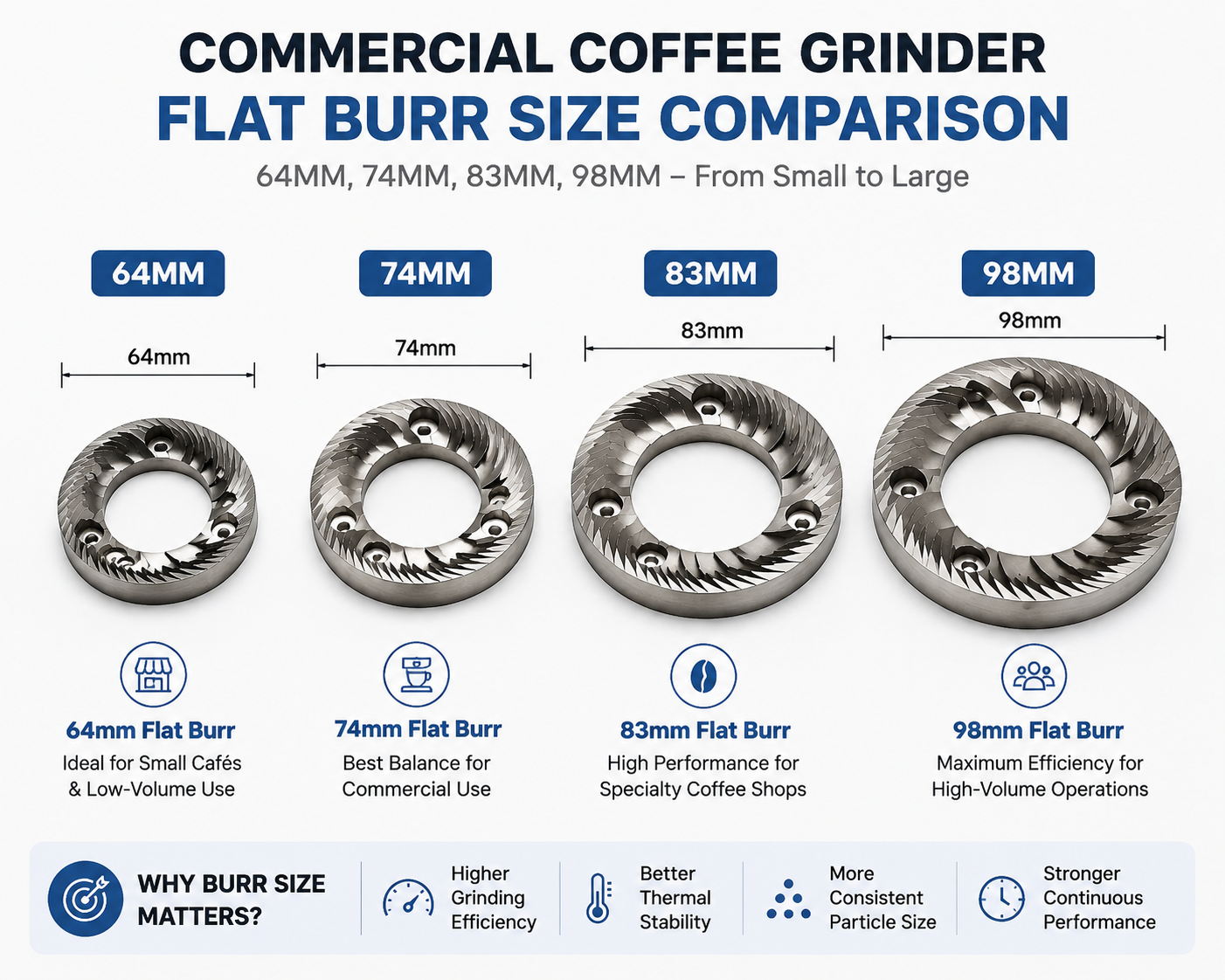
Common flat burr sizes include:
· 64mm
· 74mm
· 83mm
· 98mm
Different sizes serve different commercial applications.
2. Motor Technology
A commercial grinder requires more than high power.
Important factors include:
· Torque output
· Speed stability
· Heat generation control
· Continuous operating capability
A powerful motor with poor thermal control may not deliver consistent performance during long working hours.
3. Grinding Adjustment System
Professional espresso applications require precise adjustment.
Important features include:
· Accurate grind adjustment
· Repeatability
· Stable positioning
· Easy operation for baristas
A good adjustment system helps coffee shops maintain consistent extraction results.
commercial coffee grinder manufacturer
2. How to Evaluate Commercial Coffee Grinder Quality Before Purchasing
Quality Control Determines Long-Term Reliability
For international buyers, product quality is one of the biggest factors when selecting a supplier.
A low-quality commercial grinder can create problems such as:
· Higher warranty claims
· Customer complaints
· Replacement costs
· Brand reputation damage
A reliable manufacturer should have a complete quality management system.
Important Quality Control Processes
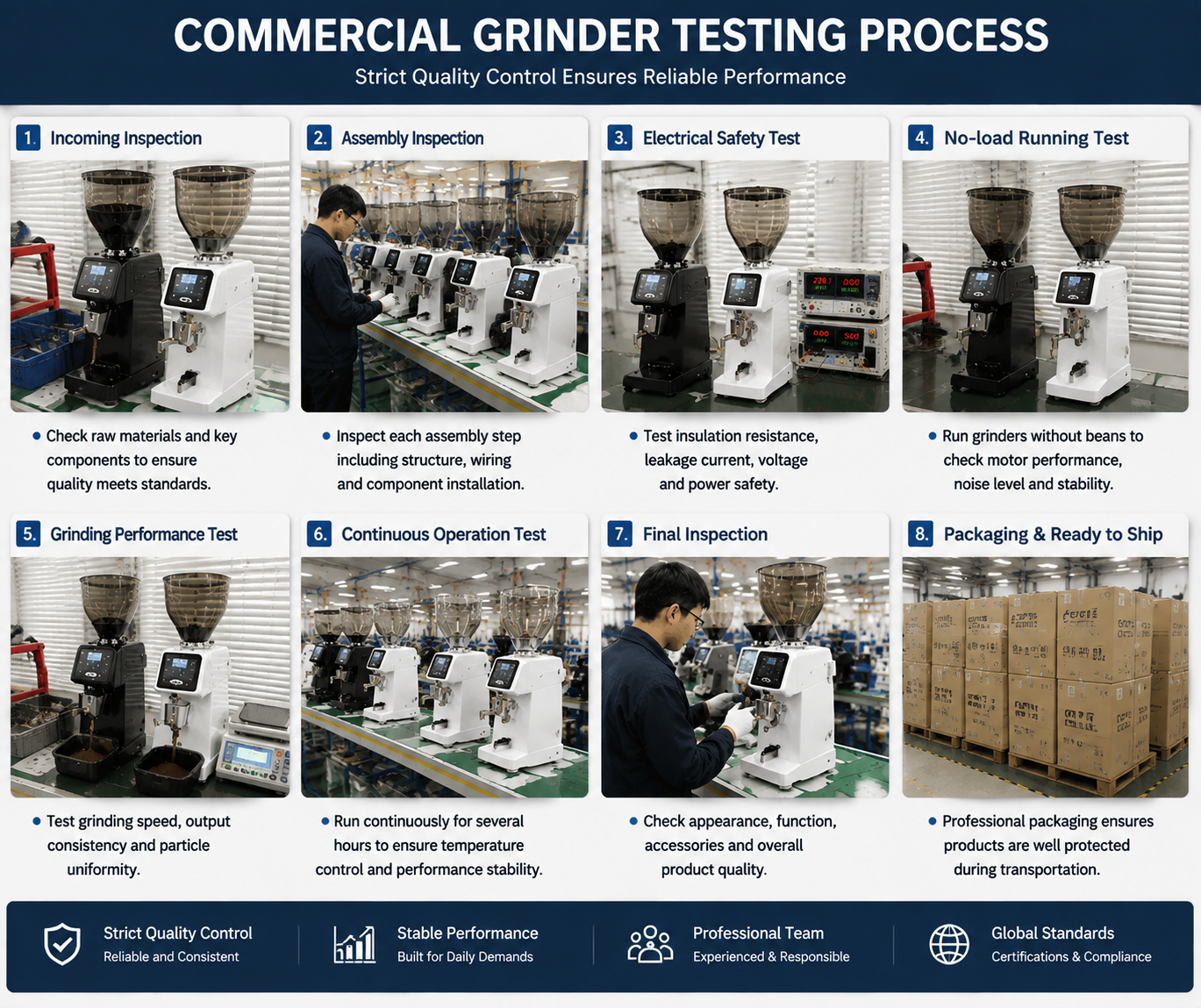
Incoming Material Inspection
Before production begins, key components should be inspected.
Including:
Burr Components
Checking:
· Material hardness
· Flatness
· Manufacturing precision
· Cutting consistency
Motor Components
Checking:
· Running stability
· Noise level
· Temperature performance
· Electrical safety
Electronic Components
Checking:
· Control systems
· Displays
· Sensors
· Circuit reliability
Assembly Quality Control
A professional factory should control:
Mechanical Assembly
Including:
· Shaft alignment
· Burr positioning
· Grinding chamber accuracy
Electrical Assembly
Including:
· Wiring inspection
· Voltage testing
· Safety testing
Final Calibration
Before shipment, grinders should be tested for:
· Grinding performance
· Output consistency
· Operating stability
Grinding Performance Testing
Commercial grinders should be evaluated through real operating conditions.
Important tests include:
Particle Distribution Testing
Ensuring consistent coffee grounds.
Grinding Speed Testing
Evaluating productivity during busy café hours.
Continuous Operation Testing
Checking performance during extended operation.
3. OEM and Private Label Capability: More Than Just Adding a Logo
Why OEM Capability Matters for Coffee Brands
Many international coffee companies are not simply looking for a supplier.
They are looking for an OEM coffee grinder manufacturer that can help them develop their own products.
OEM cooperation includes much more than logo printing.
Professional OEM Services May Include:
Product Appearance Customization
Options include:
· Housing design
· Color customization
· Brand identity elements
Product Configuration Adjustment
Depending on market requirements:
· Burr size selection
· Motor specifications
· Voltage options
· Display systems
· Dosing methods
Packaging Customization
Including:
· Product packaging
· User manuals
· Labels
· Marketing materials
Why OEM Capability Creates Business Advantages
For coffee brands, customized products provide:
· Stronger market differentiation
· Better brand recognition
· Higher customer loyalty
· Improved profit margins
A professional OEM partner can help transform an idea into a market-ready commercial coffee grinder.
OEM coffee grinder manufacturer
4. Export Experience and Global Market Support
Manufacturing Is Only Part of International Business
A factory may produce good products, but exporting commercial coffee equipment requires additional experience.
International buyers should evaluate whether the supplier understands:
· Global regulations
· Documentation requirements
· Packaging standards
· Shipping requirements
· After-sales support
Important Export Capabilities
Certification Support
Depending on the market, products may require:
· CE
· ETL
· RoHS
Voltage and Plug Customization
Different regions require different electrical standards.
Examples:
· North America
· Europe
· Australia
· Middle East
Export Packaging
Commercial grinders require professional packaging because they are:
· Precision equipment
· Heavy products
· Long-distance shipments
Proper packaging reduces transportation risks.
5. Choosing the Right Grinder Configuration for Your Market
A professional supplier should help customers select the right product based on application.
Burr size selection is also an important factor when developing commercial coffee grinder solutions for different markets. From compact 64mm flat burr grinders to high-performance 98mm flat burr systems, each configuration serves different applications and customer requirements.
For a detailed comparison of different burr sizes and how they influence grinding performance, check our guide: [64mm vs 74mm vs 83mm vs 98mm Flat Burr Grinder: Which Size Is Best for Commercial Coffee?]
64mm Flat Burr Grinder
Suitable for:
· Small cafés
· Restaurants
· Entry commercial applications
Advantages:
· Compact size
· Competitive pricing
· Easy installation
74mm Flat Burr Grinder
One of the most popular commercial configurations.
Suitable for:
· Coffee shops
· Café chains
· Commercial espresso applications
Advantages:
· Balanced performance
· Reliable productivity
· Strong market acceptance
83mm Flat Burr Grinder
Suitable for:
· Specialty coffee businesses
· Premium cafés
· Professional applications
Advantages:
· Higher grinding capacity
· Better thermal stability
· Strong continuous performance
98mm Flat Burr Grinder
Suitable for:
· Large coffee chains
· High-volume locations
· Professional environments
Advantages:
· Maximum productivity
· High consistency
· Premium positioning
64mm 74mm 83mm 98mm flat burr coffee grinder comparison
6. Common Mistakes When Choosing a Coffee Grinder Supplier
Mistake 1: Choosing Only Based on Price
The cheapest supplier may not provide the lowest total cost.
Consider:
· Failure rate
· Warranty cost
· Customer complaints
· Replacement parts
Mistake 2: Working With Suppliers Without Manufacturing Capability
Some companies act only as trading companies.
Potential risks:
· Limited technical support
· Higher communication costs
· Less customization ability
Mistake 3: Ignoring Quality Control
Without proper testing:
· Product consistency may vary
· Performance problems may appear later
Mistake 4: Not Evaluating After-Sales Support
Commercial equipment requires long-term support.
Important factors:
· Spare parts availability
· Technical assistance
· Warranty service
7. Building a Long-Term Partnership With a Coffee Grinder Manufacturer
Successful B2B relationships are not built around one purchase order.
They are built through continuous cooperation.
A strong manufacturing partner can support:
Product Development
Helping brands create products that fit market demand.
Stable Supply
Ensuring:
· Reliable production
· Consistent quality
· On-time delivery
Continuous Improvement
Supporting future upgrades and product expansion.
Final Checklist Before Selecting a Commercial Coffee Grinder Manufacturer
Before starting cooperation, buyers should evaluate:
Manufacturing Capability
✓ Own production facility
✓ Engineering team
✓ Production management system
Product Capability
✓ Multiple grinder configurations
✓ Commercial application experience
✓ Stable product portfolio
Quality System
✓ Material inspection
✓ Assembly testing
✓ Grinding performance testing
OEM Capability
✓ Private label support
✓ Product customization
✓ Packaging solutions
Export Capability
✓ International shipping experience
✓ Market compliance knowledge
✓ After-sales support
Conclusion: The Right Manufacturer Creates Long-Term Business Value
Choosing the right commercial coffee grinder manufacturer is not simply about purchasing equipment.
For distributors, importers, and coffee brands, the manufacturer you choose will influence:
· Product quality
· Customer satisfaction
· Brand reputation
· Long-term profitability
A reliable manufacturing partner should provide:
✓ Strong engineering capability
✓ Stable production capacity
✓ Strict quality control
✓ OEM solutions
✓ Export experience
✓ Long-term cooperation support
The right supplier does not only deliver coffee grinders.
They help your business build a stronger position in the global coffee equipment market.
Looking for a Reliable Commercial Coffee Grinder Manufacturer?
Whether you are a coffee equipment distributor, importer, or coffee brand, we provide professional commercial espresso grinder solutions including:
· OEM and private label services
· Flat burr grinder options
· Custom product development
· Global export support
Contact us today to discuss your commercial coffee grinder project.
FAQ:
What should I consider when choosing a commercial coffee grinder manufacturer?
Look for manufacturing capability, quality control systems, OEM experience, export knowledge, and long-term support capability.
What burr size is best for commercial coffee grinders?
The best burr size depends on your market. 74mm is widely used for mainstream commercial applications, while 83mm and 98mm are designed for premium and high-volume environments.
How can I find an OEM coffee grinder manufacturer?
Choose manufacturers with engineering teams, customization experience, stable production capability, and international export experience.
Why is quality control important for commercial espresso grinders?
Because commercial grinders operate under heavy workloads. Reliable quality control ensures consistent performance and reduces long-term maintenance costs.