




For coffee equipment buyers, selecting the right commercial coffee grinder is not only about choosing a machine with attractive design or powerful specifications.
The grinder configuration directly influences:
· Grinding consistency
· Product positioning
· Customer experience
· Maintenance requirements
· Long-term market competitiveness
Among all grinder specifications, the flat burr size is one of the most important factors that coffee equipment distributors, café chains, and private-label brands should evaluate.
Currently, the most common flat burr sizes used in commercial espresso grinders include:
· 64mm flat burr
· 74mm flat burr
· 83mm flat burr
· 98mm flat burr
Each burr size serves different market segments.
A compact 64mm grinder may be suitable for entry-level commercial applications, while a 98mm grinder is designed for high-volume professional environments.
For coffee grinder manufacturers and suppliers, understanding these differences helps create the right products for different global markets.
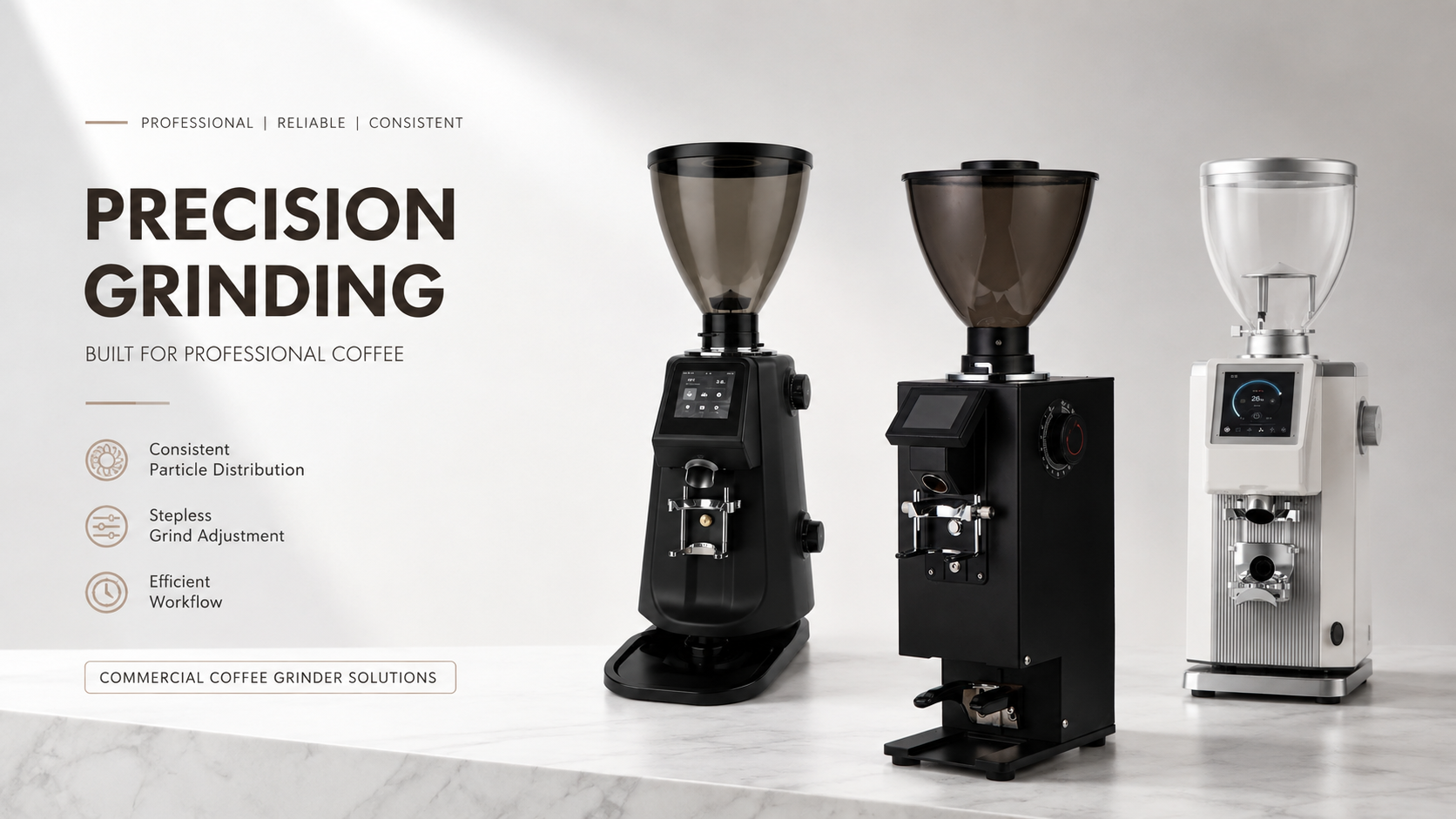
Commercial coffee grinder product lineup showing different models.
Why Flat Burr Size Matters in Commercial Coffee Grinders
A flat burr coffee grinder uses two parallel grinding discs to cut and grind coffee beans.
During operation:
· One burr remains fixed
· One burr rotates
· Coffee beans pass through the grinding chamber
· The burrs produce consistent coffee particles
Compared with traditional grinding systems, commercial flat burr grinders are widely used in professional espresso applications because they offer:
· More consistent particle distribution
· Better espresso extraction control
· Improved repeatability
For coffee shops, consistency is essential.
For coffee equipment distributors and brands, consistency determines customer satisfaction and product reputation.
A commercial espresso grinder that performs reliably every day helps café operators maintain stable beverage quality.
Does a Larger Burr Always Mean a Better Commercial Grinder?
One common misunderstanding in the coffee equipment market is:
“The bigger the burr, the better the grinder.”
This is not always true.
A larger burr size generally provides:
Higher grinding efficiency
A larger cutting surface allows the grinder to process more coffee beans in less time.
Benefits include:
· Faster grinding speed
· Higher production capacity
· Better workflow during peak hours
Better thermal stability
During commercial operation, heat is generated by:
· Motor operation
· Burr friction
· Continuous grinding
Excessive heat may affect coffee extraction consistency.
Larger burrs usually have greater metal mass, which helps reduce temperature fluctuations.
Better continuous performance
Commercial coffee shops may grind several kilograms of coffee every day.
The important question is not:
“How does the grinder perform for the first shot?”
The real question is:
“Can the grinder maintain consistent performance after hundreds of shots?”
This is where larger commercial burr systems provide advantages.
64mm Flat Burr Grinder: A Cost-Effective Commercial Solution
A 64mm flat burr grinder is one of the most popular entry-level commercial configurations.
It is commonly used for:
· Independent coffee shops
· Small specialty cafés
· Restaurants
· Hotels
· New coffee brands
For coffee grinder suppliers, 64mm models are often positioned as practical commercial solutions with competitive pricing.
Advantages of 64mm Commercial Coffee Grinders
Compact Design
64mm grinders usually require less counter space.
This makes them suitable for:
· Small cafés
· Limited-space locations
· Entry-level commercial projects
Competitive Pricing
For distributors developing affordable product lines,64mm grinders offer:
· Lower manufacturing cost
· Easier maintenance
· Attractive market pricing
Flexible Market Application
A well-designed 64mm flat burr coffee grinder can support:
· Espresso applications
· Medium-volume cafés
· Specialty coffee programs
Limitations of 64mm Burr Systems
For high-volume commercial environments,limitations may appear:
· Lower grinding speed
· Reduced continuous workload capability
· Less thermal stability compared with larger burr systems
Therefore, 64mm is best positioned for small and medium commercial applications.
74mm Flat Burr Grinder: The Best Balance for Commercial Espresso Applications
Among professional espresso grinder solutions, 74mm flat burr grinders have become one of the most widely adopted configurations.
For many coffee equipment buyers, 74mm represents the ideal balance between:
· Performance
· Cost
· Reliability
· Market positioning
This makes it one of the most attractive options for commercial coffee grinder manufacturers and distributors.
Why 74mm Is Popular Among Coffee Equipment Buyers
1.Suitable for Mainstream Commercial Markets
74mm grinders are commonly used in:
· Coffee shops
· Café chains
· Restaurants
· Hotels
· Specialty espresso businesses
They provide enough capacity for professional daily operation without excessive equipment cost.
2. Excellent Espresso Performance
Espresso requires precise grinding control.
A high-quality 74mm flat burr grinder can provide:
· Stable particle distribution
· Reliable dosing
· Easier espresso adjustment
This makes it suitable for:
· Espresso blends
· Medium roast coffee
· Milk-based beverages
3. Strong Value Proposition for Distributors
For coffee equipment distributors, product positioning is extremely important.
A 74mm commercial espresso grinder offers:
· Professional performance
· Competitive pricing
· Broad customer application
This makes it an attractive product category for international markets.
83mm Flat Burr Grinder: A Premium Solution for Specialty Coffee and Professional Markets
For coffee equipment distributors and professional coffee brands, the 83mm flat burr grinder represents a step toward higher-performance commercial espresso grinding.
Compared with 64mm and 74mm models, an 83mm flat burr system provides:
· Higher grinding capacity
· Better thermal stability
· Stronger continuous operation capability
· More consistent performance during demanding workloads
Because of these advantages, 83mm commercial coffee grinders are commonly selected for premium market segments.
Typical applications include:
· Specialty coffee shops
· Premium café chains
· Coffee roasters
· Training centers
· High-end espresso bars
For manufacturers and suppliers, 83mm grinders are often positioned as premium commercial espresso grinder solutions.
Key Advantages of 83mm Commercial Coffee Grinders
1. Higher Productivity for Professional Coffee Businesses
Commercial customers are not only looking for good espresso quality.
They also need equipment that can support daily business operations.
A larger 83mm burr provides:
· Faster grinding performance
· Reduced waiting time during peak hours
· Improved workflow efficiency
For busy cafés, this means baristas can handle more orders without sacrificing consistency.
2. Better Grinding Stability During Continuous Operation
One of the biggest differences between consumer and commercial coffee grinders is workload.
A commercial grinder may operate:
· Several hours per day
· Hundreds of grinding cycles
· Several kilograms of coffee consumption
During long operation periods, grinder stability becomes critical.
An 83mm flat burr coffee grinder can help maintain:
· Stable particle distribution
· Consistent espresso extraction
· Reduced adjustment frequency
For coffee shop owners, this improves daily operation.
For distributors, this reduces after-sales complaints and improves customer satisfaction.
3. Suitable for Premium Coffee Product Lines
For coffee equipment brands developing premium products, an 83mm grinder provides strong market positioning.
It can support products targeting:
· Specialty coffee professionals
· High-end cafés
· Premium espresso enthusiasts
Compared with smaller burr systems, 83mm models provide a stronger “professional equipment” image.
83mm Flat Burr Grinder Limitations
Although 83mm grinders offer excellent performance, they are not suitable for every market.
Potential limitations include:
Higher Production Cost
Larger burr systems usually require:
· More powerful motors
· Larger machine structures
· Higher-cost components
This affects:
· Manufacturing cost
· Wholesale pricing
· Final retail positioning
Larger Equipment Size
Compared with 64mm and 74mm models, 83mm grinders generally require:
· More counter space
· Stronger support structures
· Higher shipping considerations
For compact café environments, this may not always be necessary.
Professional Espresso Grinder Manufacturer
98mm Flat Burr Grinder: Designed for High-Volume Commercial Applications
The 98mm flat burr grinder represents the flagship level of commercial coffee grinding technology.
It is designed for businesses where productivity, consistency, and long-term durability are the highest priorities.
Typical applications include:
· Large coffee chains
· Airports
· Shopping mall cafés
· Commercial beverage stations
· Coffee production facilities
For these applications, the grinder is not simply a coffee preparation tool.
It is a critical part of the business operation.
Why Choose a 98mm Commercial Espresso Grinder?
1. Maximum Grinding Efficiency
The larger burr diameter provides a larger cutting area.
This enables:
· Higher grinding output
· Faster preparation
· Better support for high-volume beverage production
For businesses processing large quantities of coffee every day, this efficiency creates measurable operational value.
2. Superior Consistency for Commercial Operations
Large coffee brands often require standardization.
A customer visiting different locations expects the same coffee experience.
A high-performance 98mm commercial espresso grinder helps support:
· Stable grind quality
· Consistent extraction
· Reduced variation between locations
This is especially important for:
· Coffee chains
· Franchise operations
· Private-label coffee brands
3. Ideal for Premium Commercial Product Positioning
For coffee grinder manufacturers and OEM suppliers, 98mm grinders can be positioned as flagship products.
They are suitable for brands that want to offer:
· Premium commercial equipment
· High-capacity solutions
· Professional-grade performance
Is a 98mm Flat Burr Grinder Right for Every Buyer?
Not necessarily.
A larger grinder requires:
· Higher investment
· More shipping space
· Higher maintenance considerations
For many coffee shops, a 74mm or 83mm commercial coffee grinder already provides excellent performance.
A 98mm model makes the most sense when the customer requires:
· High daily volume
· Continuous operation
· Maximum productivity
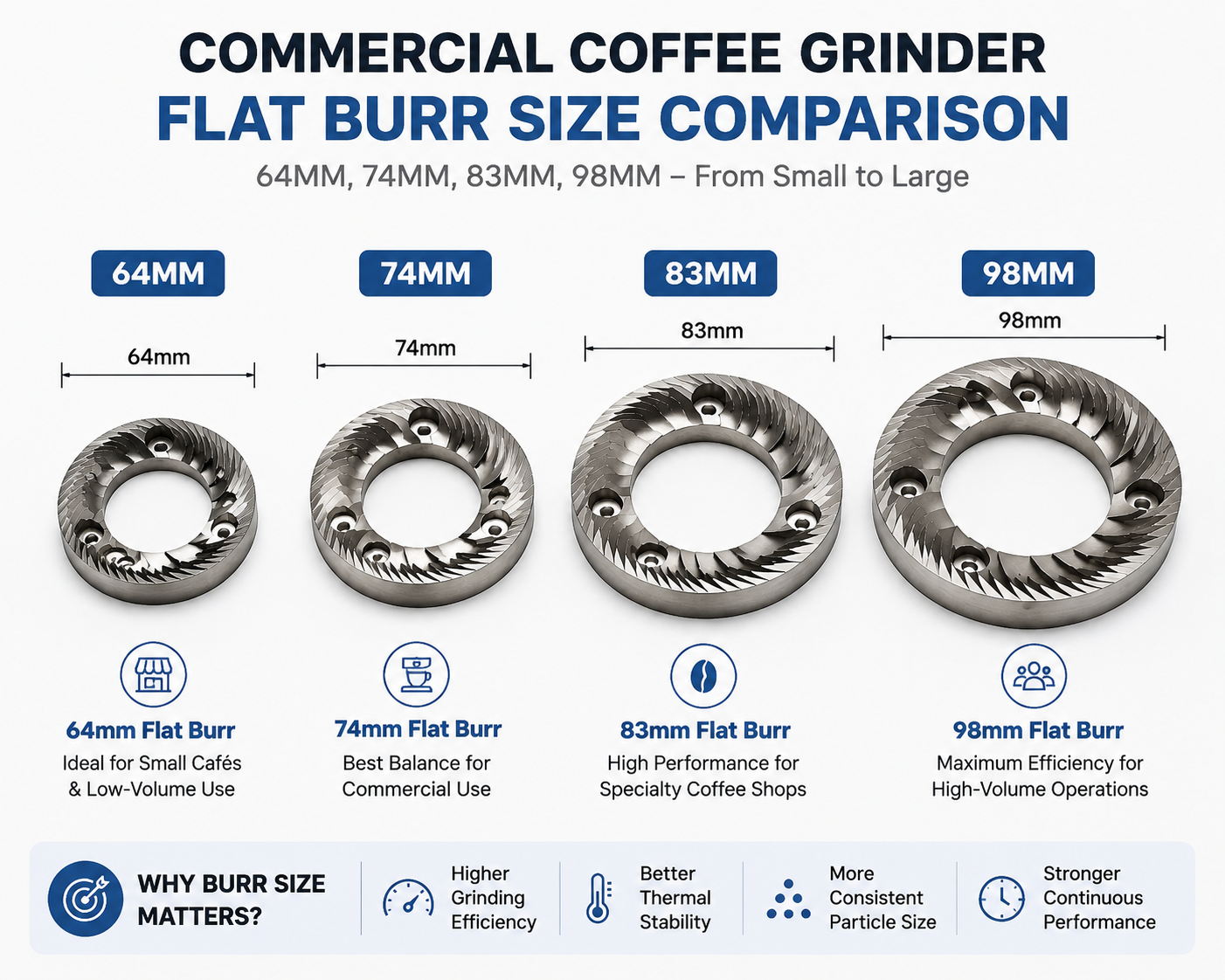
Commercial Coffee Grinder Burr Size Comparison
|
Burr Size |
Market Position |
Typical Customers |
Main Benefits |
|
64mm Flat Burr |
Entry Commercial |
Small cafés, restaurants, hotels |
Competitive price, compact design |
|
74mm Flat Burr |
Mainstream Commercial |
Coffee shops,café chains, distributors |
Best balance of performance and cost |
|
83mm Flat Burr |
Premium Commercial |
Specialty cafés,professional users |
Higher stability and productivity |
|
98mm Flat Burr |
Flagship Commercial |
Large chains, high-volume businesses |
Maximum output and consistency |
OEM Commercial Coffee Grinder Solutions for Global Coffee Brands
For international coffee equipment brands, choosing the right grinder configuration is only the beginning.
Many companies are looking for reliable:
· Coffee grinder manufacturers
· OEM coffee grinder suppliers
· ODM espresso grinder partners
A professional coffee grinder manufacturer can provide customized solutions based on different market requirements.
OEM Options for Commercial Coffee Grinders
1.Different Burr Size Configurations
A professional supplier can develop products with different burr options:
64mm Flat Burr Grinder
Suitable for:
· Entry-level commercial products
· Budget-conscious markets
· Small café solutions
74mm Flat Burr Grinder
Suitable for:
· Mainstream commercial espresso grinders
· Coffee shop equipment brands
· Distributor product lines
This is often the most commercially balanced configuration.
83mm Flat Burr Grinder
Suitable for:
· Premium product ranges
· Specialty coffee markets
· Professional applications
98mm Flat Burr Grinder
Suitable for:
· Flagship commercial products
· High-volume customers
· Premium coffee equipment brands
2. Private Label Coffee Grinder Manufacturing
Many coffee equipment companies prefer private-label solutions.
A reliable OEM coffee grinder manufacturer can support:
· Custom logo
· Housing design
· Color options
· Packaging solutions
· User manual customization
· Market-specific requirements
This allows distributors and brands to build their own coffee equipment product lines.
3. Global Market Requirements
Different regions may require different configurations.
Professional coffee grinder suppliers should support:
· Voltage customization
· Plug standards
· Certification requirements
· Packaging requirements
· Shipping solutions
For international buyers, supplier capability is just as important as product specifications.
How Coffee Equipment Buyers Should Select the Right Burr Size
When sourcing a commercial coffee grinder, buyers should consider four key factors:
1.Target Market Position
Ask:
Who is the end customer?
Examples:
Entry-level café market
Recommended:
64mm
Mainstream commercial coffee shops
Recommended:
74mm
Premium specialty coffee market
Recommended:
83mm
Large-scale commercial applications
Recommended:
98mm
2. Expected Coffee Volume
Daily coffee consumption is one of the most important factors.
Approximate guideline:
|
Daily Volume |
Recommended Burr Size |
|
Low volume |
64mm |
|
Medium commercial volume |
74mm |
|
High-performance specialty use |
83mm |
|
Industrial/high-volume use |
98mm |
3. Product Pricing Strategy
For distributors and brands, product positioning matters.
A 64mm grinder may compete in price-sensitive markets.
A 74mm grinder can target mainstream commercial customers.
83mm and 98mm models can support premium product categories.
4.Supplier Manufacturing Capability
The right supplier should provide:
· Stable production quality
· Technical support
· OEM customization
· Reliable delivery
· Quality control systems
Choosing the right coffee grinder manufacturer is as important as choosing the right grinder specification.
Frequently Asked Questions (FAQ)
Q1: What flat burr size is best for a commercial coffee grinder?
There is no single best size.
The ideal burr size depends on:
· Customer market
· Coffee volume
· Product positioning
· Budget
For many commercial applications, 74mm provides the best balance.
Q2: Why do many coffee brands choose 74mm flat burr grinders?
Because 74mm offers:
· Professional performance
· Competitive cost
· Broad market application
It is suitable for many café businesses and distributor product lines.
Q3: Are 83mm and 98mm grinders better than 74mm?
They provide higher capacity and stronger continuous performance.
However, they are designed for different applications.
A larger grinder is not always a better commercial solution.
Q4: What should distributors consider when choosing a coffee grinder supplier?
Important factors include:
· Manufacturing experience
· Product quality
· OEM capability
· Certification support
· After-sales service
· Production capacity
Partner With a Professional Commercial Coffee Grinder Manufacturer
Choosing the correct burr size is only one part of developing a successful coffee equipment product.
A reliable commercial coffee grinder supplier can help you select:
· Burr size configuration
· Motor specifications
· Product design
· OEM solutions
· Market positioning
Whether you are a coffee equipment distributor, coffee machine brand, or café chain purchasing team, working with an experienced manufacturer helps create products that match your market requirements.
Huazell designs and manufactures commercial coffee equipment, including a full range of commercial espresso machines and commercial coffee grinder models with OEM/ODM customization. Burr configurations, dosing systems, housings, and control interfaces can all be tailored to your specifications. To request a quotation, technical datasheet, or private-label partnership details, reach out through our website contact form.
Contact us to discuss your commercial coffee grinder project and OEM requirements.