




Introduction: A Customer Approved Our Temperature Stability, Then Rejected the Machine Because of Its Boiler Material
Recently, I spoke with a customer who was looking for a commercial espresso machine 2 group configuration for professional café operations.
At the beginning, our conversation went very well.
To help the customer understand how our machine performed under real operating conditions, I shared several product testing videos.
These included a video showing the machine extracting espresso while steaming milk at the same time, another demonstrating continuous water output to observe when the brewing temperature would begin to decline, and a video showing the internal boiler structure and water circuits.
My goal was to show the customer more than the machine's appearance and specifications. I wanted him to see how the machine performed under actual operating loads.
In our testing, this standard two-group commercial espresso machine from our factory—not a high-end model—maintained a measured brewing temperature of 92°C after delivering a cumulative water output of 1,200 mL during a direct water-flow test.
According to our test records, during normal continuous extraction, its temperature fluctuation can be maintained at approximately ±0.3–0.5°C.
These results gave us a practical way to demonstrate the machine's thermal management performance rather than relying solely on the technical specifications in a product brochure.
For a Professional espresso machine, temperature stability is an important part of delivering consistent brewing conditions, especially when a machine is expected to handle repeated extractions throughout a busy service period.
However, one day later, the customer suddenly raised a completely different objection:
"Your boiler is made of stainless steel, not pure copper, so it does not meet my requirements."
I was genuinely surprised.
Until that point, our discussion had focused on temperature stability, continuous extraction performance, and the machine's ability to brew coffee while producing steam. The customer had already watched the relevant testing videos.
But now, the decisive factor appeared to be the boiler material.
This raised an important question:
If a commercial espresso machine can demonstrate its temperature stability and thermal performance through actual testing, should it be rejected simply because it uses a stainless steel boiler instead of a pure copper boiler?
Of course, a customer may insist on copper boilers for legitimate reasons, including technical specifications, established purchasing standards, maintenance experience, or brand positioning. We cannot assume that his preference is unreasonable based on one conversation.
Nevertheless, this experience made me reconsider a broader question.
When purchasing a commercial espresso machine, are we choosing a particular material, or are we choosing a complete system designed to deliver consistent performance over time?
This is not simply a debate about copper versus stainless steel. It also concerns machine engineering, temperature control, continuous operating capability, and how B2B buyers should evaluate the real value of commercial coffee equipment.
1. Why Does Boiler Material Matter So Much to Buyers?
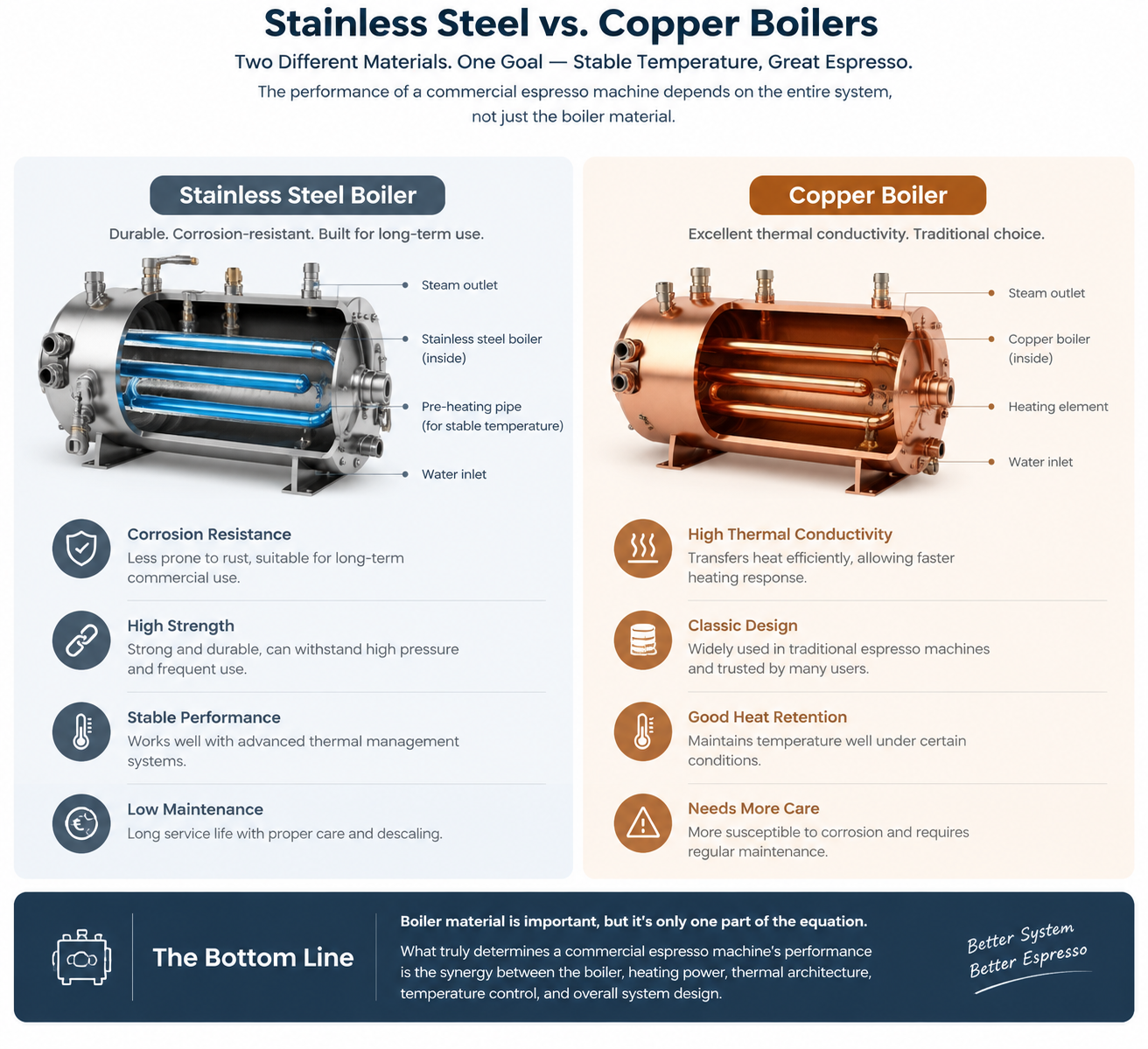
Copper boilers have a long history in the commercial espresso machine industry.
Copper has a high thermal conductivity, allowing it to transfer heat efficiently. For this reason, it has been widely used in traditional espresso machines and other heat-transfer equipment.
For many buyers, a pure copper boiler is more than a material specification. It may represent a familiar engineering approach, a traditional equipment design, and an expectation of product quality.
At the same time, stainless steel boilers are widely used in modern commercial coffee equipment. Depending on the specific alloy and construction, stainless steel offers advantages such as corrosion resistance, mechanical strength, and long-term durability.
Therefore, choosing between copper and stainless steel is not an irrelevant technical consideration.
The real question is whether we are treating the advantages of one material as a guarantee of the performance of the entire machine.
Copper's higher thermal conductivity does not mean that every espresso machine with a copper boiler will necessarily maintain a more stable brewing temperature than every machine with a stainless steel boiler.
Likewise, a stainless steel boiler does not automatically make a machine better simply because it is paired with an advanced temperature-control system.
Actual performance depends on how the material, boiler structure, heating power, heat-transfer pathways, temperature-control strategy, and overall machine design work together.
For a Commercial espresso machine supplier, explaining these differences accurately is essential when helping distributors and importers select equipment for their target markets.
If buyers focus exclusively on boiler material, they may overlook the factors that actually determine performance under demanding commercial operating conditions.
2. Copper Transfers Heat More Efficiently. Why Doesn't That Automatically Mean Better Temperature Stability?
This is the key to understanding the difference between the two materials.
Copper has a higher thermal conductivity than stainless steel. This is an established material property.
However, thermal conductivity and temperature stability are not the same thing.
Thermal conductivity describes how efficiently a material transfers heat. Temperature stability describes how well an entire system maintains its target temperature under changing operating conditions.
These two properties are related, but they cannot be treated as interchangeable.
There are three important factors to consider.
1. Fast Heat Transfer Does Not Guarantee Sufficient Heat Supply
During extraction, an espresso machine must continuously supply thermal energy to the water flowing through its brewing system.
As repeated extractions remove heat, the system must replenish that energy.
If heat is removed faster than the system can effectively replace it, the brewing temperature may eventually decline, regardless of whether the boiler is made of copper or stainless steel.
This is why buyers should also consider heating power, available thermal capacity, incoming water flow, and the efficiency of the complete heat-transfer system.
The real question is whether the machine can replenish the heat being consumed during sustained operation.
2. How Heat Travels Through the System Matters More Than Material Alone
Even when two espresso machines use the same boiler material, their internal structures can be completely different.
Some rely on conventional boiler heating. Others use dedicated brew boilers, heat exchangers, or pre-heating pipe systems to manage the temperature of incoming water.
These designs influence the water's heating path, heat-transfer efficiency, and the system's response to continuous demand.
In a system with a pre-heating circuit, the important question is whether pre-heating effectively reduces the thermal burden on downstream heating components and helps maintain the target temperature at the intended flow rate.
This is why buyers should examine not only the metal used for the boiler, but also the internal thermal architecture.
For an OEM espresso machine manufacturer, thermal architecture is an important part of product engineering because it influences how the machine performs under different operating conditions and how its capabilities can be demonstrated to overseas buyers.
3. Temperature Control Depends on the Entire System
Temperature control in a modern commercial espresso machine involves more than a sensor or controller.
Sensor placement, heating-element configuration, control response, and the way heat reaches the group head can all affect the final result.
Even if two machines use identical copper boilers, differences in heating power, control logic, and brewing-system design can produce different operating results.
Therefore, boiler material alone cannot tell us how much the brewing temperature will fluctuate during continuous extraction.
Material determines certain physical properties. Overall engineering determines how effectively those properties translate into real-world performance.
3. The Real Commercial Challenge Is Not a Single Shot, but Sustained Operation
For a home espresso machine, users may prepare one drink and then wait before making another.
Commercial cafés often operate very differently.
During busy periods, baristas must grind, dose, distribute, tamp, extract, steam milk, and prepare drinks continuously. In some cafés, two baristas may use a two-group machine simultaneously, with one extracting espresso while the other operates the steam wand.
Under these conditions, the machine is not performing one isolated heating task. It is managing a constantly changing thermal load.
Three performance indicators deserve particular attention.
First: Temperature Performance During Continuous Extraction
When water flows continuously through the brewing system, can the machine maintain its brewing temperature within the required range?
If the temperature changes significantly during sustained operation, baristas may encounter different extraction conditions.
However, the measurement method must be clearly defined. Boiler temperature, group-head temperature, and the temperature experienced by the coffee puck are not necessarily identical.
For buyers evaluating commercial espresso machine temperature stability, this distinction is important. A temperature reading is meaningful only when the measurement location, operating conditions, and testing method are clearly understood.
Second: Heat Recovery Between Extractions
Real café workflows normally include intervals between shots.
These intervals give the machine an opportunity to replenish some of the thermal energy removed during extraction. The extent of recovery depends on the machine's design, the duration of the interval, the preceding thermal load, and steam demand.
Therefore, buyers should evaluate not only continuous water-flow performance but also whether the machine maintains consistent operating conditions across repeated extractions.
Third: Performance During Simultaneous Brewing and Steaming
In commercial environments, steam demand may occur at the same time as espresso extraction.
The machine must then manage the brewing system's thermal requirements while also meeting the steam boiler's demand.
Different boiler configurations and thermal management systems respond differently to these conditions. A machine's performance during extraction alone cannot automatically establish its performance during simultaneous brewing and steaming.
Together, these three indicators help determine whether a machine is suitable for actual commercial operations.
A commercial espresso machine should not merely produce one good shot. It should deliver repeatable performance under the workload it is designed to handle.
4. Why Test Continuous Water Output Instead of Relying Only on Product Specifications?
Continuous water-flow testing is one useful way to investigate an espresso machine's thermal performance under sustained demand.
The procedure is straightforward: under defined initial conditions, water flows continuously through the brewing system while the operator records cumulative output and temperature changes.
As the total output increases, the system must continue supplying the thermal energy required to heat the incoming water.
If the heating and heat-transfer system can replenish that energy effectively, the temperature may remain within a relatively stable range. When the thermal demand exceeds the system's effective heating capacity, the temperature may begin to decline.
This type of test helps buyers understand how a machine responds to sustained thermal demand.
However, the results must be interpreted in the context of the testing conditions.
For example:
-
Was the machine fully warmed up and thermally stabilized before testing?
-
Was temperature measured inside the boiler, at the group head, or at another location?
-
What was the water flow rate?
-
Was steam used simultaneously during the test?
-
Does a temperature decline refer to any measurable change or to a clearly defined threshold?
-
How long did the machine take to recover after the test?
Without clear answers to these questions, two machines claiming to deliver the same volume of water may not be directly comparable.
The value of continuous water-flow testing is therefore not simply achieving a larger milliliter figure. It is using a repeatable method to observe how the machine responds as thermal demand increases.
Our Factory Test: A Standard Two-Group Commercial Espresso Machine
In one of our direct water-flow tests, our standard two-group commercial espresso machine—not a high-end model—maintained a measured brewing temperature of 92°C after reaching a cumulative output of 1,200 mL.
According to our test records, temperature fluctuation during normal continuous extraction can also be maintained at approximately ±0.3–0.5°C.
These results provide useful evidence for evaluating the thermal management performance of this machine.
However, we do not consider a single water-flow test sufficient to represent every commercial operating condition. For actual café applications, the machine should also be evaluated during repeated extractions, at realistic intervals between shots, and while steaming milk where applicable.
Our objective is to help buyers understand the machine's performance through actual data rather than relying exclusively on boiler material, boiler capacity, or an isolated marketing specification.
For businesses sourcing a commercial espresso machine 2 group configuration, this type of evidence can help support a more informed comparison between suppliers and equipment designs.
5. Why Must Test Results Be Considered Alongside Real Café Workflows?
Suppose a machine performs well during a continuous water-flow test.
Does this mean it can produce an unlimited number of espresso shots under every commercial condition?
Strictly speaking, no. A single test cannot establish that conclusion.
Continuous water-flow testing differs significantly from the normal espresso preparation process.
During a continuous-flow test, water may run without interruption, creating a sustained thermal load.
In actual café operation, baristas must grind, distribute, tamp, change portafilters, and prepare orders. These activities create intervals between extractions, potentially giving the machine opportunities to replenish heat.
As a result, performance during a real café workflow may differ from performance during uninterrupted water flow.
However, the existence of intervals does not guarantee that every machine will maintain a stable brewing temperature.
If heating capacity is insufficient, thermal management is poorly designed, or steam demand is excessive, temperature fluctuations may still occur during busy periods.
A more reliable evaluation combines continuous water-flow testing with repeated extraction tests and tests involving simultaneous brewing and steaming.
For buyers, this provides a much more useful understanding of real-world performance than focusing on a single test number.
For manufacturers, it also creates a more credible basis for communicating the capabilities of a Professional espresso machine to commercial buyers.
6. What Is the Role of a Patented Pre-Heating Pipe System in Thermal Management?
Returning to the customer conversation that inspired this article, when the customer questioned our boiler material, we explained that our boiler uses a patented design incorporating an internal pre-heating pipe system intended to improve thermal management.
It is important to clarify the purpose of this design.
The value of a pre-heating pipe system is not simply to prove that one material is better than another. Its purpose is to modify the water's heating path and the way thermal energy is transferred through the system.
When properly engineered, a pre-heating circuit can help incoming water gain heat before it reaches the brewing stage, potentially reducing part of the thermal burden on downstream heating components.
The actual benefit depends on the specific design, flow rate, heating power, and measured operating results.
This highlights a more important principle:
Boiler material is one component of the machine's design, not the entirety of its performance.
When a material is combined with an appropriate thermal management structure, sufficient heating capacity, and effective temperature control, the complete system may deliver strong performance.
Conversely, even a copper boiler with excellent thermal conductivity cannot guarantee consistently stable temperature if the machine's heat supply and control systems are inadequate.
For buyers, understanding the internal structure and operating principles of a boiler can therefore be more useful than checking the material alone.
7. How Should B2B Buyers Choose a Commercial Espresso Machine?
If you are a coffee equipment importer, distributor, OEM brand purchasing manager, or buyer sourcing equipment for a café chain, boiler material can certainly be part of your selection criteria.
In particular, if your customers, brand standards, or technical specifications explicitly require pure copper boilers, that requirement may be mandatory.
However, if your primary objective is to find a two-group semi-automatic espresso machine capable of handling demanding commercial operations, it is worth evaluating several additional factors.
1. Is temperature stability supported by actual test data?
Ask the supplier for the measurement location, testing conditions, temperature records, and supporting videos rather than relying only on verbal assurances.
2. How does the machine perform during sustained operation?
Investigate temperature behavior during continuous water flow, repeated extractions, and high-frequency use.
3. Can the machine meet simultaneous brewing and steaming demands?
This capability may be particularly important if your customers primarily serve milk-based coffee drinks.
4. Is its heat recovery suitable for the intended service pace?
Evaluate recovery under the expected workload rather than inferring all-day performance from a single test.
5. Are the boiler structure and temperature-control system properly engineered?
Understand how incoming water is heated, how thermal energy is managed, and how the brewing system's temperature is controlled.
6. What are the maintenance requirements and long-term operating costs?
Boiler material, material grade, water quality, descaling practices, repair accessibility, and spare-parts availability may all influence long-term ownership costs.
For an importer working with a Commercial espresso machine supplier, these questions can also help evaluate the supplier's technical transparency, manufacturing capabilities, and ability to support the target market.
Ultimately, purchasing decisions should account for material requirements, technical performance, maintenance, after-sales support, and the specific needs of the target market.
Different commercial applications may require different solutions.
8. Rethinking Commercial Espresso Machine Purchasing Standards: One Specification Should Not Replace a Complete Evaluation
Let's return to the customer at the beginning of this article.
His insistence on a pure copper boiler may reflect a specific purchasing standard or a preference for a familiar engineering approach.
As a manufacturer, we naturally want customers to understand the design advantages and test results of our products.
However, we must also recognize that a customer's purchasing requirements and a machine's actual performance are related, but they are not the same thing.
If a customer must purchase a pure copper boiler machine, a stainless steel boiler machine may not meet that requirement, even if it performs well in certain thermal tests.
In that situation, continuing to argue about which material is better may not move the sales conversation forward.
A more effective approach is to understand why the customer insists on copper.
Does the requirement come from a formal technical specification? Is the customer concerned about long-term durability? Does the preference reflect local market expectations? Or does the customer believe that a copper boiler automatically guarantees better temperature stability?
Only after understanding the underlying reason can the supplier decide whether to provide material and maintenance information, explain the machine's thermal management design, or confirm whether the product matches the customer's purchasing criteria.
The same principle applies across the commercial espresso machine industry.
Buyers can reasonably prioritize boiler material, but they should not assume that a particular material guarantees overall performance without sufficient evidence.
Likewise, manufacturers should not rely solely on claims about an advanced internal design to demonstrate product quality. Wherever possible, they should provide clear, verifiable data relevant to actual operating conditions.
When both sides evaluate equipment against defined technical criteria and real business requirements, purchasing decisions become more informed and productive.
Conclusion: Material Matters, but Real-World Performance Deserves Verification
Copper boilers offer excellent thermal conductivity, while stainless steel boilers have their own engineering advantages.
There is no need to dismiss one material to recognize the value of the other.
For commercial espresso machines, what truly matters is how effectively boiler material, heating power, thermal architecture, temperature control, and brewing-system design work together.
If a machine demonstrates good temperature stability and heat recovery under its intended workload through clear, repeatable testing, those results should form an important part of the purchasing evaluation.
Conversely, regardless of the material used, buyers should not assume that a machine will meet every commercial requirement simply because its boiler is made from a particular metal.
For B2B buyers, the most useful question is not simply:
"What material is the boiler made of?"
It is:
"What performance can this machine consistently deliver under the operating conditions I actually need, and what evidence supports that performance?"
That is the key to moving beyond material specifications toward meaningful performance evaluation—and a more informed approach to selecting commercial semi-automatic espresso machines.
For an OEM espresso machine manufacturer, this approach also offers a stronger foundation for building long-term relationships with distributors and importers: transparent specifications, verifiable testing, and equipment designed around the actual demands of commercial coffee businesses.