




How Many Espresso Shots Can a 2-Group or 3-Group Commercial Machine Pull Continuously?
The Truth Behind Continuous Extraction Capacity, Zero Recovery Time, and Real Chain Store Validation
Introduction: The Question Most Coffee Machine Brands Are Too Afraid to Answer
Walk into any coffee show, flip through any catalog, or browse any website selling a commercial espresso machine, and you'll see the same glossy spec sheet: dual boiler, PID temperature control, saturated group head, 10L+ steam boiler, high-wattage heating element. It all looks incredibly impressive on paper.
But here is the million-dollar question that directly affects your daily revenue — the one that almost no manufacturer wants to answer honestly:
When two or three baristas are working both or all group heads simultaneously, with zero recovery time between shots, how many consecutive espresso shots can this machine pull before the brewing temperature collapses?
I've been in the coffee equipment industry for years as an OEM espresso machine manufacturer, and I can tell you exactly why this matters. Most brands will dodge this question entirely. They'll use fluffy marketing phrases like "high volume" or "designed for demanding cafés." But when you press them for hard data under real zero-gap workflow? Crickets.
Because in the real world, your commercial semi automatic espresso machine isn't operating in a lab. It's behind a cramped bar during a Saturday morning rush. Two or three baristas are flying. One person finishes extracting a double shot, immediately locks in the next prepped portafilter, and hits the brew button — all within 5 seconds. No 30-second breathing room. No recovery time. Just pure, unbroken thermal punishment.
And if your machine can't hold its temperature through that, your customers will taste it immediately.
1. The Zero-Gap Hell Test: Two or Three Baristas, Multiple Groups, Zero Recovery Time
Let me describe a scenario that every busy café owner knows intimately — but almost no manufacturer tests for.
It's 8:15 AM. Your café is slammed. You have two or three baristas on the machine, each owning one group head. They've developed a rhythm:
Barista A is on the left group. They pull a double shot of a medium-roast Colombian blend. The shot finishes. Before the group head has even finished dripping, Barista B — who's been standing by with a pre-dosed, pre-tamped portafilter already locked and loaded — hands off the next portafilter. It's swapped in under 4 seconds. Brew button pressed. Next shot is already running.
Barista B is on the right group (or center group on a 3-group), doing the exact same thing with a different coffee — maybe a single-origin Ethiopian. While Barista A is mid-extraction, Barista B is already grinding the next dose, tamping, and getting ready to swap.
On a 3-group machine, Barista C runs the third group, handling high-volume batch drinks or a second coffee origin, completely independently.
This is what we call zero-gap extraction. There is no 30–60 second natural interval for the heating system to recover. The machine is under continuous thermal load from multiple groups simultaneously. Cold water is entering the brew boilers after every shot. The heating elements are fighting to keep up. The group heads are bleeding heat into every puck.
In this scenario, most heat exchange machines on the market will start showing temperature instability after just 8–10 consecutive shots per group. The PID display might still read 93°C, but the water actually hitting the coffee has already dropped to 88°C or lower. Your carefully dialed-in recipe falls apart. The shots taste sour. Your baristas start frantically adjusting grind settings. Service descends into chaos.
A true professional espresso machine should not just survive this — it should make every shot taste identical from the first to the eightieth on a 2-group, or the hundredth-plus on a 3-group.
2. Why Continuous Extraction Capacity Is the Only Metric That Actually Matters
Here's something that frustrates me about our industry: most manufacturers test their machines in completely unrealistic conditions. They'll pull one shot, wait five minutes for everything to cool down, adjust the PID, pull another shot, and call it "stable." That's not a test. That's a demonstration for a trade show booth.
A real high volume espresso machine needs to survive what I call "the multi-barista zero-gap torture test."
The reason is simple physics. Every time you extract a shot, you're pulling hot water out of the brew boiler. Fresh cold water enters to replace it. The heating element has to fire up to reheat that water. The group head loses thermal energy into the coffee puck. And if any one of these systems can't keep pace, temperature drifts.
Under zero-gap conditions with multiple baristas and multiple groups, this thermal drain is relentless. There is no mercy. No breathing room. No "natural recovery interval" between shots.
This is why the only meaningful test is continuous water output — and why we push our multi-group machines to extreme limits in the lab, because that represents the absolute worst-case scenario. If the machine can hold temperature through brutal continuous discharge, then real café workflow with even 4–8 seconds of portafilter swap time becomes trivial.
3. The Big Lie of the Industry: "PID Means Perfect Temperature Stability"
Let me get on my soapbox for a second. One of the biggest misconceptions in coffee equipment right now is that having a PID controller automatically means your machine has perfect temperature stability. I see this everywhere — brands slapping "PID" on their feature list like it's a magic bullet.
A PID is simply a smart thermostat. It reads temperature and tells the heating element when to fire. That's it. It's a useful tool, but it is not a substitute for proper thermal engineering.
Here's why: a PID can only react after temperature has already dropped. It cannot create thermal mass out of thin air. It cannot magically increase your boiler capacity. It cannot insulate a poorly designed group head. And it certainly cannot recover a small brew boiler that's being depleted by back-to-back shots with zero recovery time across multiple groups.
True, sustained temperature stability under zero-gap extraction depends on the entire thermal ecosystem:
- Independent brew boilers per group: Each group needs its own thermal reservoir. Sharing one small boiler between two or three groups is a recipe for disaster during peak hours.
- Heating element wattage: 1000W per brew boiler is the bare minimum. Anything less, and you'll fall behind within 10 shots.
- Brew boiler pre-heating pipe system: Incoming cold water must be pre-warmed before entering the main chamber, or you create a thermal shock with every shot.
- Actively heated saturated group heads: Passive metal blocks lose heat into every puck. You need active heating (200W per group) to maintain thermal equilibrium.
- Recovery speed: After a thermal hit, how fast does the system bounce back? 8–13 seconds is what you need for real commercial service.
I've tested plenty of machines with PID that completely fall apart under zero-gap conditions. The PID is screaming at the element to catch up, but the boiler is too small and the wattage too low. Temperature bleeds out. Your espresso suffers.
4. The Continuous Flow Test: No Hiding, No Marketing Spin
At our R&D facility, we run what we call the Continuous Water Output Test on our 2-group and 3-group platforms. No portafilter. No coffee puck. Just pure, unbroken thermal load from each group head. Target temperature: 92°C.
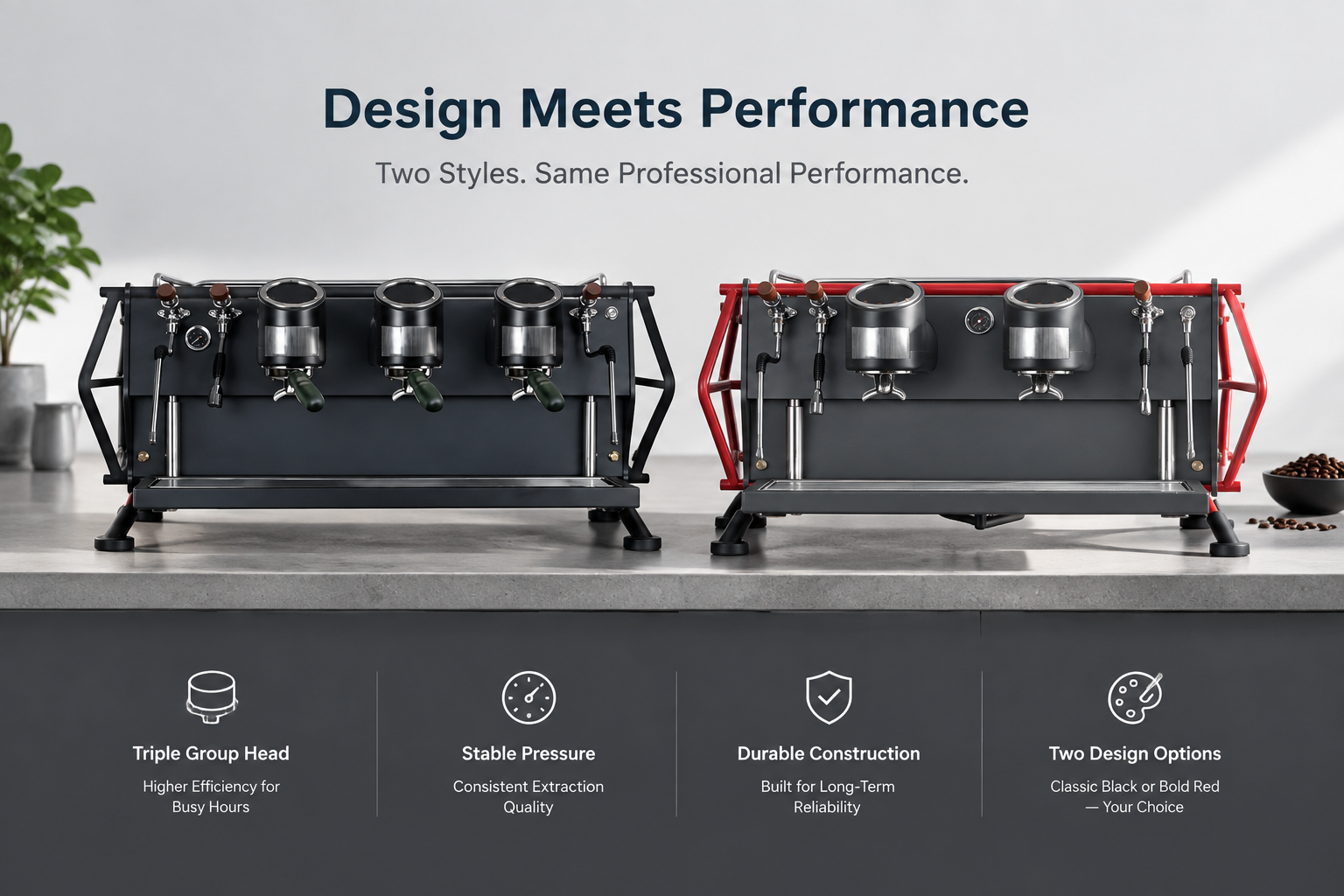
KY-T33 2-Group Extreme Test Results (per group):
- Continuous Water Output: 2500ML+ per group
- Temperature Stability: Held 92°C (±0.5°C) throughout the entire discharge
- Post-Test Behavior: Only after exceeding 2500ML did temperature begin a gradual, controlled decline of 3–6°C. Full recovery to target in 8–13 seconds.
KY-T33 3-Group Extreme Test Results (per group):
- Same per-group performance: 2500ML+ continuous output at stable 92°C
- All three groups can be tested simultaneously under load
Now, here's the key point: 2500ML of continuous discharge from a single group is a much more brutal condition than any real café workflow. Even under zero-gap extraction with multiple baristas, there's still a 4–8 second portafilter swap time. That's 4–8 seconds of thermal recovery that the machine gets for free.
Under real zero-gap conditions:
- 2-Group machine: Both groups working simultaneously can deliver 80+ consecutive double espresso shots (40+ per group) with no measurable temperature drop across the entire rush window.
- 3-Group machine: All three groups working can deliver 120+ consecutive double espresso shots with no measurable temperature drop.
Shot #1 tastes identical to Shot #80 on a 2-group. Shot #1 tastes identical to Shot #120+ on a 3-group. Guaranteed.
5. Chain Store Validation: Proven in the Real World, Not Just the Lab
Lab data is one thing. Real-world proof is another. And this is where I'm proudest of what we've built.
We don't just test our machines in a climate-controlled R&D lab. We've deployed the KY-T33 2-group and 3-group series in real chain store environments — high-volume café chains where the machines run 10+ hours a day, 7 days a week, serving 300–500 drinks per day per location. These are businesses where consistency isn't a nice-to-have; it's the entire brand promise.
Here's what those chain partners report, consistently, across dozens of locations:
Morning Rush (7:30 AM – 10:00 AM):
- Two or three baristas, multiple group heads, zero-gap extraction
- 2-Group stores: 80–100 double shots pulled across both groups during peak
- 3-Group stores: 120–150 double shots pulled across all three groups during peak
- ±0.3-0.5°C temperature deviation reported across the entire rush period on every group
- Extraction pressure holds steady at 9 bar throughout
- Baristas never need to adjust grind settings mid-service
One of our chain partners — a growing café brand with 8+ locations — put it best: "We used to have to re-dial our grinders every two hours during peak because the old machines would drift. Since switching to KY-T33 2-group and 3-group units, we set the recipe once in the morning and it holds until close. The temperature just doesn't move — even when both groups are getting hammered with zero gap between shots."
That's not marketing. That's 15 stores, 365 days a year, thousands of shots per week. The data is undeniable.
6. Why the KY-T33 2-Group and 3-Group Don't Flinch Under Fire
The engineering behind this consistency comes down to non-negotiable design choices shared across both platforms:
1. Three Independent Boilers (10L Steam + 2×0.8L or 3×0.8L Brew)
Brew and steam functions are completely separated. You can steam milk continuously on both wands while pulling shots on all groups, and neither function affects the other. The 10L steam boiler (3000W) handles milk duty. Each 0.8L brew boiler (1000W) handles its own group independently.
2. Advanced Heating Pipeline System with Pre-Heating Pipe
Cold water entering the system passes through a pre-heating pipe inside the brew boiler before entering the main chamber. This reduces thermal shock and cuts recovery time to 8–13 seconds. Under zero-gap conditions, this is the difference between holding temperature and collapsing.
3. Heated Saturated Groups (200W per Group, 100% Pure Copper)
Each group head is actively heated and made of pure copper for superior thermal conductivity. The group doesn't just sit there losing heat — it maintains thermal equilibrium with the brew boiler, shot after shot, across all groups simultaneously.
4. FOT Rotary Pump + GICAR Flowmeter
Stable pressure delivery and precise water measurement ensure every shot gets exactly the right volume at exactly the right pressure. The real extraction pressure gauge (not pump pressure) lets baristas monitor what's actually happening during brewing.
7. Two or Three Baristas, Multiple Groups: The Workflow Multiplier
A Commercial Espresso Machine for Cafe environments with real volume isn't just about thermal stability. It's about workflow architecture.
With two or three independent group heads, each with its own boiler, heating, and saturated group, you can run completely separate extraction streams simultaneously. This is the foundation of the "multi-barista zero-gap" workflow.
During peak hours at our chain partner locations:
- 2-Group Setup: Barista A on left group (espresso/Americano), Barista B on right group (milk drinks/second origin). Zero bottlenecks.
- 3-Group Setup: Barista A on left (espresso), Barista B on center (milk drinks), Barista C on right (batch/backup/second origin). Maximum throughput.
A Commercial Espresso machine China OEM that understands real café workflow doesn't just build a machine with "multiple group heads." They build completely independent extraction systems that happen to share a chassis. That's what the KY-T33 series is.
8. The Industry Needs a New Standard (And We're Setting It)
Right now, most buyers evaluate a commercial espresso machine by checking boiler size, brand name, and price. That's not good enough for high-volume operations.
The next time you evaluate a machine — whether from a premium Italian brand or any Commercial Espresso machine China factory — ask these questions:
- "Can you show me continuous extraction data with zero recovery time between shots on ALL group heads simultaneously?"
- "How many back-to-back double shots can you guarantee per group during real multi-barista operation?"
- "What's your temperature curve after 2500ML of continuous discharge per group?"
- "Do you have chain store deployment data proving zero temperature drift during peak hours with multiple baristas?"
If they can't answer, walk away.
KY-T33 2-Group & 3-Group: Performance You Can Measure
KY-T33 2-Group
✓ 2500ML+ continuous water output per group at stable 92°C (±0.5°C)
✓ 80+ consecutive double shots across both groups under zero-gap café workflow
✓ Zero temperature deviation during 2-barista simultaneous operation
✓ 8–13 second thermal recovery after extreme load
✓ Validated in 15+ chain store locations, 300–500 drinks/day per store
✓ Advanced heating system with brew boiler pre-heating pipe
✓ 2×0.8L independent brew boilers + 10L steam boiler
✓ 100% pure copper heated saturated groups (200W per group)
KY-T33 3-Group
✓ All of the above, multiplied across three independent extraction points
✓ 120+ consecutive double shots across all three groups under zero-gap workflow
✓ Designed for 120–150+ double shots per hour in high-volume environments
✓ Perfect for busy chains, hotel breakfast service, and high-foot-traffic cafés
✓ Zero workflow bottlenecks during peak hours with 3-barista operation
Conclusion: The Real Test Isn't One Perfect Shot — It's Shot #80 on a 2-Group, Shot #120 on a 3-Group
A real professional espresso machine doesn't have a simple "maximum cup limit." The real limitation is thermal integrity under sustained, zero-gap commercial demand with multiple baristas working multiple groups.
The best machine isn't the one that pulls one perfect shot when it's cold. It's the one that can pull the 1st cup, the 100th cup, and the 500th cup of the day with identical flavor clarity — while two or three baristas hammer all available groups simultaneously with no recovery time between shots.
Because your customers don't care if it's the first order of the morning or the last ticket before close. They expect perfection every single time.
And our chain partners prove, day after day, that the KY-T33 2-group and 3-group series delivers exactly that.
KY-T33 2-Group & 3-Group Series: Engineered for Continuous Café Operation.
Tested beyond normal extraction limits. Validated in real chain stores. Built for zero-gap commercial demand.