




Walk into any high-end coffee shop, and your eyes immediately go to the shiny espresso machine sitting on the front counter. But ask any bench technician or serious coffee practitioner, and they’ll tell you the same thing: the commercial coffee grinder sitting next to it is what actually sets the ceiling for what ends up in the cup.
Bean quality dictates roughly 70% of a coffee's potential. Of the remaining variables you can actually control behind the bar, grinding easily carries the most weight. You can program exact water temperatures, pre-infusion curves, and yields on a top-tier machine, but if your grinder throws wide particle distributions, overheats the burr chamber, drifts in dose weight, or spews fines, no machine on earth can fix those front-end mistakes.
If you’ve worked a morning rush in a busy café, you’ve probably run into this wall:
-
The first shot dialed in at 7:00 AM drops with dense crema, crisp acidity, and a clean mouthfeel.
-
By drink 40, using the exact same beans and collar settings, shots start running astringent and bitter, accompanied by constant puck channeling.
-
Trying to switch between a house blend and a single-origin bean leaves old grounds lingering in the chute, muddying up the flavor profile of both.
When extractions go sideways like this, the problem almost always traces back to four core areas: burr geometry, thermal management, adjustment collar design, and dosing accuracy.
Browse our full range of commercial coffee grinders → /commercial-coffee-grinders
1. What Grinding Actually Does: Mechanical Shear and Particle Size Distribution
Grinding isn't just about smashing coffee beans into smaller bits. From an extraction mechanics standpoint, the goal of the best coffee grinder is to cut roasted beans into a narrow, tightly controlled particle size distribution (PSD) tailored specifically for pressurized water flow.
Coffee beans are brittle, porous structures holding trapped carbon dioxide, aromatic fats, and soluble solids. Under proper mechanical shear, grounds turn out as uniform micro-flakes or columns. This geometry creates a predictable total surface area, allowing hot water to push through the puck without finding paths of least resistance.
When particle sizes drift too wide, extraction breaks down on two fronts:
-
Boulders (Coarse Particles): Under-extract due to insufficient surface area contact, throwing sharp sourness, paper-like dryness, or thin body into the cup.
-
Fines (Ultra-Fine Dust): Settle into the microscopic voids between larger grounds, choking water flow and causing localized over-extraction. This releases harsh bitterness and astringent tannins. Excess fines also migrate through the portafilter basket screen under pressure, breaking apart crema stability and leaving a muddy, gritty texture on the tongue.
On a laser diffraction analyzer, a well-aligned commercial unit lands over 82% of its total output right in the target micron window. Cheaper or worn-out setups routinely drop fines levels past 18%. That single metric explains why swapping to higher-grade equipment yields an instant jump in cup clarity—even without changing a single variable on the espresso machine.
2. Comparing Mainstay Burr Platforms
The burr set is the workhorse of the machine, dictating shear mechanics, heat output, particle geometry, and throughput limits. Commercial options generally fall into three design categories:
                 ┌─────────────────────────────────────────┐
                 │    Commercial Burr Geometry Comparison  │
                 └─────────────────────────────────────────┘
                                      │
        ┌─────────────────────────────┼─────────────────────────────┐
        ▼                             ▼                             ▼
【Flat Burrs】                【Conical Burrs】               【Specialized Low-Fines】
 (Parallel Shear)              (Progressive Shear)            (Ghost Tooth / Milling)
 ✦ Narrow, tight PSD           ✦ Minimal friction heat        ✦ Ultra-narrow PSD
 ✦ High clarity & acidity      ✦ Rich body & thick crema      ✦ Virtually no fines
 ✦ Fast output for volume bars ✦ For dark roasts & milk drinks ✦ Prone to clogging on fine grinds
 ✦ Sweet spot: 74mm Titanium   ✦ Tradeoff: Broader PSD curve  ✦ Best for: Filter/Cupping only
2.1 Flat Burrs (Parallel Shear)
A Flat burr grinder uses two flat, ring-shaped metal plates sitting parallel to each other face-to-face. The motor spins one plate at high RPM while the other remains stationary. Beans drop into the center hole and get flung outward by centrifugal force, getting sheared down as the gap narrows toward the outer rim.
-
Strengths: Produces a remarkably tight particle size distribution. Because the beans move through a uniform shearing plane, the fragments stay consistent with minimal shatter. Flat burrs handle high-RPM motors easily, grinding an 18–20g double dose in 3 to 5 seconds.
-
In the Cup: The uniform flake geometry creates a predictable puck structure that highlights origin characteristics, bright acidity, and distinct flavor layers in light-to-medium roasts.
-
Tradeoffs & Engineering Solutions: The extensive surface contact area between parallel burrs generates substantial friction heat under continuous use. Engineers tackle this by increasing burr diameter (64mm, 74mm, 83mm, 98mm) and slowing down motor RPM. A larger cutting surface maintains fast throughput even at lower rotational speeds, cutting friction at the source. Adding Titanium Nitride (TiN) or Diamond-Like Carbon (DLC) coatings reduces surface friction and delays blade dulling. Currently, a high-spec 74mm burr grinder hits the sweet spot for busy bars, balancing fast dosing with manageable thermal build-up.
2.2 Conical Burrs (Progressive Shear)
A cone-shaped inner burr spins inside an inverted outer ring burr. Beans enter from the top and get crushed progressively as they travel downward through the narrowing funnel.
-
Strengths: Low RPM and minimal thermal transfer. Because the shearing happens along a long vertical cone rather than a flat plane, beans break down in stages without getting subjected to instant high-speed friction.
-
In the Cup: Conical burrs yield a wider particle size spread with a natural balance of coarse particles and fines. This creates a shot with heavy body, rounded mouthfeel, and dense crema—making them popular for traditional dark roast espresso blends and milk-based menus.
-
Tradeoffs: Flavor separation and clarity take a backseat compared to flat burrs. Peak throughput is lower at equivalent motor powers, and setting proper burr alignment during replacement requires more bench time.
2.3 Specialized Low-Fines Burrs (Ghost Tooth & Custom Cuts)
These feature blocky, tooth-like projections rather than sharp cutting flutes, breaking coffee down through direct impact cracking rather than slicing.
-
Strengths: Keeps fine production lower than almost any other design, generating extremely tight particle uniformity that shines in filter brewing and cupping.
-
Tradeoffs: They move slow and struggle when pushed down to fine espresso ranges. Fine grounds pack into the tooth recesses, causing frequent chute jams. They work great as dedicated pour-over grinders, but fail when forced into duty as a main espresso workhorse doing 200+ shots a day.
3. Grinding Heat: What Destroys Flavor on Busy Bars
Heat is an absolute killer of espresso quality during rush periods, yet it’s often completely overlooked. The delicate aromatic compounds inside roasted coffee are thermally unstable organic molecules.
-
At 48°C (118°F), volatile aromatic oils on the particle surface oxidize and evaporate rapidly.
-
Past 55°C (131°F), subtle floral and fruity top notes degrade beyond recovery.
-
Sustained high heat bakes residual coffee grounds stuck inside the burr chamber, charring them and contaminating every subsequent shot with flat, burnt off-flavors.
Home grinders don’t run long enough for heat build-up to matter, but back-to-back commercial service is a different story. Bench testing shows that a standard 250W model lacking an active cooling system can hit burr chamber temperatures over 62°C (144°F) after 30 continuous double shots.
Burr Chamber Heat vs. Flavor Degradation:

 60°C (140°F) ──────────────────────── Scorched flavors / Oil rancidity
 55°C (131°F) ──────────────────────── Loss of floral & fruit aromatics
 48°C (118°F) ──────────────────────── Accelerated surface oil oxidation
 25°C (77°F)  ────── [Optimal Window] ── Full flavor profile intact
Keeping operating temperatures down requires smart physical engineering:
-
Drive Motor Setup: Run large burrs on low-RPM, high-torque motors. Lower rotational speeds mean fewer friction contacts per second for the same gram output. A 74mm burr spinning at 1,200 RPM runs 12–18°C cooler during peak service than a 58mm burr spinning at 2,500 RPM.
-
Forced Air Cooling: Machines built for volume feature isolated air channels driven by dedicated cooling fans. These draw heat away from the motor housing before it can travel up into the burr chamber. High-end units also add thermal barrier sleeves or aluminum cooling fins around the grinding chamber.
-
Low-Friction Coatings: Titanium-coated burrs conduct less thermal energy than raw stainless steel, keeping heat from transferring directly into the coffee grounds.
4. Retained Grounds and Chute Geometry
Busy bars switch beans throughout the day: a house dark blend for milk drinks, a light-roast single origin for straight shots, and decaf on demand. If a machine traps grounds inside its internal housing, stale coffee from the previous run mixes directly into the fresh basket, throwing off shot timing and muddying flavors.
Grounds trapped in the exit chute also trap ambient moisture, forming clumps that restrict flow and cause dose weights to jump around randomly.
Retention comes down to chamber geometry, exit chute angles, and static management:
-
Straight Vertical Drop Chutes: Depend entirely on gravity. Grounds easily pack into the corners of the burr housing and along the ledges of the exit pathway.
-
Swept Sweepers & Auger Outlets: Curved chute designs reduce internal ledges, while motor-driven sweepers or augers physically push lingering grounds out of the chamber. Some grinders include an auto-purge cycle that briefly reverses motor direction at the end of a grind to drop trapped grounds out of the burr teeth.
-
Static Control (De-Clumpers): High-speed shearing builds up a heavy static charge on coffee particles, making fine dust cling to the inner walls of the chute. Installing anti-static wire grids, plasma ion generators, or smooth PTFE liners at the exit keeps grounds flowing cleanly without packing up.
5. Dosing Tech: Timed vs. Weight-Based (Grind-by-Weight)
Hit your target dose weight every single time, and half your extraction stability issues disappear.
┌─────────────────────────────────────────────────────────────┐
│                   Dosing Systems Comparison                 │
└─────────────────────────────────────────────────────────────┘
                               │
       ┌───────────────────────┴───────────────────────┐
       ▼                                               ▼
【Timed Dosing】                                【Grind-by-Weight (GbW)】
 ✦ Controls motor runtime                        ✦ Built-in load cell measures mass live
 ✦ Simple, low repair cost                       ✦ Accurate to ±0.3g–0.5g regardless of beans
 ✦ Drifts (±1.5g) as hopper empties/burrs wear   ✦ Sensitive to counter vibration, higher cost
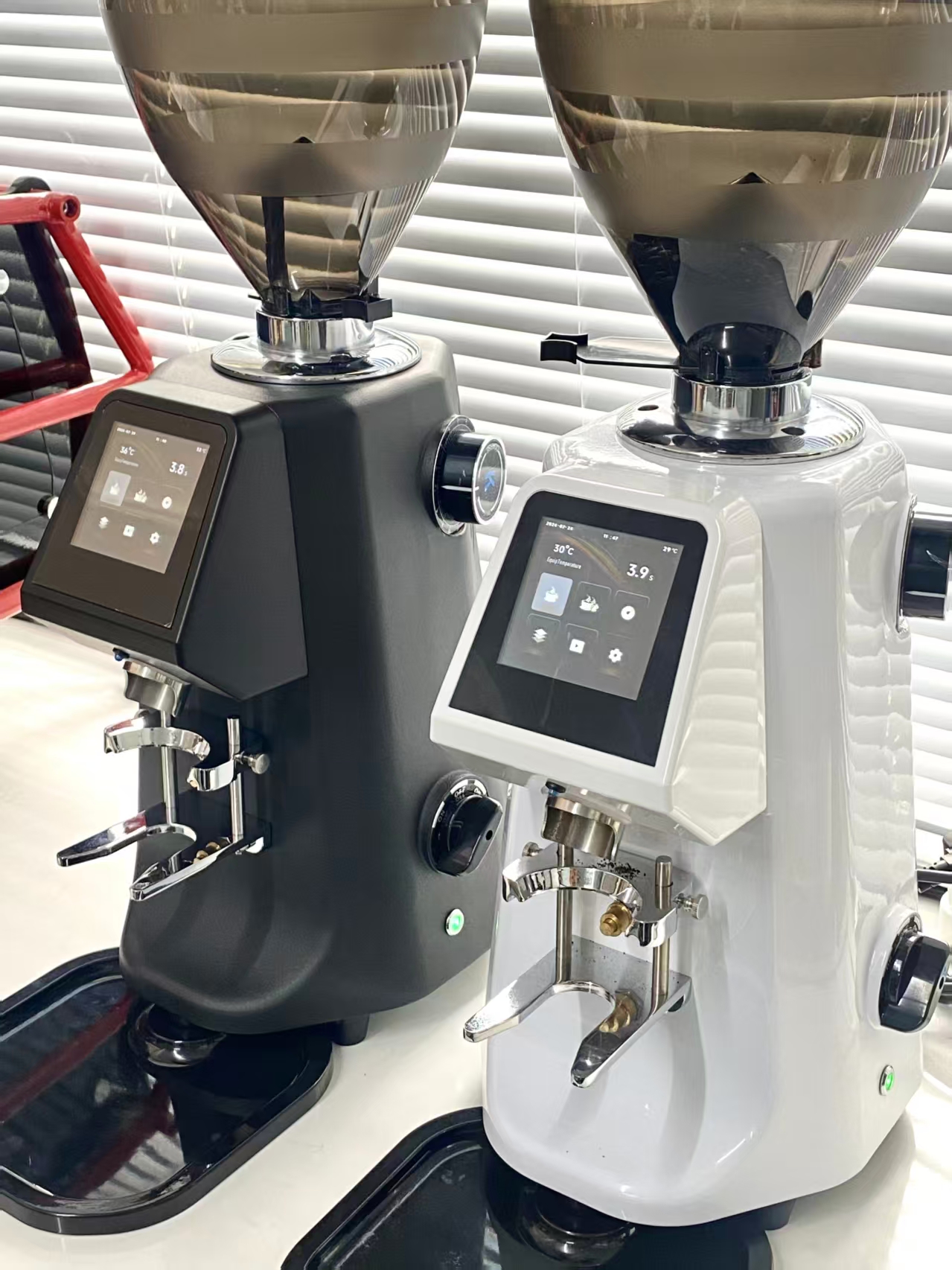
5.1 Timed Dosing(Grind-by-Time)
The motor runs for a set duration programmed by the user. It’s simple and inexpensive, but it suffers from a major structural flaw: as the bean level in the hopper drops (changing column pressure), humidity shifts, or the burrs heat up and expand, the actual mass of coffee dropped in that timeframe changes. On burrs showing moderate wear, timed dosing can drift by as much as ±1.5g per dose—more than enough to turn a sweet 28-second shot into a channeled 18-second mess.
5.2 Weight-Based Dosing (Grind-by-Weight)
A load cell built into the portafilter fork or base plate measures grounds dropping in real time, cutting power to the motor the instant the target mass is hit. A properly calibrated GbW system holds dose variances within ±0.3g to ±0.5g.
GbW configurations generally use one of two setups:
-
Fork-Mounted Load Cells: The sensor sits directly under the portafilter cradle. It reacts quickly, but aggressive baristas or counter vibrations can throw off live weight readings.
-
Chassis-Integrated Load Cells: The scale mechanism is isolated inside the base of the machine beneath the chute assembly. This offers far better protection against external knocks, though it requires precise internal vibration dampening.
Technical Note: Because ground coffee is mid-air when the motor cuts off, GbW systems use predictive stop algorithms to cut power a fraction of a second early, compensating for the falling grounds.
6. Burr Alignment and Maintenance Cycles
Plenty of grinders perform brilliantly right out of the box, only to start throwing wider particle spreads, excess fines, and weird motor noises after three to six months behind a bar. Nine times out of ten, the culprit is burr misalignment.
Parallel flat burrs have to stay flat relative to each other down to the micron. If one burr tilts even slightly, the gap becomes uneven across its circumference. The wide side passes oversized boulders, while the tight side pinches coffee into excessive fines while generating intense friction heat and uneven blade wear.
Aligned Burrs: Uniform Gap ────► Consistent PSD ────► Even Extraction
Maligned Burrs: Uneven Gap ────► Boulders + Fines ───► Channeling & Bitterness
Adjustment Collar Design
-
Threaded Collar Mechanisms: Standard on cheaper grinders. The top burr carrier turns on fine screw threads. Over time, motor vibration wears down the thread tolerances, allowing the top burr to wobble slightly under load.
-
Worm Gear & Micrometric Stepless Adjustments: Used on commercial-grade machines. These systems isolate the adjustment mechanism from the burr carrier, holding set gaps down to 0.01mm increments without drifting under vibration.
Real-World Burr Replacement Intervals
Burrs are wear items. As cutting edges dull, they stop slicing cleanly and start crushing coffee beans, spiking fines production and doubling heat output.
-
Standard Stainless Steel Burrs: Swap out after 350–500 kg of throughput (around 20,000 to 25,000 shots).
-
Titanium (TiN) Coated Burrs: Good for 600–800 kg.
-
Red Speed / DLC (Diamond-Like Carbon) Burrs: Can push past 1,000+ kg before needing replacement.
7. Sourcing Guide: Matching Equipment to Your Bar Model
Whether you are evaluating a coffee grinder for sale for your new venue or sourcing wholesale coffee grinders for a distributor catalog, matching hardware capabilities with actual operational workflow is critical:
| Venue Type | Target Burr Spec | Priority Metrics | Ideal Setup |
|
Specialty Coffee Shop (Focus: Light roasts / Single origins / Clarity) |
64mm or 74mm Flat Burrs | Particle uniformity, low retention, taste clarity | Large flat burrs + Isolated duct cooling + Grind-by-Weight + Titanium coating |
|
High-Volume Commercial Bar (Focus: Medium/Dark roasts / Milk drinks / Speed) |
74mm/83mm Flat or Large Conical | Output speed, continuous thermal limits, durability | High-wattage motor + Forced-air cooling + Quick-cleaning chamber |
|
Hotel, Restaurant & Office (Focus: Multiple beans / Staff rotation) |
Low-retention Curved Flat | Minimal retention, simple UI, low maintenance | Preset dose buttons + Auto-purge cycle + Simple volumetric control |
| Equipment Distributors & Private Label (OEM) | Modular Burr Housing | Low field-failure rate, common parts, serviceability | Interchangeable burr carriers + Modular logic boards + Heavy shock mounting |
Café owners shopping for the best espresso grinders should prioritize heat management and particle consistency over raw speed, while high-volume chains need robust motors and serviceability above all else.
8. Where Commercial Grinder Tech Is Heading Next
Grinder design has advanced rapidly over the past few years, with several key engineering shifts taking hold across the industry:
-
Active Chamber Thermoregulation: Thermistors placed inside the burr chamber feed real-time temperature data back to the control board, modulating variable-speed fans to lock chamber heat within a 35°C–40°C window regardless of rush volume.
-
Variable RPM Control: Brushless DC motors let baristas tune motor RPM to match specific roast profiles. Lower speeds minimize shatter on dense, light-roast coffees, while higher speeds boost throughput for darker espresso blends.
-
Modular Quick-Release Assemblies: Grinding chambers, chutes, logic boards, and motor units are turning into self-contained modules. Baristas or technicians can swap out a burr assembly or chute without tools in under a minute, cutting down on-site service calls.
-
Targeted Noise Suppression: Using suspended motor mounts, heavy rubber internal dampeners, and double-walled insulated housings drops operating noise under 65 dB, making morning prep much quieter for front-of-house service.
Summary
A commercial coffee grinder isn't just a sidekick to your espresso machine—it’s the primary gatekeeper of your extraction quality.
Evaluating equipment means looking past shiny outer casings and assessing five core physical realities: shear geometry, particle distribution, heat management, retention control, and dosing consistency. Get those five things right at the grinding stage, and your espresso machine can finally do what it was built to do.