



Spend any time working a busy café bar and you'll learn one thing quickly: boiler PID accuracy is not the finish line. The real test happens at the last centimeter — where water meets the coffee puck. It's not about how the first shot tastes after warm-up. It's about what happens after 100 back-to-back drinks during a rush.
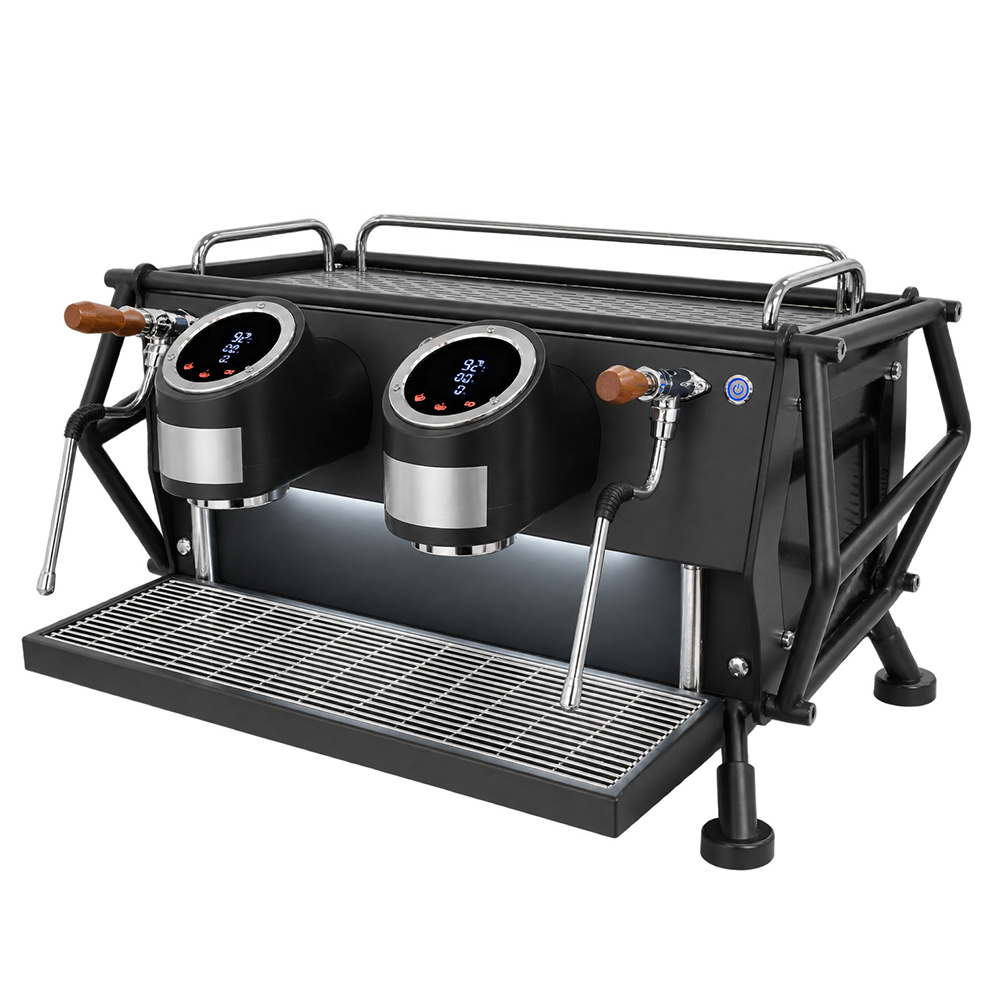
For shop owners searching for the best commercial espresso coffee machine, this distinction matters. Many espresso coffee machines commercial options control boiler temperature well, but very few manage heat precisely where extraction happens. The KY-T33 2-group commercial espresso machine was built for exactly that scenario.
It keeps the features professional baristas rely on: independent multi-boiler system, rotary pump, volumetric dosing, strong steam, and 58mm portafilter compatibility. But the feature that changes the game is this:
Saturated group head with built-in active heating module + T5 multi-loop temperature control system.
This isn't just "adding a PID." We moved the temperature control loop to where extraction actually happens — and went a step further by integrating a dedicated heating element directly inside the saturated group head. This solves the dynamic heat loss problem that plagues machines during continuous service.

Why Saturated Group Heads Became the Commercial Standard
A saturated group head isn't a standalone metal block that gets passively heated by circulating water. It's essentially an extension of the brew boiler. Hot water from the brew boiler wraps around and continuously feeds the group head cavity, keeping the metal around the basket at brew temperature even during peak hours.
This matters because:
-
A cold group head pulls heat away from the water the moment extraction starts
-
Back-to-back shots cause progressive temperature drop
-
If brew and steam share a heat source, milk steaming disrupts brew temperature
-
Light roasts expose even small temperature errors immediately
High-end commercial machines have adopted multi-boiler setups paired with saturated group heads. The Victoria Arduino Black Eagle T3, for example, controls steam boiler, brew boiler, and group head temperature independently.
KY-T33 follows the same design philosophy but takes it further: a built-in active heating module is integrated directly inside the saturated group head cavity, giving it both static thermal stability and dynamic heat compensation. For anyone researching the best commercial espresso machine, this hardware upgrade is a key differentiator.
KY-T33 Hardware Foundation: Three Physically Isolated Boilers
Many machines on the market are marketed as "dual boiler" but still share a heat source or switch water between brew and steam through valves.
The KY-T33 2-group eliminates this compromise entirely:
-
Brew Boiler A → feeds the left group head only
-
Brew Boiler B → feeds the right group head only
-
Dedicated Steam Boiler → serves both steam wands exclusively
Three separate boilers. Three independent heating elements. Three completely isolated water paths.
When a barista steams milk, the brew boilers are not involved. They don't supplement, they don't lose temperature to the steam side, and they don't need to switch water flow. Espresso and milk drinks run in parallel without compromise.
This physical isolation is the foundation everything else is built on — the saturated group heads, the active heating modules, and the T5 control system all depend on it.
Saturated Group Head: Built-In Active Heating for Static Hold + Dynamic Recovery
Traditional multi-boiler machines with saturated group heads rely on boiler circulation to maintain head temperature. This handles static stability well but can't keep up with rapid heat loss during continuous shots. Once the coffee puck draws heat from the group head metal, the system has to wait for hot water from the boiler to slowly make up the difference. Recovery between shots is always a bottleneck.
KY-T33 redesigns the saturated group head with one key upgrade: an independent heating module is built into the group head cavity, positioned close to the basket side. The saturated water path handles static temperature hold, keeping the group head metal close to the boiler setpoint. The built-in heating module handles dynamic compensation, actively putting heat back into the head during the gap between shots to replace what the puck drew away. Together, they eliminate the weakness of traditional saturated heads — stable when idle, slow to recover under load.
The group head cavity is fully wrapped by boiler-temperature water, while the internal heating module stands by for immediate response:
-
During idle standby, the saturated water path maintains base head temperature while the heating module stays in low-power standby
-
During continuous shots, the previous extraction pulls heat from the head, the NTC sensor detects the drop, and the heating module kicks in immediately
-
The left and right group heads are structurally independent — one sitting idle has no impact on the other
When hot water reaches the shower screen, the surrounding metal isn't just passively held at brew temperature by distant boiler circulation. It has a local heat source actively supporting it, so the coffee puck gets consistent thermal conditions from the first shot to the hundredth.
Active Heating: A Local PID Actuator Inside the Group Head
The saturated structure handles static temperature hold. The built-in active heating module handles dynamic recovery. Together they form a complete head-end temperature management system.
KY-T33 embeds a high-precision NTC temperature sensor inside the group head metal, positioned near the basket side, paired with the cavity-mounted heating module. This sensor location is closer to the coffee than the boiler-end sensor — the most practical measurement point achievable in an engineered, serviceable design.
The T5 main board runs multiple PID loops in parallel:
-
Brew Boiler PID → maintains boiler set temperature, e.g. 93°C
-
Group Head PID → reads NTC data and drives the built-in heating module to stabilize metal temperature around the basket
-
Steam Boiler PID → runs independently with zero thermal coupling to the brew side
-
Ambient Temperature Compensation → adjusts warm-up power curves based on shop environment
The moment a shot ends and the group head temperature drops, the group head PID responds within milliseconds. It drives the heating module inside the saturated head to add heat back, completing temperature recovery before the next shot is pulled.
The result:
Inter-shot group head recovery: < 10 secondsCold start to brew-ready: < 5 minutes
This isn't achieved by brute-forcing power. It's the saturated structure and built-in active heating working together, with the temperature control loop placed directly inside the group head.
Commercial Espresso Machine Temperature Control: Where Temperature Is Actually Managed
For any commercial espresso machine temperature control system to perform in a real café, the sensor and actuator must be close to the puck. Placing sensors only at the boiler creates a delay — by the time the boiler reacts, the group head has already lost heat to the coffee. The KY-T33 closes this gap by putting both the sensor (NTC②) and the actuator (built-in heating module) inside the saturated group head itself.
|
Layer
|
Component
|
Function
|
|---|---|---|
|
①
|
Independent Brew Boiler A/B + NTC①
|
Per-group temperature reference, physically isolated
|
|
①'
|
Dedicated Steam Boiler + PID
|
Zero shared water path or heating element with brew side
|
|
②
|
Short Distribution Line
|
Minimizes heat loss along the way
|
|
③
|
Saturated Cavity (with built-in heating module)
|
Boiler water maintains static temperature; heating module provides dynamic compensation
|
|
④
|
NTC② (near basket)
|
Closest practical measurement point to the extraction surface
|
|
⑤
|
Shower Screen → 58mm Basket
|
Actual extraction zone
|
|
⑥
|
T5 Main Board
|
Coordinates all temperature loops
|
The core design logic is straightforward:
NTC② is not placed at the boiler. It's not mid-pipe.It sits inside the metal structure directly above the coffee.The heating module is integrated inside the saturated group head cavity, forming a local closed loop with the temperature sensor.
The heating module isn't retrofitted either. During the casting stage of the KY-T33 group head, the heating element position, sensor depth, and cavity wall thickness are all defined by the mold. This ensures consistent temperature performance across every production unit.
Continuous Shots: What < 10 Seconds Recovery Actually Means
Target temperature 92°C, 25–30 seconds per shot, continuous service:
|
Time
|
Traditional Dual-Boiler Saturated Head (no active heating)
|
KY-T33 Saturated Head + Built-In Active Heating
|
|---|---|---|
|
Water hits puck
|
Drops to ~90.1°C
|
Drops to ~91.2°C
|
|
+5 sec
|
Slow recovery, waiting for boiler circulation
|
Built-in heating module actively compensating
|
|
+10 sec
|
Not yet back in target range
|
Back inside temperature window
|
|
Next shot starts
|
Head still below target
|
Full-temperature contact with puck
|
|
80-shot cumulative drift
|
~-2°C
|
Within ±0.3°C
|
For the barista:
-
Shot #1 and shot #120 happen under the same thermal conditions
-
No need to flush water between shots for temperature compensation
-
No waiting for the machine to "settle"
-
New staff can match the consistency of experienced baristas
Cold Start < 5 Minutes: No Waste Shots
Traditional logic: boiler reaches set temperature → unlock brewing. The problem is that a standard saturated group head may still be warming up, so the first shot often comes out under-temperature.
KY-T33 uses a dual-unlock condition — both must be met:
-
Brew boiler NTC① is within range
-
Group head NTC② is within range
During warm-up, the saturated cavity is heated by boiler water circulation while the built-in heating module simultaneously assists, speeding up the group head's approach to target temperature. The first shot pulled after turn-on is a selling shot — no waste cups needed to stabilize the head.
Within 5 minutes, all of the following happen in parallel:
-
Brew boilers reach set temperature
-
Saturated group heads are heated evenly by boiler water
-
Built-in heating modules help pull NTC② into the ±0.3°C window
-
Steam boiler completes its own warm-up curve independently
Morning opening routine becomes: turn on the machine, prep your beans, start serving.
T5 vs T3: Same Direction, More Precise Local Control
The Victoria Arduino T3 control system manages:
-
Steam boiler temperature
-
Brew boiler temperature
-
Group head temperature
The T5 system on KY-T33 retains these three control domains and adds:
-
Per-group head local PID closed loop (executed by the built-in heating module inside the saturated head)
-
Ambient temperature auto-compensation
-
Independent left/right group temperature control under asymmetric load
The distinction:
T3 focuses on boiler + group head temperature management.
T5 delivers boiler + saturated group head with built-in active heating + head-end closed loop + environmental awareness in one integrated system.
Same design family, but KY-T33 takes it further by placing the heating actuator directly inside the saturated group head — making temperature response significantly faster.
Real Café Scenario: Two Groups + Steam, All Parallel
Typical morning rush:
-
Left group: continuous SOE shots
-
Right group: intermittent Americanos, double shots
-
Steam wand: constant milk texturing
On the KY-T33:
-
Continuous left-group shots aren't affected by the right group sitting idle
-
When the right group is idle, the built-in heating module in its saturated head maintains temperature with minimal power draw
-
The steam boiler is completely independent from the brew system
-
Left group can be set to 94.5°C for light roast
-
Right group can be set to 90.5°C for dark roast
-
After a temperature change, stabilization takes 20–30 seconds
Why Generic Group Heads Can't Replicate This System
The core challenge here isn't in the circuit board — it's in the group head structure.
The saturated cavity, built-in heating module position, sensor depth, water flow channels, and cavity wall thickness are all defined at the mold design stage. The group head is a precision thermal component, not a standard off-the-shelf part. Standard saturated group heads on the market only offer passive heat retention. Without a built-in active heating module, they cannot replicate the dynamic recovery performance of the KY-T33.
Key advantages:
-
Sensor readings accurately reflect the real metal temperature around the basket, calibrated at the factory
-
Modular service design: heating module and NTC sensor can be accessed and replaced from the side of the group head
-
Fault codes pinpoint Group Head Heater or Group Head Sensor issues directly
-
Service can be done without draining the boiler or disassembling core water lines
-
OEM customers get consistent temperature curves across every unit off the production line
This is why the KY-T33 group head is a core proprietary component — no generic commercial group head on the market can serve as a substitute.
What Buyers Actually Get Out of This
For café owners evaluating the best espresso machine for cafe use:
-
Shorter daily warm-up time
-
Less coffee wasted on test shots
-
Lower staff training requirements
-
Stable performance for both light and dark roast service
-
Espresso extraction and milk steaming truly running in parallel
For distributors and private-label brands looking for a coffee machine professional standard at a competitive price point:
-
A strong, defensible technical selling point
-
Not just a generic "we have PID" claim
-
Clear technical story: saturated group head with built-in active heating, temperature control loop at the puck, brew and steam physically separated from the boiler up
-
Available in 110V / 220V / 380V configurations
-
Full OEM/ODM support: branding, housing customization, UI options, spec adjustments
KY-T33 2-Group in One Line
Triple-boiler independent architecture + saturated group head with built-in active heating module + T5 multi-loop temperature control: group head recovery < 10 seconds, cold start < 5 minutes, left/right groups and steam system fully independent.
FAQ
Q: Is the KY-T33 a T3 or T5 system?
A: T5. Three boilers with independent PIDs; each saturated group head has a built-in heating module with its own PID loop; ambient temperature compensation and independent left/right group control are also included.
Q: Do I need to flush the group between shots during continuous service?
A: Not for temperature compensation. The saturated group head with built-in active heating recovers quickly on its own. Standard cleaning and backflushing procedures still apply as normal bar maintenance.
Q: Will steaming milk affect brew temperature?
A: No. The steam boiler and both brew boilers have completely separate water paths and heating elements.
Q: Can the left and right groups run at different temperatures?
A: Yes. One group can be set for light roast, the other for dark roast. The two groups operate independently.
Q: Is it compatible with 58mm portafilters?
A: Yes. Standard 58mm baskets, shower screens, and most aftermarket bottomless portafilters are compatible.
Q: If the group head sensor fails, does the machine need a major overhaul?
A: No. The heating module and NTC sensor are modular components that can be accessed from the side of the group head. Fault codes identify the issue directly.
Q: Does the active heating module inside the group head use a lot of power?
A: No. It only adds heat when needed. When a group is idle, the module provides minimal compensation only if temperature drops below the threshold. Standby power draw is very low.
Q: Who is the KY-T33 for?
A: Specialty cafés, hotel bars, roasters, equipment distributors, and anyone building a private-label brand who needs reliable commercial performance at a more accessible price point than flagship Italian machines.
Get in Touch
If you're sourcing a 2-group commercial espresso machine directly from a Chinese manufacturer and need:
-
Triple-boiler stable architecture
-
Saturated group head with built-in active heating module
-
T5 multi-loop temperature control system
-
OEM/ODM private label partnership
Send us an inquiry. You can request:
-
KY-T33 group head drawings
-
Original temperature test data from continuous shot sessions
-
T5 control logic diagram
-
Configuration sheet tailored to your target market
Huazell —Commercial espresso machines, coffee grinders, OEM/ODM solutions.