




Introducing the New KY-T33: A 3-Group Commercial Espresso Machine Built for High-Volume Coffee Service
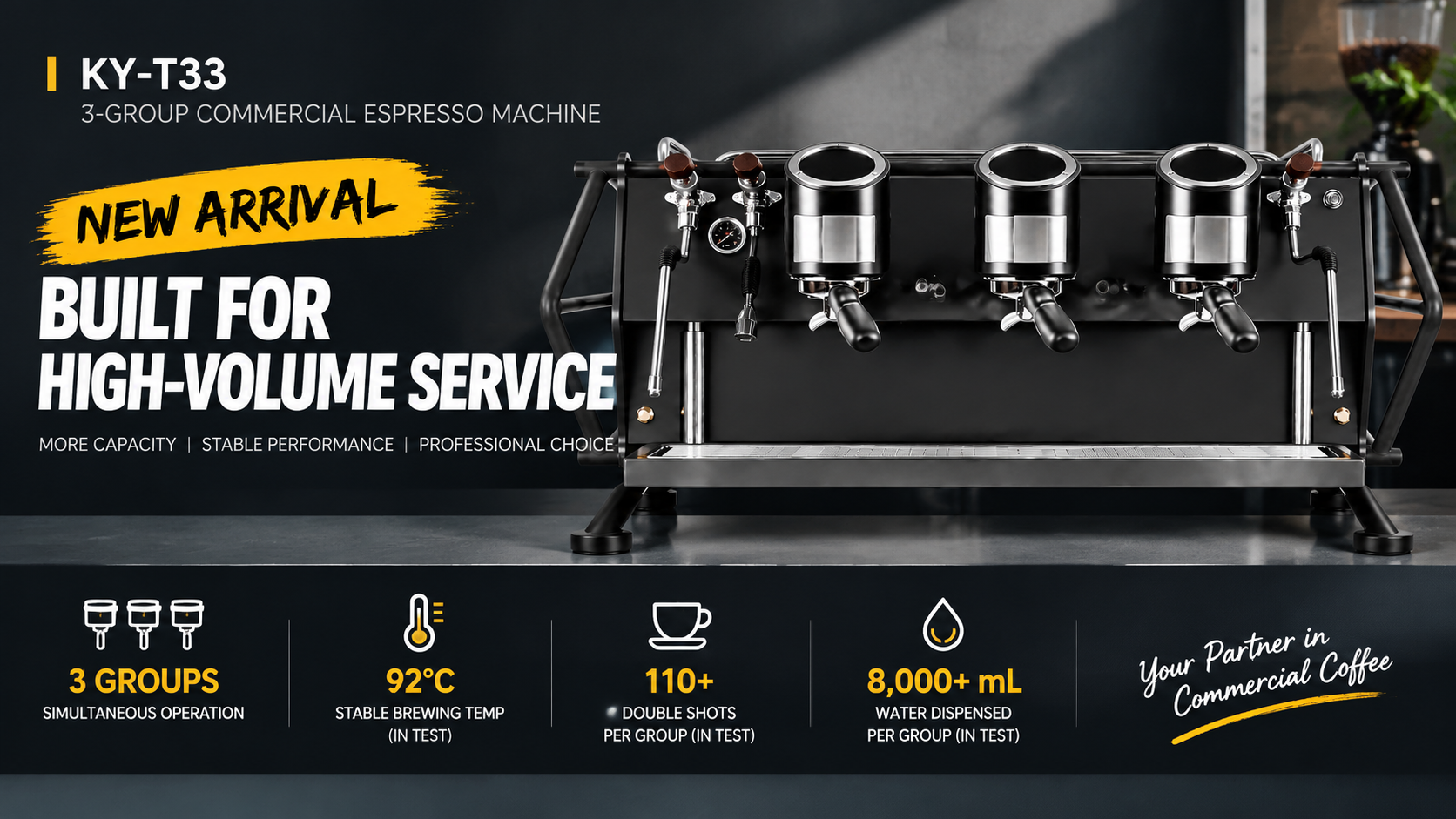
In a busy café, every second counts. During peak hours, multiple orders arrive at once, baristas work under pressure, and espresso machines must deliver consistent performance without slowing down service.
To meet the demands of high-volume coffee operations, Huazell introduces the new KY-T33, a 3-group commercial semi-automatic espresso machine designed for demanding professional environments.
With three brewing groups, simultaneous operation, and a focus on brewing temperature stability, the KY-T33 offers a practical solution for businesses that need greater workflow capacity and dependable performance during busy service periods.
1. Three Brewing Groups for Greater Service Capacity
The KY-T33 features three independent brewing groups, allowing baristas to prepare multiple espresso orders simultaneously.
Compared with a single-group or two-group machine, a three-group configuration provides more brewing positions for busy operations, helping baristas manage overlapping orders and improve workflow efficiency.
The KY-T33 is particularly suitable for:
-
High-volume cafés and specialty coffee shops
-
Hotel breakfast services and hospitality venues
-
Restaurants and foodservice operations
-
Coffee chains and central beverage stations
-
Commercial coffee equipment distributors and project suppliers
For businesses planning to expand their coffee service, a three-group machine can provide additional brewing capacity without requiring multiple separate espresso machines.
2. Temperature Stability Under Continuous Operation
High brewing capacity alone is not enough. For professional espresso preparation, temperature stability is equally important.
During consecutive brewing cycles, a machine must manage repeated water delivery and heating demands. Significant temperature fluctuations can affect extraction consistency and make it more difficult for baristas to maintain repeatable results.
The KY-T33 is designed with a focus on stable brewing performance under demanding operating conditions.
In our continuous extraction test, all three brewing groups operated simultaneously, with each group dispensing over 8,000 mL of water—equivalent to more than 110 double-shot cycles per group. The brewing temperature remained stable at 92°C throughout the test.
This test demonstrates the machine's temperature stability during sustained, simultaneous water dispensing.
Note: This was a no-load water-dispensing test without a coffee puck or pre-infusion. The results describe the specified test conditions and should not be interpreted as a direct measurement of espresso extraction performance under every café operating condition.
For commercial buyers, this type of testing provides useful insight into the machine's thermal performance during sustained operation.
3. Designed for Simultaneous, High-Demand Workflows
During peak hours, espresso preparation rarely happens one order at a time. Baristas may need to prepare several espresso drinks while coordinating milk steaming, cup preparation, and order handoff.
The KY-T33's three-group layout supports simultaneous brewing across multiple stations, giving professional teams more flexibility when handling busy periods.
For cafés, hotels, and foodservice businesses, this can help support:
-
More efficient order handling
-
Better coordination between baristas
-
Higher potential throughput during peak periods
-
A more organized espresso preparation workflow
Actual output will depend on drink recipes, barista workflow, grinder performance, water supply, and other operating conditions.
4. A New Commercial Espresso Machine for B2B Buyers
The KY-T33 is not only a new product for cafés. It is also an option for commercial coffee equipment distributors, importers, hospitality suppliers, and businesses developing their own product portfolios.
When evaluating a three-group espresso machine, B2B buyers typically consider several factors:
Commercial capacity: Is the machine suitable for the expected volume of orders?
Thermal performance: Can it maintain stable brewing conditions during sustained operation?
Workflow design: Does the multi-group configuration support the team's daily service requirements?
Product positioning: Does the model fit the needs of the local market and target customer segment?
Supplier cooperation: Can the manufacturer support product selection, technical communication, and potential OEM/ODM requirements?
With the launch of the KY-T33, Huazell expands its commercial espresso machine offering for businesses seeking equipment designed around high-volume coffee service.
OEM/ODM options, specifications, certifications, and order requirements should be confirmed with our team according to the target market and project needs.
5. Is a 3-Group Espresso Machine Right for Your Business?
A three-group commercial espresso machine is worth considering when a two-group model may not provide sufficient brewing capacity for your operation.
It may be a suitable choice for:
-
Cafés with concentrated morning or lunchtime demand
-
Coffee shops with several baristas working simultaneously
-
Hotels and restaurants serving espresso-based beverages throughout the day
-
Coffee chains seeking equipment for higher-volume locations
-
Distributors supplying professional coffee equipment to commercial customers
Before choosing a machine, businesses should assess expected daily beverage volume, peak-hour demand, available counter space, electrical requirements, water connections, and local service capabilities.
Selecting equipment based on actual workflow requirements can help businesses balance capacity, operating efficiency, and investment costs.
Discover the New Huazell KY-T33
The new Huazell KY-T33 3-group commercial semi-automatic espresso machine is designed for professional coffee environments where simultaneous brewing capacity and temperature stability matter.
With three brewing groups and a demonstrated stable 92°C brewing temperature during our specified continuous water-dispensing test, the KY-T33 offers B2B buyers a new option for demanding commercial coffee applications.
Looking for a three-group commercial espresso machine for your product portfolio or next coffee project?