



Why Does Your Café Struggle to Maintain Espresso Quality During Busy Hours?
When customer orders increase, an undersized espresso machine can quickly become a bottleneck. Baristas may experience unstable brewing temperatures, insufficient steam power, slow drink preparation, and inconsistent extraction between groups. These problems increase waiting times and make espresso quality harder to control. A commercial machine with two brewing groups, independent temperature control, a high-capacity steam boiler, and a reliable rotary pump provides the performance required for continuous café service. The JC-128 is designed as a two group espresso machine for cafés, restaurants, hotels, and coffee equipment distributors that need stable commercial output.
A two group commercial espresso machine allows baristas to prepare multiple espresso shots simultaneously. The JC-128 combines two 1-liter brew boilers, a 10-liter steam boiler, independent brewing temperature control, adjustable pre-infusion, an Italian rotary pump, and GICAR flowmeters to support consistent extraction and efficient milk beverage preparation.
Choosing a professional espresso machine requires more than comparing the number of group heads. Boiler configuration, temperature management, steam capacity, internal components, installation requirements, and supplier support all affect long-term performance. The following guide explains how the JC-128 addresses these factors in demanding commercial environments.

What Is a Two Group Espresso Machine?
A two group espresso machine has two brewing groups that can operate at the same time. This configuration allows two baristas to work together or enables one barista to prepare several espresso shots during peak service. It is commonly used in busy cafés, restaurants, bakeries, hotels, and beverage chains where a single-group machine may limit workflow.
Buyers frequently search for terms such as commercial espresso machine 2 group, double group coffee machine, or professional two-group coffee machine. Although these terms describe the working format, the internal boiler system can differ significantly among models. Some machines use one boiler for both brewing and steam, while others separate these functions for better temperature stability.
The JC-128 uses three boilers in total: one 10-liter steam boiler and two separate 1-liter brew boilers. Each brewing group therefore has a dedicated brew boiler rather than sharing one brewing circuit.
Key Features of the JC-128 Commercial Espresso Machine
Three-Boiler Configuration for Independent Brewing and Steaming
The JC-128 is equipped with two 1-liter brew boilers and a 10-liter steam boiler. Separating brewing from steam production helps the machine maintain the different temperature conditions required for espresso extraction and milk steaming.
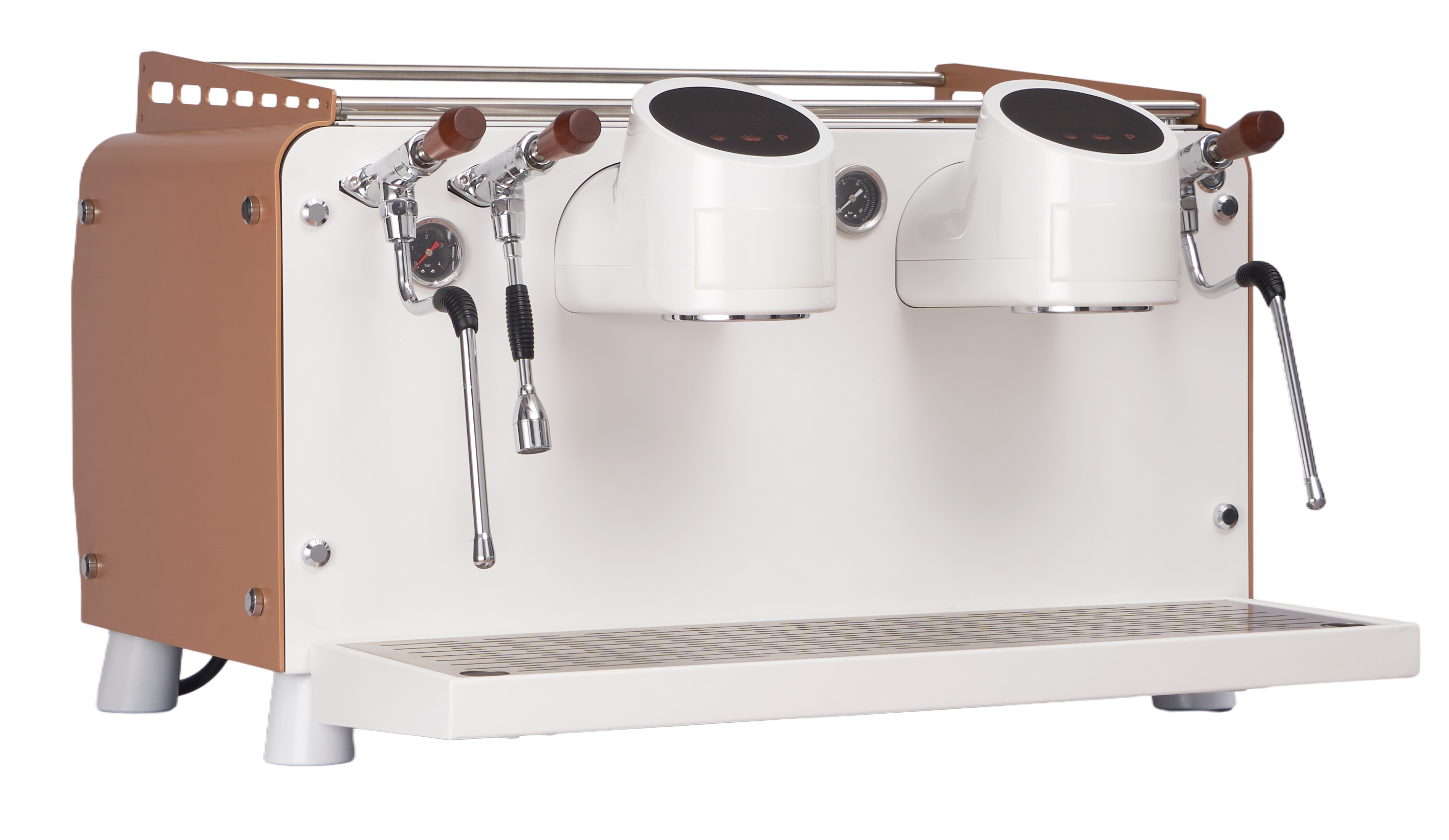
This configuration is particularly useful in cafés serving cappuccinos, lattes, and other milk-based beverages. Baristas can extract espresso and steam milk at the same time without relying on a single boiler to perform both tasks. Compared with a basic double boiler espresso machine, the JC-128 provides an individual brew boiler for each group plus a separate high-capacity steam boiler.
Independent Temperature Control
Different coffee beans and roast profiles may require different extraction temperatures. The JC-128 allows the brewing temperature to be adjusted from 88°C to 95°C. Independent control gives cafés greater flexibility when changing beans or developing espresso recipes.
Stable temperature control also reduces variation between consecutive extractions. This is important for commercial operators that need different baristas to reproduce the same beverage standard throughout the day. Distributors and private-label brands can position this feature toward specialty cafés that value recipe control and repeatable results.
Adjustable Pre-Infusion from 1 to 9 Seconds
Pre-infusion gently introduces water to the coffee bed before full-pressure extraction. The JC-128 offers an adjustable pre-infusion time from 1 to 9 seconds, allowing baristas to adapt the brewing process to different grind sizes, doses, and roast levels.
This adjustment can help promote more even saturation before extraction. However, the appropriate setting should be determined through recipe testing rather than applying the longest pre-infusion time to every coffee. The combination of temperature adjustment and controllable pre-infusion gives professional users more room to refine espresso recipes.
Italian Rotary Pump and GICAR Flowmeters
The machine uses an Italian FOT PA204 rotary pump. Rotary pumps are commonly selected for professional espresso equipment because they are suitable for stable water delivery in commercial installations. The JC-128 also incorporates Italian GICAR flowmeters to measure the water supplied during programmed extraction.
Volumetric measurement helps baristas repeat selected brewing volumes and manage several orders more efficiently. Instead of manually stopping every extraction, the operator can focus on grinding, dosing, milk steaming, and beverage assembly. Actual beverage consistency still depends on correct grinder adjustment, coffee dose, tamping, water quality, and machine maintenance.
Preheating Pipeline and T3 Heating System
The JC-128 includes a preheating pipeline for the brew boilers and a T3 heating system. Preheating incoming water reduces sudden temperature changes as water enters the brewing system, supporting more stable operation during repeated use.
Internal copper pipes provide efficient heat transfer, while customized connectors are used throughout the internal system. Together with the separate boilers, these components form a thermal structure intended for continuous commercial espresso preparation rather than occasional household use.
Commercial Construction and Installation Requirements
The JC-128 housing is made from SUS 304 stainless steel using a sheet-metal manufacturing process. Stainless steel provides a professional appearance and is suitable for frequent cleaning in café and food-service environments.
The machine measures 75 × 66 × 50 cm, has a net weight of approximately 70 kg, and is rated at 5700 W. Buyers should confirm counter dimensions, electrical capacity, water inlet arrangements, drainage, and local installation requirements before placing an order.
Because this is a high-power commercial machine, installation should be completed by a qualified technician according to local electrical and plumbing regulations. Suitable water filtration is also recommended. Water hardness and scale accumulation can affect boilers, valves, pipes, flowmeters, and long-term heating performance.
Who Should Choose the JC-128?
Busy Independent Cafés
The two-group layout suits cafés that need to prepare several orders during morning, lunch, or weekend rush periods. Independent brew boilers allow the operator to manage two brewing groups while the 10-liter boiler supplies steam for milk-based drinks.
Restaurants, Hotels, and Bakeries
Food-service businesses often need a machine that can handle irregular demand. Orders may arrive slowly at one moment and increase sharply after meals or during events. A professional commercial espresso machine with separate brewing and steaming systems provides greater workflow flexibility than a compact single-group model.
Coffee Equipment Distributors and Private-Label Brands
Huazell works as a coffee machine Manufacturer, Supplier, and Wholesaler for international commercial buyers. The JC-128 can support distribution, project purchasing, and private-label equipment programs.
Customizable, OEM, and ODM requirements should be discussed according to order quantity and project scope. Buyers can communicate their target market, branding requirements, electrical standards, preferred appearance, packaging, and documentation needs before confirming the final configuration.
How Does the JC-128 Compare with Other Espresso Machine Types?
A single-group machine is smaller and may be suitable for low-volume locations, mobile coffee setups, offices, or businesses where coffee is not the main product. Its compact size can reduce counter-space requirements, but it may create delays when several espresso drinks are ordered at once.
A conventional two-group heat-exchanger machine can serve a busy café, but both groups may depend on a shared thermal system. By comparison, the JC-128 assigns a separate 1-liter brew boiler to each group and uses another boiler for steam.
Three-group machines provide additional brewing capacity but require more counter space, power, and investment. The JC-128 offers a middle position for businesses that need professional two-group workflow without installing a larger three-group platform.
How Long Can a Commercial Two Group Espresso Machine Last?
The service life of a commercial two group espresso machine depends on water quality, daily workload, installation, cleaning, maintenance, and access to replacement parts. There is no reliable universal lifespan that applies to every café.
Daily cleaning should include flushing the brewing groups, cleaning the steam wands, emptying the drip tray, and removing coffee residue from baskets and portafilters. Backflushing, gasket inspection, water-filter replacement, scale management, and preventive servicing should follow the manufacturer’s instructions and local water conditions.
Correct maintenance protects more than the external appearance. It helps preserve temperature stability, water flow, steam performance, and extraction consistency. Distributors should also evaluate technical documentation, spare-parts availability, and after-sales communication when selecting a long-term espresso machine supplier.
Conclusion
The JC-128 combines two brewing groups, three independent boilers, adjustable temperature and pre-infusion settings, Italian components, and commercial stainless-steel construction. It is designed for cafés and B2B buyers seeking stable espresso production, strong steam capacity, and a customizable professional coffee machine platform.
Huazell supports B2B buyers with professional coffee machine and coffee grinder product lines for cafés, distributors, wholesalers, and OEM/ODM projects. Explore our espresso machine and grinder categories to build a stable, serviceable, and market-ready coffee equipment solution.