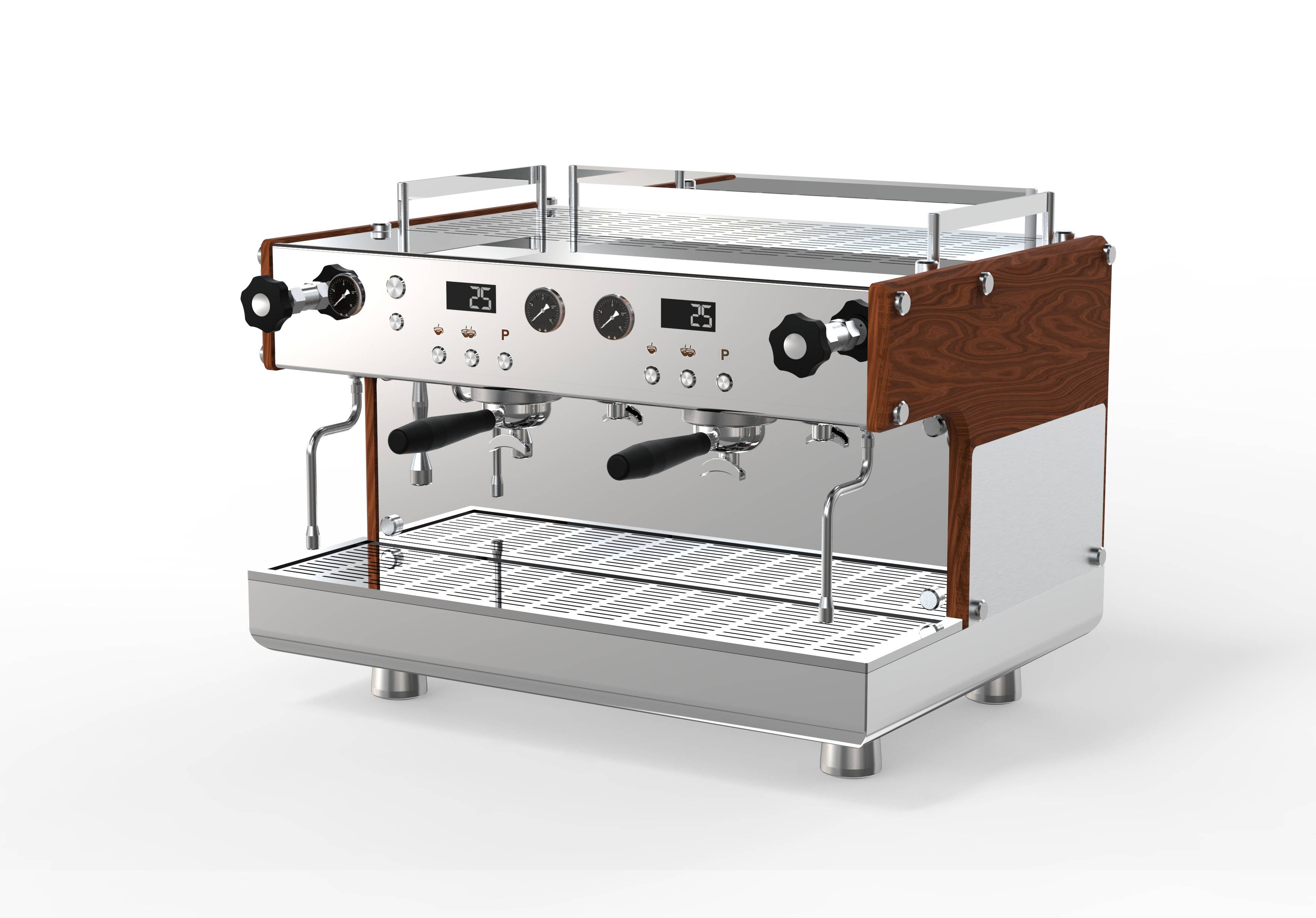
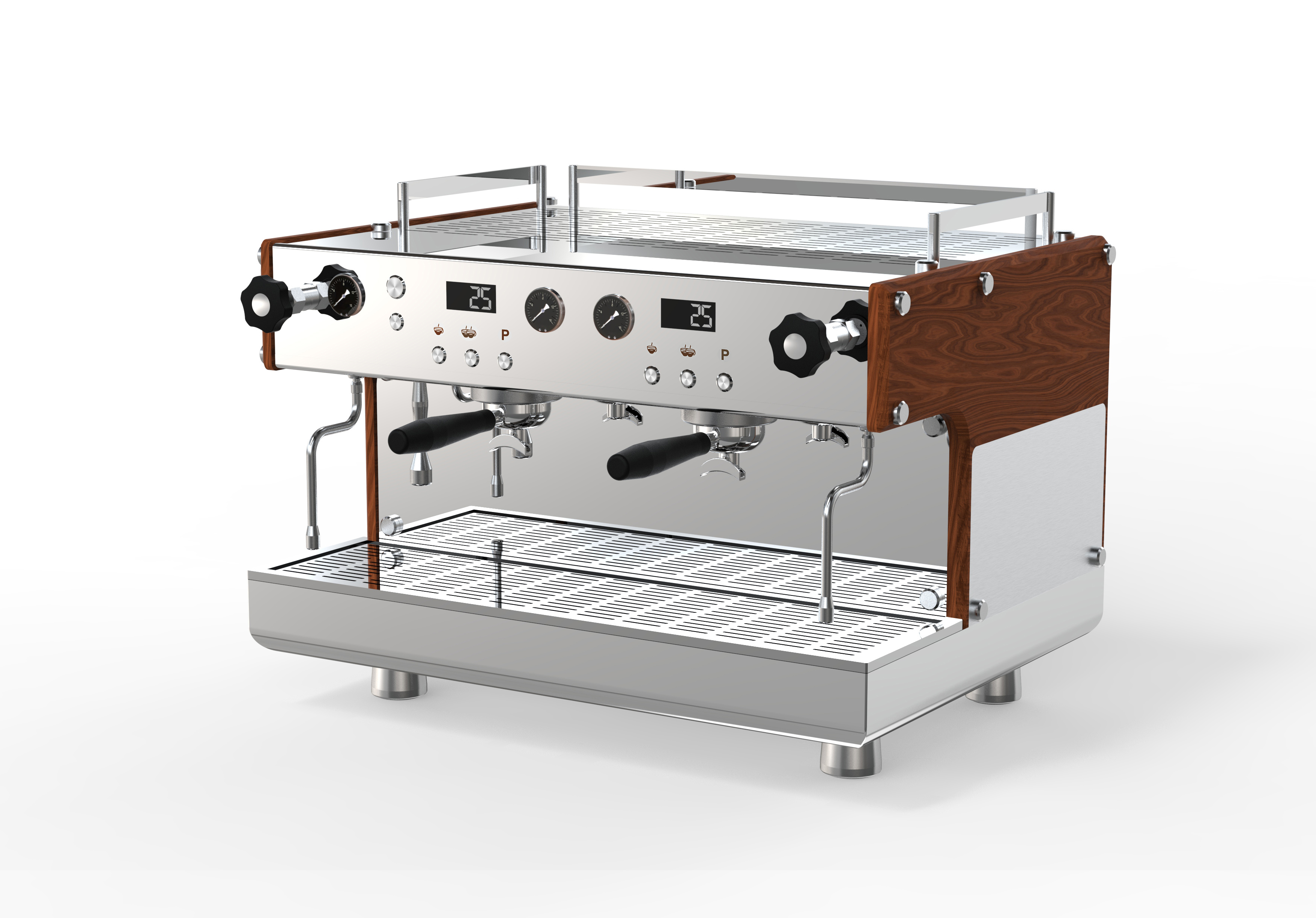
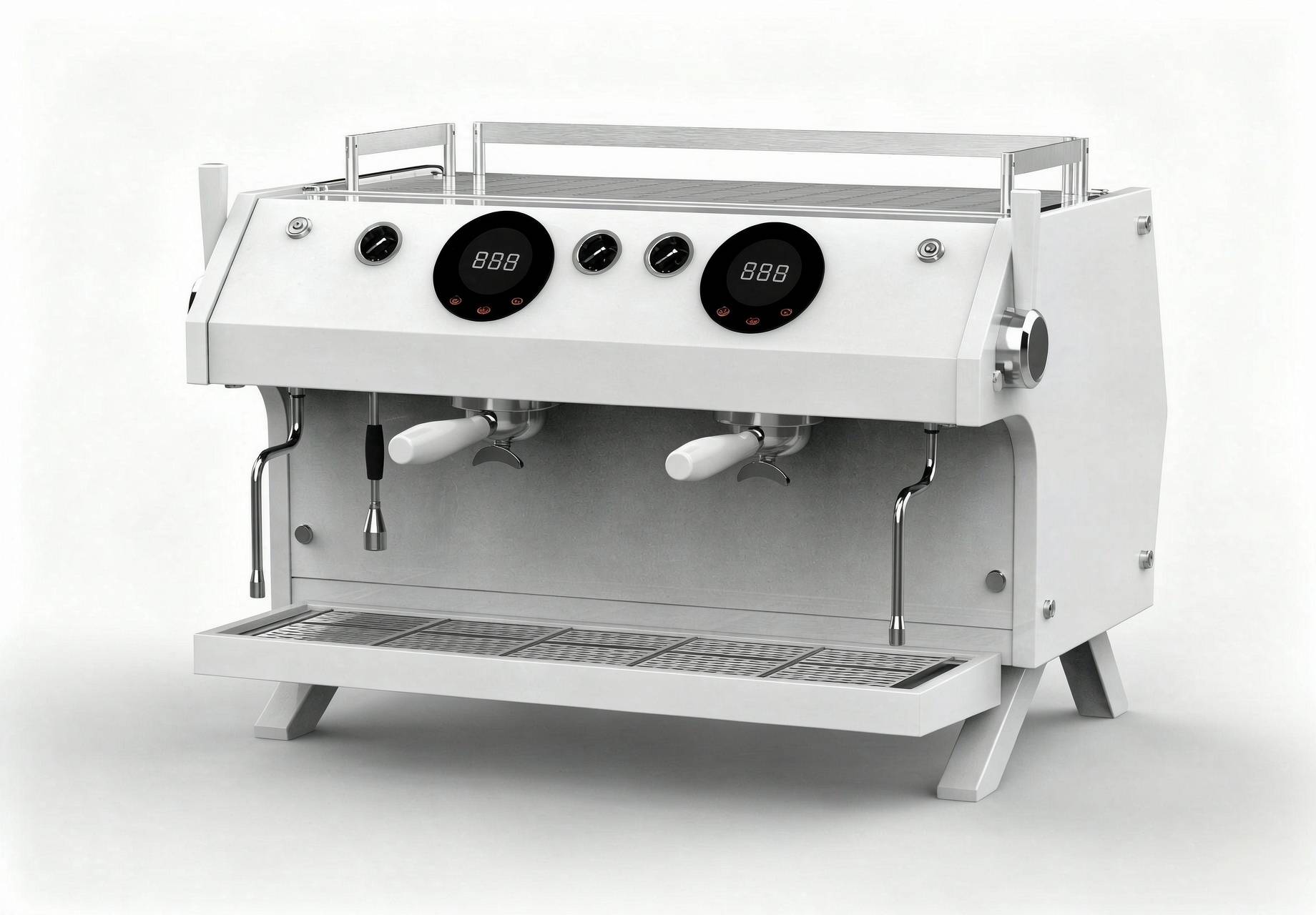
JC-128 2 Group Espresso Machine
Commercial Semi Automatic Espresso Machine for Café, Roastery & Distributor Orders
When you are choosing a 2 group espresso machine, the real question is not whether the specification sheet looks impressive. The question is: will it hold temperature when your barista is under pressure, will it steam milk without slowing down service, and will your staff still get consistent shots in the fourth hour of the morning rush.
JC-128 is a commercial semi automatic espresso machine designed for daily café service. It is built as a professional espresso machine for distributors, roastery bars, restaurant groups and equipment importers who need predictable performance, not just factory claims.
Will It Hold Temperature When You Actually Need It?
This is the first thing importers and café owners ask.
JC-128 uses:
- 10L steam boiler
- 2 × 0.8L independent brew boilers
- T3 heating system: brew boiler + pre-heating pipe + heated saturated group
- 200W heating per group head
For most café owners, the real fear with a 2 group espresso machine is not the first shot of the day—it is shot number 20, shot number 30, and whether quality starts to fall apart while the queue is still out the door.
That concern is valid. Many lower-spec machines lose brew temperature after a few consecutive extractions, and once that happens, flavor becomes sour, thin and inconsistent.
JC-128 is engineered to solve that exact problem.
In our factory stress testing, we ran one group continuously, measuring pure water output without interruption. The result: up to 1200ML of continuous output while brew temperature held at stable 92°C. Beyond that threshold, temperature gradually declined toward 86°C, and once extraction stopped, the system recovered back to 92°C within 8–13 seconds.
This is not a claim about pouring 1200ML through a single group in normal service. A standard double shot is 40–60ML. The test exists to prove one thing: thermal margin under sustained load.
In real café operating conditions, JC-128 supports unlimited consecutive double-shot extractions(≤ 5s between double shot cycles). Even during continuous service, brewing temperature fluctuation remains within ±0.3–0.5°C under this workflow. This allows baristas to keep serving without an arbitrary cup-count limit or unnecessary pauses to protect brewing temperature.
For buyers, the practical meaning is clear:
That is the difference between a specification sheet and a professional espresso machine built for real commercial environments.
Is steam strong enough for milk drinks?
If your market sells lattes, flat whites and cappuccinos, steam matters more than boiler wattage on paper.
JC-128 steam boiler:
- 10L capacity
- 3000W heating
- Reaches 122°C in about 7.5 minutes
Because steam and brew boilers are separate, your baristas can:
- Texture milk on one side
- Pull espresso on the other
- Repeat without waiting for the machine to “recover”
How fast can staff start using it in the morning?
Open-shop routine matters for café buyers.
- Brew boiler: 28°C → 92°C in 3.5 minutes
- Steam boiler: up to 122°C in 7.5 minutes
Staff can arrive, switch on, prep beans and setup bar while the machine heats. You do not need 30-minute warm-up claims to sound “pro”—you need predictable opening time.
Is it easy for new baristas but still adjustable for pros?
Yes. That is why it fits both independent cafés and franchise training.
Adjustable parameters:
- Steam temperature
- Extraction temperature
- Pre-infusion time: 1–9 seconds
- Shot time
- Water flow
- Coffee volume
Equipped with:
- Italian GICAR flowmeter
- FOT PA204 rotary pump
For the owner: volumetric dosing reduces “every barista makes a different cup” problems.
For the barista: pre-infusion and temp settings still allow real tuning.
For the importer: the machine sits between entry commercial models and high-end Italian price points.
Does the gauge actually help technicians and baristas?
JC-128 shows:
- Steam pressure gauge
- Real-time extraction pressure gauge — not pump pressure
Buyers often miss this difference.
Pump pressure = what the machine pushes
Extraction pressure = what the coffee puck accepts
For service teams, extraction pressure helps diagnose grind, dose, tamp and group issues faster. For B2B resellers, it makes the product look more credible next to expensive European brands.
Will maintenance become a headache after 6 months?
Commercial buyers care about year-two cost, not only year-one price.
JC-128 addresses this with:
- All copper piping
- 100% pure copper brew head
- Independent heated saturated groups
- Automatic backflush function
Why this matters:
- Copper is familiar to most commercial espresso technicians
- Saturated groups reduce first-cup temperature loss
- Automatic backflush lowers daily cleaning errors
- Service path is clearer than plastic-heavy low-cost machines
For distributors: fewer “machine tastes bad after one month” complaints.
What’s included so the buyer can operate immediately?
Standard package:
- Single spout portafilter
- Double spout portafilter
- Tamper
For café owners: less add-on purchasing.
For OEM buyers: we can change accessories, packaging and manuals per market.
Technical Specification
|
Item
|
JC-128
|
|
Machine type
|
Commercial semi automatic espresso machine
|
|
Groups
|
2
|
|
Voltage
|
110–220V, 50/60Hz, Single Phase
|
|
Total power
|
5700W
|
|
Steam boiler
|
3000W / 10L
|
|
Brew boiler
|
1000W × 2 / 0.8L × 2
|
|
Group head heating
|
200W × 2
|
|
Motor / valves / PCB
|
300W
|
|
Heating system
|
T3 brew boiler + pre-heating pipe
|
|
Pump
|
FOT PA204 rotary pump
|
|
Flowmeter
|
Italian GICAR
|
|
Real service
|
Approx. 40 double shots per group
|
|
Temp recovery
|
8–13 seconds
|
|
Net / gross weight
|
60KG / 74KG
|
|
Machine size
|
780 × 610 × 525 mm
|
|
Carton size
|
93 × 72 × 62 cm
|
Who Should Consider JC-128
- Coffee equipment distributors
- Roastery brands building bar programs
- Café franchise procurement teams
- Hotel and restaurant project buyers
- Professional espresso machine resellers
If your customers need a 2 group espresso machine that can handle real service, recover quickly, and be supported with clear technical documentation, JC-128 is a strong candidate.
FAQ:
1. What does the 1200ML continuous output test mean, and why should I care as a buyer?
The 1200ML result is a factory stress test, not a normal café workflow. In the test, we ran one group continuously and measured water output without stopping. Brew temperature stayed around 92°C through 1200ML. After that point, temperature gradually dropped toward 86°C, then recovered to 92°C within 8–13 seconds once extraction stopped.
In a real café, a double shot is only 40–60ML, so no operator would ever pour 1200ML through one group non-stop. The test exists to prove thermal reserve — how much heat the machine can hold before performance moves outside the target range.
What matters to you: in real café operating conditions, JC-128 supports unlimited consecutive double-shot extractions, with a 5-second interval between cycles and temperature fluctuation maintained within ±0.3–0.5°C under this workflow. That means your bar team does not need to slow down service, rotate groups artificially, or worry about temperature instability during continuous service.
2. What happens after one group keeps pulling consecutive double shots?
In real café operating conditions, JC-128 is designed to support unlimited consecutive double-shot extractions, with a 5-second interval between cycles while maintaining temperature fluctuation within ±0.3–0.5°C under the stated workflow.
The key difference is that normal café operation is not the same as an uninterrupted water-flow stress test. Between double shots, the 5-second interval allows the system to continue operating within its designed temperature-control range. Baristas can maintain a continuous workflow without an arbitrary cup-count limit or the need to stop service for temperature recovery.
For buyers, the practical answer is straightforward: JC-128 is designed to maintain stable brewing temperature throughout continuous café service, rather than imposing a fixed limit on the number of consecutive double shots.
3. If both groups are busy during morning rush, is the steam still strong enough for milk drinks?
Yes. JC-128 uses three independent boilers: a 10L steam boiler and two separate 0.8L brew boilers. Steam generation and espresso extraction are physically separated, so pulling shots does not steal heat from the steam boiler.
In practice, one group can be extracting while the other is idle, and the steam wand can still texture milk without pressure drop. For latte- and cappuccino-heavy menus, this is the difference between a machine that “looks commercial” and a professional espresso machine that actually holds up when milk drinks stack up.
4. What is the difference between a normal dual-boiler system and the T3 heating system?
A basic dual-boiler machine separates steam and brew water, but brew water can still enter the group head with temperature loss along the way.
JC-128 uses a T3 heating structure:
- brew boiler
- pre-heating pipe system
- independently heated saturated group head
Brew water is pre-conditioned before it reaches the puck, then enters a group head that is kept thermally stable by its own heating circuit. The result is less first-cup temperature loss, smaller group-to-group variation, and more consistent extraction across a long shift — which is exactly what distributors and café groups want from a commercial semi automatic espresso machine.
5. Why do you highlight the extraction pressure gauge instead of pump pressure?
Pump pressure tells you how hard the machine is pushing.
Extraction pressure tells you what the coffee puck is actually experiencing.
That difference matters. If pump pressure is high but extraction pressure is low, the puck may have channeling, uneven dosing, or tamping issues. With a real-time extraction pressure gauge, baristas get immediate feedback, and technicians can diagnose problems faster.
For B2B buyers, this also changes how the machine is perceived: it reads like a professional espresso machine with serious diagnostics, not a consumer device with a decorative gauge.