




Why Many Specialty Cafés Still Prefer Semi-Automatic Commercial Espresso Machines | Huazell
If you have spent any time around specialty coffee, the semi-automatic commercial espresso machine needs no introduction. It might be a La Marzocco, a Synesso, a Slayer—two or three group heads on the bar, steam wands ready, baristas moving between grinder and group with practiced efficiency.
This can look outdated. Super-automatic machines have matured. They grind, dose, tamp, extract, and steam milk in one automated cycle. They deliver consistent drinks across shifts. They cut training from weeks to minutes. In markets facing labor shortages, a machine that doesn't depend on a skilled barista looks like an operational lifeline.
So why don't specialty cafés switch?
The answer isn't sentiment. It's a calculation: for a business whose product is coffee quality, the control a semi-automatic machine provides is a precondition, not a perk.
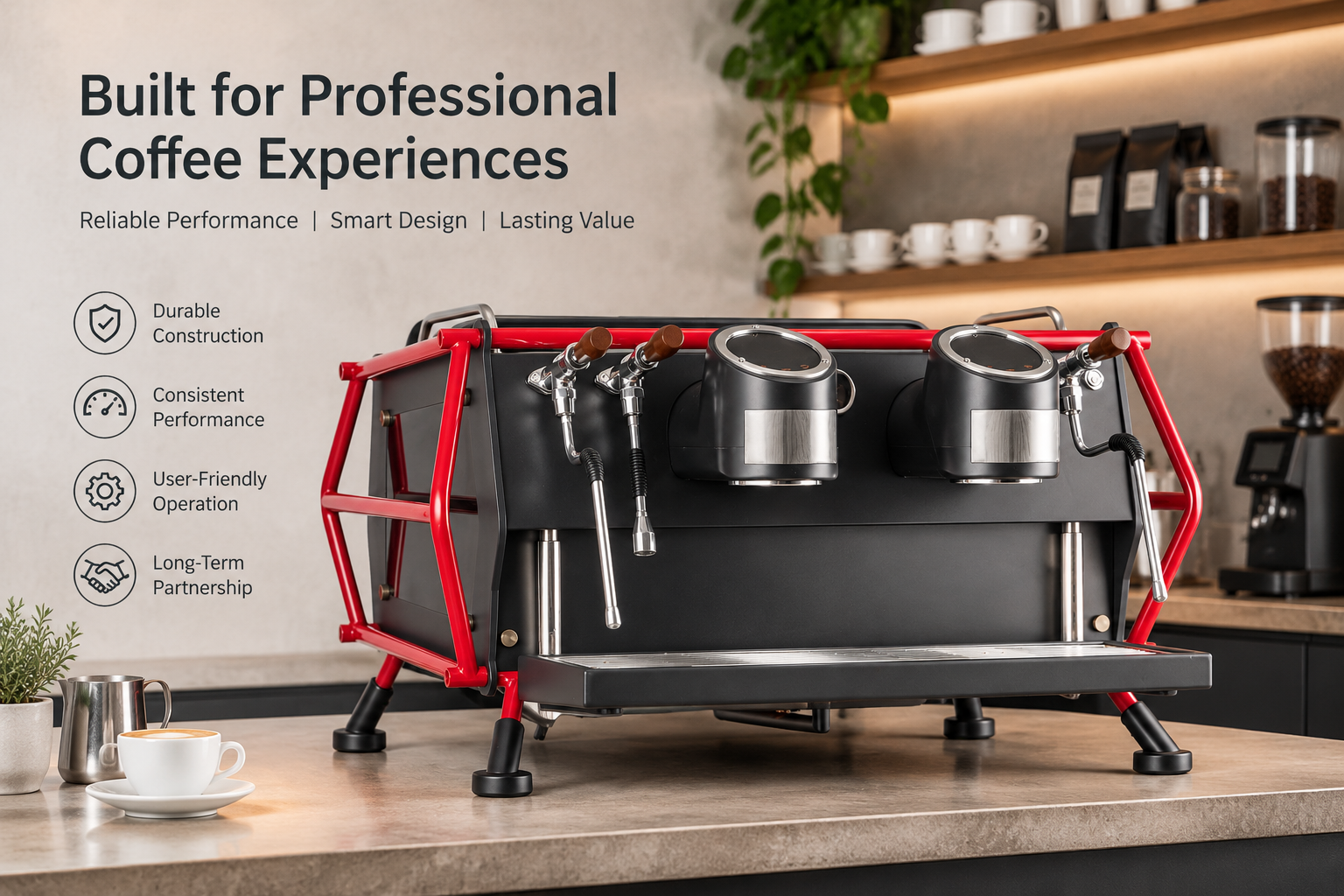
Why the Semi-Automatic Espresso Machine Became a Specialty Café Classic
The semi-automatic commercial espresso machine has remained dominant in specialty coffee for decades because it combines durability, extraction control, and serviceability in one proven design. Its core logic is simple: the machine provides a stable pressure foundation, and the barista decides how the coffee tastes.
This division of labor lets baristas adjust in real time based on bean condition. Grind size needs adjustment based on humidity. Dose needs tweaking based on bean density and roast level. Extraction time needs monitoring by watching flow rate. A super-automatic machine cannot make these judgments—not because the technology is insufficient, but because its design premise is "fixed parameters covering all cases."
For commercial settings, semi-automatic machines offer another advantage: they are robust and easy to service. Many semi-automatic commercial espresso machines can last 10 to 20 years with proper maintenance. In higher-volume settings, dual-group configurations provide more capacity during busy service periods.
Without Super-Automatic Convenience, It Still Delivers Core Value
Semi-automatic machines don't pursue "one-button output." They pursue human-in-the-loop control.
A super-automatic machine hands extraction decisions to a program. The barista's role reduces to pressing a button and refilling the hopper. For convenience stores, hotel breakfast stations, and quick-service restaurants, that's exactly right—these settings need predictable consistency, not a cup that takes time to get right.
But a specialty café sells something different.
When the menu lists a washed Ethiopian Yirgacheffe, light roast, and a customer walks three extra blocks for a four-dollar espresso, the product is the bean's origin character. Expressing that character requires a series of fine-grained judgments. These judgments require a machine that can be intervened with, not one that completes the process on its own.
Semi-automatic machines allow that exploration. Take flow profiling: the barista changes water flow rate during extraction, letting different flavor compounds emerge on an ideal schedule. Darker roasts may need a gentler early stage. Lighter roasts may need more thorough pre-infusion to avoid channeling. A super-automatic machine's adjustable range is determined by the manufacturer. A semi-automatic machine's adjustable range is determined by the barista.
Specialty Café VS Super-Automatic Solution
|
Aspect |
Super-Automatic |
Semi-Automatic Commercial |
|
Extraction decision |
Program preset |
Barista real-time judgment |
|
Flavor flexibility |
Fixed parameters, limited range |
Adjustable based on bean condition |
|
Quality ceiling |
Determined by factory settings |
Determined by barista skill |
|
Labor dependency |
Low, minutes to train |
High, weeks to months to train |
|
Consistency |
Stable across shifts |
Depends on barista skill |
|
Brand value |
Convenience, speed |
Craft, quality, experience |
|
Best use case |
Convenience stores, office coffee, QSR |
Specialty cafés, professional coffee service |
|
Maintenance |
Automated systems, specialized repair |
Proven design, common parts, easy service |
A Quick Visual on the Decision Logic
Super-automatic logic works like this:
Brand positioning → Convenience first → Super-automatic → Fast output → Low labor cost
Semi-automatic logic works like this:
Brand positioning → Coffee quality first → Semi-automatic → Barista control → Product differentiation
This isn't about which is better. It's about what your brand monetizes.
If the answer is "speed and convenience," super-automatic or a hybrid setup makes sense. If the answer is "coffee quality and experience," semi-automatic is infrastructure. You need it not because it's "better," but because it's the only option that lets you extract the full potential of your beans and makes your people part of the product.
Barista Skill as Asset, Not Cost
The most common mistake in procurement is treating barista training costs as pure expense.
In a specialty café's business model, barista skill is part of the product. Customers pay a premium for an espresso partly because someone who knows what they're doing made it. The details behind the bar—the focus while weighing beans, the even motion while distributing grounds, the eye on flow rate during extraction—together create the texture of what "specialty" means.
Operationally: training a barista who can deliver consistent quality and adjust parameters based on bean condition takes weeks or months. But if the café's selling proposition is "our coffee is different," that investment is a cost of production, not overhead to cut.
Semi-automatic machines give that skill room to operate and let customers see it happening. The customer-facing preparation process is itself a form of value demonstration. In front of a super-automatic, the barista's skill compresses to near invisibility—pressing a button requires no craft, and customers see no "making."
The Question Buyers Should Actually Ask
If you're choosing equipment for a café, or advising on that purchase, the question isn't "super-automatic or semi-automatic."
The question is: what does your brand monetize?
If the answer is "speed and convenience," super-automatic or a hybrid setup makes sense. Convenience stores, office coffee corners, QSR coffee programs prioritize labor efficiency and cross-shift consistency.
If the answer is "coffee quality and experience," semi-automatic is infrastructure. You need it not because it's "better," but because it's the only option that lets you extract the full potential of your beans, makes your people part of the product, and distinguishes your shop from the café down the street.
A hybrid approach is increasingly common: super-automatic for baseline volume and self-serve needs, semi-automatic where craft matters. That's not a compromise. It's operational segmentation—matching machine characteristics to scenario requirements.
Why Choose a Semi-Automatic Commercial Espresso Machine as Your Core Equipment?
For specialty cafés, small shops, and professional coffee service, a semi-automatic commercial espresso machine provides repeatable quality control and the foundation for brand differentiation. It preserves the barista's full control over extraction, supports real-time adjustment based on bean condition, and offers commercial-grade durability and serviceability.
If you are sourcing a semi-automatic commercial espresso machine or looking for commercial espresso machine wholesale options, Huazell can offer OEM/ODM support, customized design options, technical service, product materials, and coffee grinder equipment for distributors, coffee equipment brands, and commercial espresso machine buyers.
At the end of the day, the semi-automatic commercial espresso machine is not "outdated technology." It is the infrastructure of the specialty café business model. You get the barista's control over every shot, the full expression of bean flavor, and craft that customers can see. What changes is technology. What doesn't change is control over coffee quality.