


Commercial Coffee Grinder Buying Guide for Cafés and Foodservice

blog avatar

Written by

Huazell

common.Published
May 31, 2026
  • blog

Follow us

Commercial Coffee Grinder Buying Guide for Cafés and Foodservice

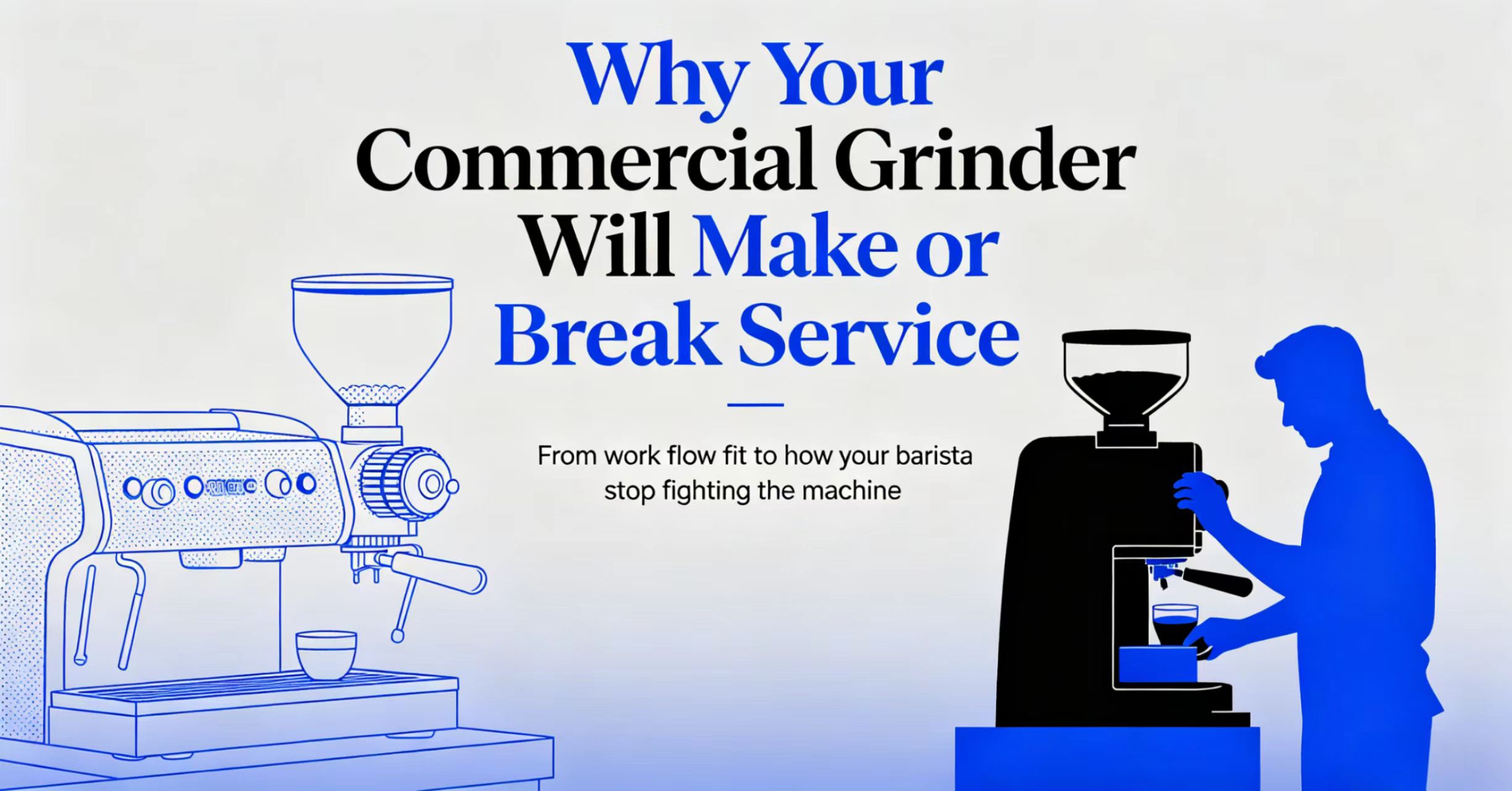
Why Your Commercial Grinder Will Make or Break Service

coffee grinder for espresso.jpg

Most cafés obsess over the espresso machine and treat the grinder as an afterthought. That’s backwards—especially when you’re running a busy bar with an espresso coffee grinder at the center of service.

In a real café, the commercial coffee grinder​ decides whether your shots stay consistent, whether your baristas fight the machine all morning, and whether your queue moves or stalls.

We’ve seen machines that look the part but fall apart by 10 a.m. The issue is rarely power. It’s workflow.

If your coffee grinder for espresso​ needs constant tweaking, slows under pressure, or leaves a mess every shift, it’s already costing you money.

What we actually look at

Grind stability​ – if it drifts, you’re dialing in all day.

Speed​ – slow grinding kills throughput.

Simplicity​ – new staff should run it without a manual.

Fit​ – not just counter space, but how it lives inside your workflow.

A coffee grinder large capacity​ hopper sounds ideal—until freshness becomes the trade-off. Modern interfaces look sharp, but if your team can’t adjust a dose mid-rush, it’s the wrong design.

Details matter: a solid portafilter holder, a clean chute, less spillage.

That’s what keeps service calm when the bar is slammed.

Where buyers go wrong

They buy based on photos.

They assume “commercial” means “busy-proof.”

They ignore cleaning, training, and everything that happens after install.

A grinder that only performs in the hands of one senior barista isn’t a smart purchase—it’s operational risk.

What we tell sourcing teams

Don’t spec the grinder for your quietest hour. Spec it for busy morning.

Ask these questions:

How long does cleaning take?

Can a new hire run it?

Are parts easy to source, or will you regret it later?

If you’re talking to a coffee grinder manufacturer, push past the sales deck. And if you’re scanning listings for a coffee grinder for sale, ignore vague claims like “high performance.”

Watch how the machine behaves when the bar is under pressure—that tells you everything.

Featured Blogs
Stainless Steel vs. Copper Boilers: What Really Determines Commercial Espresso Machine Performance?

Stainless Steel vs. Copper Boilers: What Really Determines Commercial Espresso Machine Performance?

Does a copper boiler automatically make a better commercial espresso machine? Inspired by a real B2B customer conversation, this article explores the differences between stainless steel and copper boilers, the engineering behind temperature stability, and why commercial buyers should evaluate real-world performance rather than material specifications alone.

Why Your Espresso Tastes Different Every Day: The Hidden Barista Setup Guide Most Shops Skip

Why Your Espresso Tastes Different Every Day: The Hidden Barista Setup Guide Most Shops Skip

A deep-dive guide for cafe owners and baristas revealing the hidden step every pro does during installation — calibrating water flow. Covers why factory defaults fail in real-world conditions, how a 5–10ml drift ruins extraction, the连锁 reactions of skipping this step, a full walkthrough of the calibration process, brand-specific instructions, how often to recheck, and common myths debunked.

How Many Espresso Shots Can a Commercial Machine Pull Continuously?

How Many Espresso Shots Can a Commercial Machine Pull Continuously?

Discover why a 2-group or 3-group high volume espresso machine maintains stable temperature even during zero-gap continuous extraction with two or three baristas working simultaneously. Backed by real chain store data: 80+ back-to-back shots on 2-group, 120+ on 3-group, without temperature drop.

Commercial Espresso Machine Troubleshooting: Solving Extraction Flow Problems & Espresso Shot Too Fast / Too Slow

Commercial Espresso Machine Troubleshooting: Solving Extraction Flow Problems & Espresso Shot Too Fast / Too Slow

If your commercial semi-automatic espresso machine is pulling shots too fast or too slow, don’t start by blaming the beans. Flow rate is the result of dose, grind, puck preparation, water pressure, group maintenance, and machine configuration. This guide breaks down what distributors, café owners, and service teams should check first.

Why Temperature Stability Is the Only Spec That Matters for Your Coffee Business

Why Temperature Stability Is the Only Spec That Matters for Your Coffee Business

Most cafés blame beans or baristas when coffee tastes off. Usually, it’s temperature drift in the semi-automatic commercial espresso machine. This piece shows why commercial rush hours break weak machines, what real stability looks like under load, and how a unit like the KY-T33​ held 92°C through 2,000 ml of continuous draw—dipping only 3–6°C after that, then recovering in 5–13 seconds. B2B buyers get the exact questions to ask, and the contract clauses that stop suppliers from hiding behind idle-temperature graphs.

Commercial Espresso Machine Group Head Sizing Guide for Cafés: Single, Double, or Triple? | HUAZELL

Commercial Espresso Machine Group Head Sizing Guide for Cafés: Single, Double, or Triple? | HUAZELL

This guide compares single, double, and triple group commercial espresso machines across peak throughput, daily volume reference, typical use cases, and electrical requirements. It explains why the double group remains the baseline for most independent cafés, when a triple group’s redundancy justifies its footprint, and why under-sizing is the more costly error. Includes a sizing table and procurement guidance on capacity headroom.