



Many café owners and coffee equipment distributors compare commercial espresso machines by boiler capacity first. A 20L boiler sounds stronger than a 6L boiler, but boiler size alone does not guarantee stable brewing temperature, fast recovery, or better espresso quality. If the heating power, PID control, group head design, heat exchanger structure, and thermal mass are weak, a large boiler may still deliver unstable shots. Huazell solves this problem with commercial coffee machines such as the KY-T33 and KY-mini A8, using independent group heating and precise temperature control for more reliable extraction.
Espresso machine thermal stability depends on heating power, thermal mass, group head design, PID control, heat exchanger efficiency, and boiler recovery speed. Boiler capacity matters, but a larger boiler does not automatically produce better temperature stability or espresso quality.

Boiler Volume Is Only Skin Deep
When evaluating a commercial semi-automatic espresso machine, thermal stability is what ultimately defines cup quality. Boiler capacity is merely one of many variables influencing temperature stability — and far from the most important.
Here’s a concept most reviews overlook: thermal mass.
Thermal mass isn’t just about how much water sits inside the boiler; it’s about how much heat the entire system—metal walls + water + group head—can store. Brass and copper have far higher specific heat capacities and thermal conductivity than stainless steel. A thick-walled small copper boiler can easily outmatch a thin-walled oversized stainless-steel boiler in terms of thermal mass.
Copper’s thermal conductivity exceeds 400 W/m·K, while stainless steel languishes around 14 W/m·K. What does this mean? Copper boilers rapidly transfer heat from the heating element across the entire boiler wall and water volume, achieving uniform heating. Stainless steel boilers, by contrast, struggle to move heat efficiently. As Michael Teahan of Analogue Coffee once put it, “The problem with steel is that it doesn’t like to share heat.” Heat pools at the bottom, the top stays lukewarm, and steam can condense back into wet vapor at the upper reaches of the boiler.
A 20-liter stainless-steel boiler with thin walls and an underpowered heating element will likely perform worse under sustained extraction than a well-engineered 6-liter copper boiler.
The Hidden Variables in Heat Exchangers
In heat-exchanger (HX) machines, boiler capacity plays an even more indirect role in brew temperature.
The HX principle: a copper tube runs through the steam boiler, and fresh water flowing through that tube is heated to brew temperature en route. What determines temperature stability is the length, diameter, and material of that exchanger tube—not the size of the surrounding steam boiler. Too short a tube means insufficient dwell time; even a 20-liter boiler won’t get the water hot enough. Long enough, with adequate surface area, and a small boiler can deliver rock-solid consistency.
Good engineering keeps HX temperature fluctuations within ±1–2°C—but that depends on the quality of the heat exchanger, not the boiler’s liter count.
Heating Elements: The Overlooked Decider
Compare a 20-liter boiler paired with a meager 1500W heating element against a 6-liter boiler equipped with a high-density 3000W element and PID temperature control. Which recovers faster?
The latter—by a mile.
Recovery speed hinges on heating element power density (wattage per unit area) and the precision of the PID controller. PID systems constantly monitor and fine-tune the heating element output to maintain stable brew temperatures throughout service. Traditional thermostats merely cycle on and off, creating temperature swings; PID makes micro-adjustments to prevent drift.
A compact semi-automatic espresso machine with precise PID control often outperforms bulky machines relying on mechanical thermostats during back-to-back shots. Real-world testing shows PID-equipped dual-boiler commercial machines holding temperature within ±0.5°C under continuous extraction, with recovery times around 45 seconds—well ahead of the industry average of 60+ seconds.
Revolution in Group Heating: Breaking Free from HX Constraints
The classic HX system’s biggest flaw? The group head relies entirely on the boiler for heat via thermosiphon circulation. That means group temperature always lags behind boiler changes, and an unavoidable thermal gradient persists between the two. You adjust the boiler setting, but the coffee grounds meet the group head—separated by piping losses you can never fully eliminate.
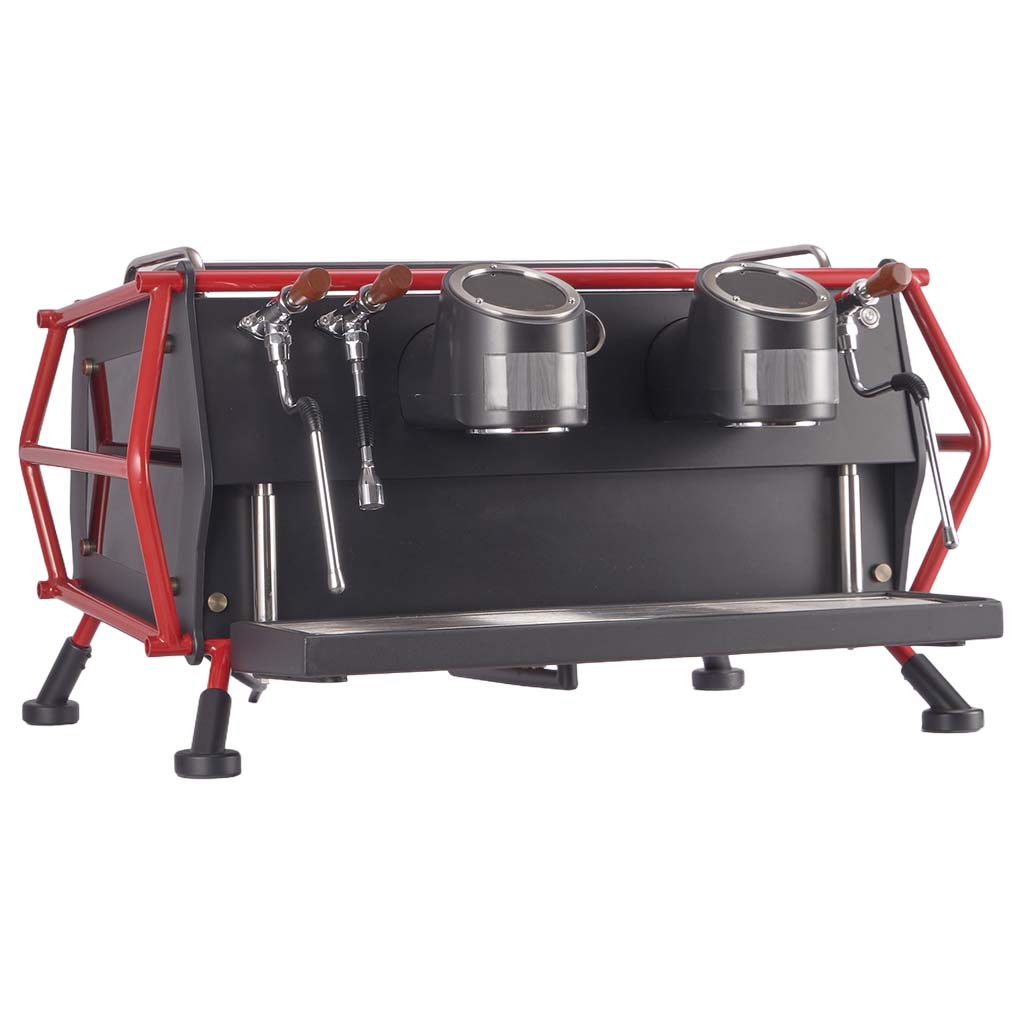
The HUAZELL KY-T33 commercial espresso machine shatters this logic. Its group head integrates an independent heating module capable of self-heating and independent temperature adjustment—no reliance on the brew boiler to warm the group. This completely decouples group temperature from boiler temperature. You can set the steam boiler for optimal steam pressure while dialing the group head into an entirely different brew temperature—neither interfering with the other.
This is unthinkable in traditional saturated-group systems, where group temperature is held hostage by boiler settings. Want better steam? You sacrifice brew temp. Need cooler extraction? Steam suffers. The KY-T33’s independent group heating gives baristas absolute control over brew temperature for the first time.
Equally notable is the HUAZELL KY-mini A8 E6 espresso machine. This E61 espresso machine retains the iconic 58 mm E61 group and mechanical pre-infusion—but fundamentally re-engineers the heating approach. Instead of relying on thermosiphon flow from the boiler, the KY-mini A8 builds a dedicated heating module directly into the group head, eliminating the need for passive thermosiphon heating altogether.
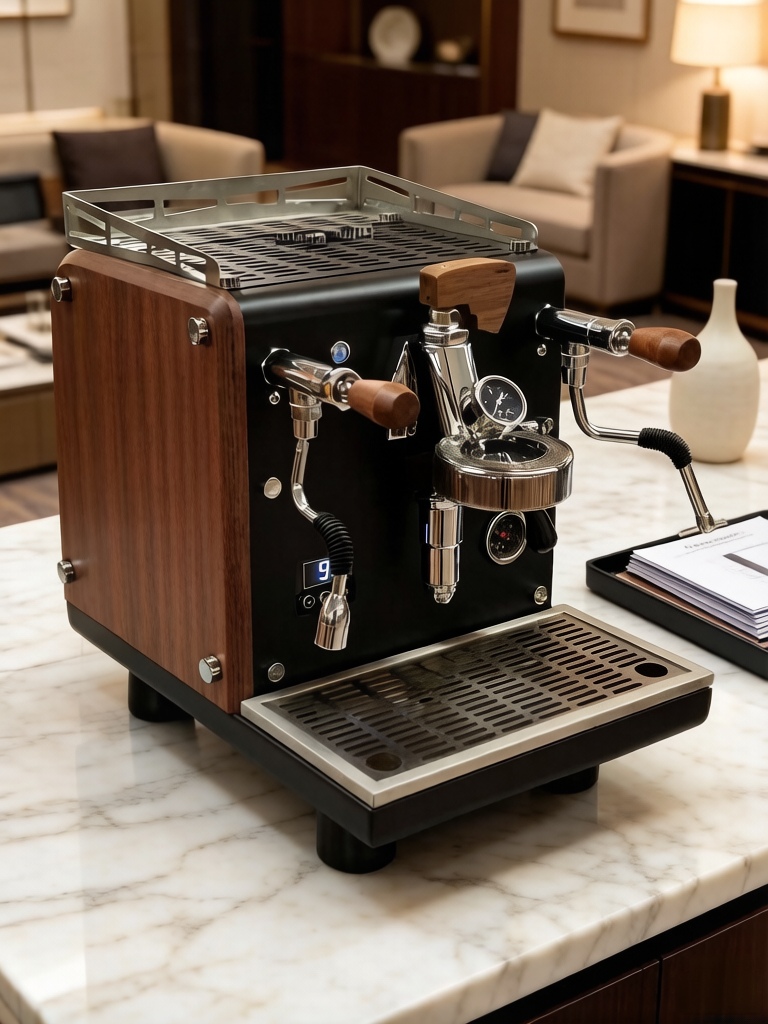
What does that mean in practice? You keep the classic E61 ergonomics and pre-infusion behavior while escaping the notorious E61 ritual of cooling flushes after idle periods. The group heats itself, controls its own temperature, avoids thermosiphon-line heat loss, and sidesteps overheating during downtime. Temperature remains flat from first shot to last. It’s a machine that honors the E61 legacy while solving its greatest thermodynamic weakness.
Multi-Boiler Advantage: It’s Not About Size
The real merit of multi-boiler systems lies in thermal isolation—brew and steam boilers operate independently. Adjusting steam pressure has zero impact on brew temperature. That’s the true value proposition, not the cumulative liter count.
The La Marzocco Linea Classic S, for instance, specs brew boilers at 1.8 liters (1-group), 3.4 liters (2-group), and 5 liters (3-group)—numbers far smaller than many entry-level buyers expect from a “commercial” machine. Yet its saturated-group design directly links the group to the brew boiler, delivering “unparalleled thermal stability, shot after shot.” Rocket Espresso’s R9 follows suit, pairing fully saturated groups with a multi-boiler architecture and PID control for exceptional temperature stability.
The HUAZELL KY-T33 pushes further still—it doesn’t need the group to be physically strapped to the boiler for thermal stability, because the group isits own heat source. This design philosophy represents a fundamental rethinking of traditional thermodynamics: stability no longer depends on minimizing physical distance between boiler and group, but on independent, intelligent thermal control.
The Group Head’s Thermal Inertia
When discussing commercial espresso machine thermal stability, the group head’s thermal mass often matters more than boiler capacity.
Classic E61 groups rely on thermosiphon loops to draw heat from the boiler. Their substantial thermal mass can buffer minor fluctuations once stabilized—but the trade-off is notorious: prolonged idle time overheats the group, forcing baristas into cooling flushes before pulling shots.
Saturated groups, by contrast, mount directly onto the brew boiler, effectively making the group part of the boiler itself. No thermosiphon-line losses. No idle overheating. Flat, consistent temperature from open to close. A small-boiler machine with saturated groups routinely outperforms a large-boiler E61 machine in real-world service.
The HUAZELL KY-T33 and KY-mini A8 offer a third path: integrated, independently heated group modules. They preserve traditional pre-infusion functionality and familiar handling while solving the congenital flaws of legacy heating systems with modern thermal engineering. This isn’t a betrayal of tradition—it’s a deliberate upgrade.
What to Look for When Buying
Next time you step into a shop advertising “commercial coffee machines for sale” and a salesperson launches into boiler-capacity talking points, ask three questions:
First, check the power-to-volume ratio. Don’t fixate on liters alone. Look at total power and, specifically, the wattage allocated to the brew boiler. A 6-liter boiler backed by 3000W+ of heating power will recover far faster than a 10-liter boiler limping along on 2000W.
Second, scrutinize the group-head heating method. This is the most overlooked—and arguably most critical—spec. Does the group rely on passive heating via a saturated brew boiler, or does it integrate its own electric heating module? If it’s the latter—as with the KY-T33 and KY-mini A8—you gain absolute freedom over temperature control. No more trading off steam pressure to tweak brew temp. No more fiddling with boiler settings to compensate for group behavior.
Third, demand dynamic temperature curves. Ignore static boiler-probe readings. Ask the dealer for measured dynamic temperature data taken at the group head. Those are the numbers that actually shape flavor in the cup.
The Cup Is the Final Judge
A single degree Celsius can transform the same coffee from “rich chocolate and caramel” into “sharp, sour austerity.” This is the unforgiving reality of extraction chemistry.
A coffee machine isn’t valuable because it has a massive boiler; it’s valuable because it delivers consistent temperature, shot after shot. Reputable commercial coffee machine manufacturers emphasize measured thermal-stability data in their specs—rather than leaning on inflated boiler volumes.
Buying an espresso machine isn’t about buying a water tank; it’s about buying a system that reliably converts electrical energy into thermal precision. That “20-liter” badge might just be a pricing anchor planted by the marketing department. The “6-liter” machine next to it could very well be a precision instrument engineered with thermodynamic intelligence.
And in 2026, the true frontier isn’t boiler size—it’s whether the group head has its own brain and heartbeat. The HUAZELL KY-T33 and KY-mini A8 answer that question unequivocally: the closer the heat source to the coffee bed, the more precise the temperature control. Simple, yet the industry spent decades obscuring this truth behind the myth of “bigger is better.”
Next time someone tells you “bigger boilers are always better,” ask them: Can your group head heat itself?☕
If you are sourcing an E61 coffee machine China build or looking for E61 coffee machine wholesale options, the KY-Mini A8 gives your brand a strong combination of classic E61 design and modern thermal stability. As a coffee machine manufacturer, Huazell can offer OEM/ODM support, customized design options, technical service, product materials, and coffee grinder equipment for distributors, coffee equipment brands, and commercial espresso machine buyers.
At the end of the day, the KY-Mini A8 is still an E61 espresso machine at heart. You get the same lever feel, the same E61 group identity, and the same proven durability that made the Faema E61 design famous around the world. What changes is the daily user experience: faster readiness, easier temperature control, more consistent espresso extraction, and less unnecessary waiting.
Send an inquiry and get the instruction!
FAQ About Espresso Machine Thermal Stability
Does a bigger boiler mean better espresso machine thermal stability?
No. A bigger boiler can store more water, but thermal stability also depends on heating power, PID control, group head design, boiler material, and heat recovery speed.
Why does group head heating matter in espresso machines?
The group head is where brew water meets the coffee bed. If group head temperature is unstable, espresso extraction can change even when the boiler temperature looks stable.
Is a dual boiler espresso machine always better?
A dual boiler espresso machine is better for cafés that need stable brewing and steaming at the same time. However, the full design still matters, including group heating, power, control system, and serviceability.
What should B2B buyers check before choosing a commercial espresso machine?
Buyers should check boiler capacity, heating power, temperature control, group head heating method, pump type, steam performance, spare parts support, and whether the machine fits their daily cup volume.