




A café owner in Melbourne called us about eighteen months after taking delivery of a batch of grinders. Nothing was broken. Motor fine, adjustment collar fine, no chipped teeth. But his baristas were re-dialling every second morning and the espresso had lost the clarity it had in week one.
He wanted to know whether the grinders were faulty.
They weren't. The burrs had worn, which is what burrs do. Nobody had thought much about it at the point of purchase, because burr material is the least glamorous line on a commercial grinder spec sheet. It sits there next to "hopper capacity" and nobody asks.
That phone call is basically why this article exists. Coffee grinder burr materials look like a minor technical detail and behave like a product strategy decision: they shape how consistent a grinder stays over its working life, how often it needs service, what it can be priced at, and what your sales team gets to say about it.
What are commercial coffee grinder burrs made of?
A commercial coffee grinder burr is a cutting tool. It is almost always steel, and what changes between products is the alloy, the heat treatment, and whether a surface coating has been applied.
The four solutions you will actually encounter:
- Stainless steel burrs — the mainstream choice. Balanced grind quality, wear life and cost.
- Hardened steel burrs — higher wear resistance through alloy and heat treatment, used in professional machines.
- Titanium coated burrs — steel burrs with a titanium-based surface layer, aimed at longer service life.
- Advanced coated burrs (TiN, TiCN, DLC) — steel with a hard PVD or plasma-applied coating, used in high-end equipment.
Here is the caveat I would put next to any list like this one: the material is maybe half the picture. Tooth geometry, heat treatment consistency, machining tolerance, and whether the grinder actually aligns the two burr faces properly all matter enormously. A beautifully coated burr sitting 0.03 mm out of parallel will produce worse coffee than a plain stainless one that is properly made. I have watched it happen on a test bench, and it is not subtle.
Why does burr material matter in commercial coffee grinding?
Because grinding is violent and repetitive, and it is worth being concrete about how violent.
A dose is roughly 150 to 250 beans. Each one gets crushed, sheared, and dragged across a metal surface. A moderately busy café runs maybe two hundred doses a day. Run that arithmetic out over a year and you are past a tonne of coffee going through two pieces of metal spinning a few hundred microns apart.
Two consequences follow, and one gets far more attention than it deserves.
Heat is the one everyone talks about. It comes from the motor, from beans fracturing, from particles grinding against each other on the way out of the chamber, and excessive heat costs you aroma. Burr material does influence this. But honestly it is the third or fourth most important factor after motor speed, chamber design, and how hard the machine is being pushed. Be suspicious of anyone selling you a coating purely as a temperature fix.
Wear is the one that actually bites commercially.
Burrs do not stay sharp. Cutting edges round off over hundreds of kilos, and when that happens the burr stops cutting cleanly and starts crushing and smearing instead. Particle distribution widens. Fines go up. The same collar position that gave you a 28-second shot in January gives you something else in August, so the barista turns it, and next week turns it again.
That slow creep is what customers eventually complain about, and by then they do not describe it as burr wear. They say the machine is inconsistent, or the coffee tastes different, or "I think this grinder is just not as good as the one at our other site."
So the interesting question about a commercial coffee grinder burr is not how it performs in the first week. It is what the curve looks like after nine months.
Flat burr material comparison: the four options side by side
Most flat burr material comparison charts you will find online stop at the material name. This one includes what actually changes for the buyer.
|
Burr Type
|
Main Characteristics
|
Typical Application
|
|---|---|---|
|
Stainless Steel Burrs
|
Balanced performance and cost
|
Mainstream commercial grinders
|
|
Hardened Steel Burrs
|
Higher wear resistance
|
Professional applications
|
|
Titanium Coated Burrs
|
Longer lifespan, improved durability
|
Premium commercial grinders
|
|
Advanced Coated Burrs (TiN, TiCN, DLC)
|
Maximum wear resistance
|
High-end professional equipment
|
One thing a flat burr material comparison like this cannot show: in head-to-head testing, all four produce good coffee when new and properly made. The differentiation lives almost entirely in what happens after month three.
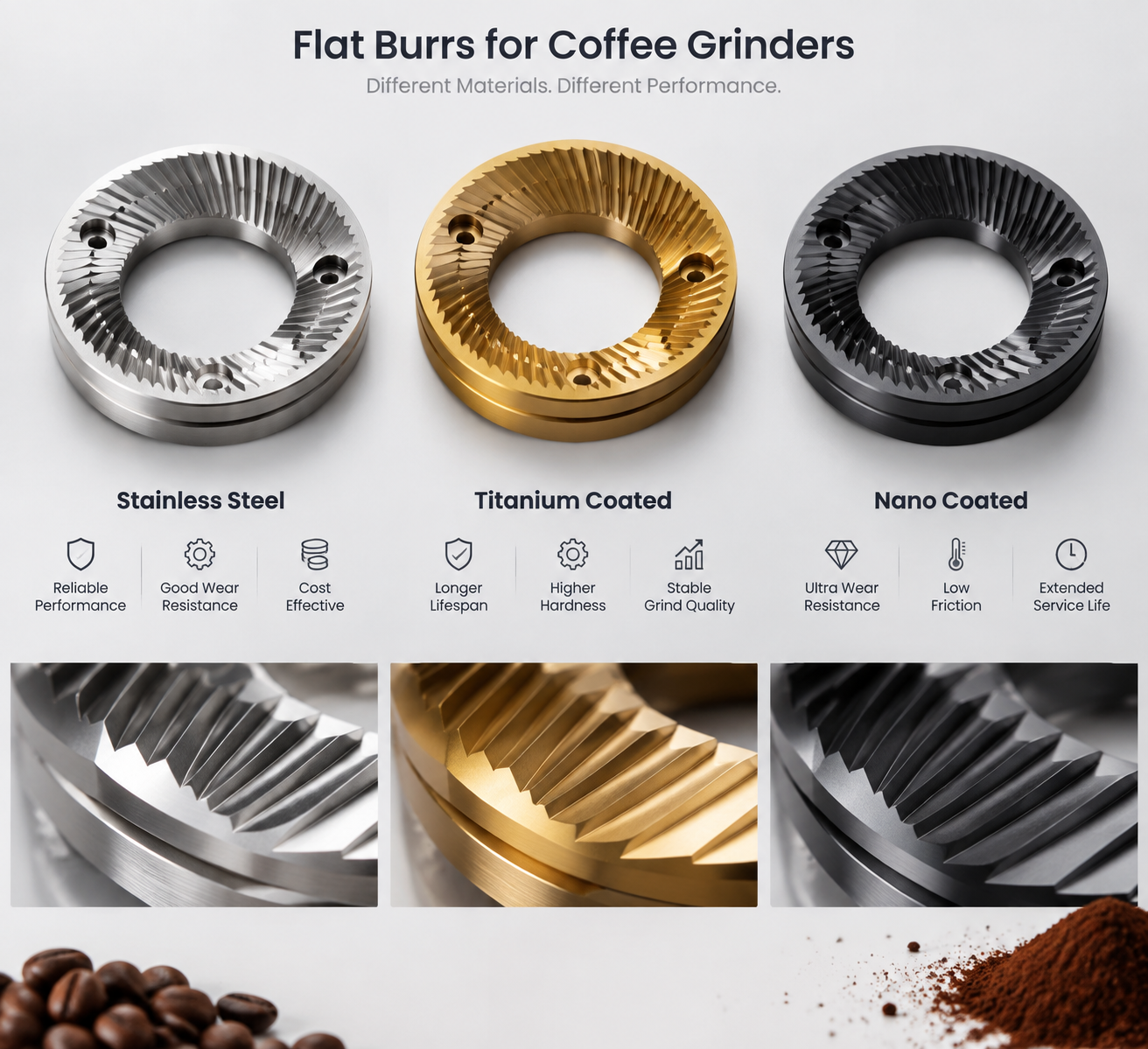
Stainless steel coffee grinder burrs: when are they the right choice?
Stainless steel coffee grinder burrs dominate mid-market commercial grinders, and not because they win any single category. It is the material that refuses to lose badly in any of them.
It grinds well. It machines predictably. The supply chain is deep, so you can second-source it, so your procurement person sleeps at night. And it needs no process step your existing metal supplier cannot handle.
What separates a good stainless burr from a bad one
"Stainless steel" on a datasheet tells you almost nothing, and this is where I would push back on how most brands write burr specs.
Alloy grade sets the ceiling. Hardness and toughness pull against each other. Push hardness up and the edge lasts longer, but you risk chipping when a stone or a very hard bean goes through. Go tougher and you absorb impact better but wear faster. Most commercial burrs sit at a deliberate compromise, and a decent supplier will tell you which way they have leaned and why.
Heat treatment is, in my experience, the single most common place where cheap burrs quietly fail. It is what gives you a hard surface over a tough core. Do it right and the burr keeps its geometry for a long time. Do it inconsistently, batch to batch, and you get burrs that measure fine on receipt and then wear unevenly six months later in someone's café, which is the worst possible time and place to discover the problem.
Machining determines whether the design works at all. Flatness, concentricity, tooth profile, surface finish. These set alignment, and alignment sets particle distribution. If you are talking to a factory, ask what tolerance they hold on burr flatness and what they do with a unit that falls outside it. How confidently and specifically they answer tells you more than any material name.
Coffee grinder burr lifespan: how long do stainless burrs last?
Coffee grinder burr lifespan is the number buyers ask for and the number most suppliers avoid giving. Typical stainless steel coffee grinder burrs run somewhere in the 500–1,500 kg range before particle distribution drifts enough for a trained barista to notice. That range is wide because burr diameter, bean hardness, chamber design and daily volume all matter more than the steel grade.
We use figures like these as planning numbers in development, not as guarantees. Any supplier quoting you a single number for coffee grinder burr lifespan is guessing.
For OEM work, stainless gives you room to move. Tooling is simpler, lead times are shorter, and you are not locked into a coating vendor. If your product targets small cafés, restaurants, office coffee service, or anyone buying mainly on reliability and price, a well-designed stainless burr will make those customers happy. The money you did not spend on coating can go into geometry or a better adjustment mechanism, which is frankly where it belongs.
Titanium coated coffee grinder burrs: what are they, really?
Let us deal with the misconception up front. In any commercial grinder you are likely to encounter, there is no such thing as a burr made of titanium. What the industry calls "titanium burrs" are steel burrs with a titanium-based coating applied to the surface.
The division of labour makes sense once you see it. The steel core does the structural work: it holds the manufactured geometry and takes the load. The coating does the surface work, raising hardness and slowing the rate at which edges go blunt. You get most of the durability benefit of an exotic material while keeping the cost and machinability of steel.
Do titanium coated coffee grinder burrs improve taste?
Not on day one, no. I want to be blunt about this because the marketing sometimes implies otherwise and it sets up wrong expectations.
What the coating does is slow the decline described earlier.
Which matters more than it sounds. In commercial service, "how good is it when new" is the easy question. The harder one is how long it holds. As edges dull, grind speed drops, particle spread widens, and the dial starts moving. One barista re-dialling twice a week is a minor irritation. Twenty locations doing it is a brand consistency problem, and head office notices before your distributor does.
On lifespan: titanium coated coffee grinder burrs typically last somewhere around 1.5–3× a comparable untreated stainless set, though that depends heavily on coating quality and grinding volume. Longer intervals between changes, fewer re-dials, less downtime. That is the pitch, and it is a legitimate one.
Titanium coated burr trade-offs
Two reasons to hesitate.
Cost. Coating is an extra process step with its own yield losses. Whether it is worth it depends entirely on whether your buyer recognises the value. In a price-sensitive segment they often do not, and you have added cost to a product competing on price.
Coating quality varies wildly. Thickness, adhesion, uniformity, process control. A good coating genuinely extends life. A bad one can delaminate or wear patchily, and a flaking coating is worse than no coating, because now you have hard particles loose in the grinding chamber.
This is a specification where auditing the supplier's process matters more than reading the material name. Ask about adhesion testing. Ask what happens to a batch that fails. If those answers are vague, that is your answer.
Advanced coatings: TiN vs TiCN vs DLC
Beyond standard titanium coatings there is a tier of surface treatments borrowed from cutting tools and precision engineering. Real technologies, real benefits, and frequently oversold in this industry.
Typical values you will see on coating datasheets — treat them as indicative, since actual figures depend on substrate and deposition method:
|
Coating
|
Typical Hardness (HV)
|
Friction Behaviour
|
Where it fits
|
|---|---|---|---|
|
TiN (Titanium Nitride)
|
~2,000–2,500
|
Lower friction than bare steel
|
Premium commercial lines
|
|
TiCN (Titanium Carbon Nitride)
|
~3,000
|
Lower still, better under load
|
Long-life professional burrs
|
|
DLC (Diamond-Like Carbon)
|
~1,500–3,000
|
Very low (often 0.05–0.15)
|
High-end, heat-sensitive use
|
TiN is the established one, the gold-coloured coating you have likely seen on drill bits. Higher surface hardness, better wear resistance, lower friction. For a grinder it means the burr holds its cutting behaviour over a longer run, and it is a reasonable fit for a premium commercial line where the coating is part of the product story.
TiCN is TiN with carbon added, pushing hardness and wear resistance up another notch. You specify it when the machine is expected to run hard for years rather than months.
DLC gives very low friction alongside high hardness. Less frictional heat at the cutting edge, excellent surface durability, and a price tag to match. Genuinely good, genuinely expensive.
Which coating lasts longest?
In wear terms, TiCN and DLC generally outlast TiN. But "longest lasting" rarely equals "correct".
Why is not every burr coated?
Because better and correct are not the same word.
Each step up adds cost, process complexity, and usually supplier dependency, since you cannot move a DLC order to another shop at short notice. And the extra lifespan is not always realised. A grinder in a small café doing four kilos a day might get retired or upgraded before its burrs wear out regardless of what they are made of, and you have paid for durability nobody used.
Good OEM development is mostly the discipline of matching performance to what the market will actually pay for. Sometimes that means specifying DLC. Quite often it does not.
Coffee grinder burr materials compared: full specification grid
|
Category
|
Stainless Steel
|
Titanium Coated
|
Advanced Coated
|
|---|---|---|---|
|
Material Structure
|
Steel alloy
|
Steel + titanium coating
|
Steel + advanced coating
|
|
Manufacturing Complexity
|
Medium
|
Higher
|
Highest
|
|
Initial Grinding Performance
|
Excellent
|
Excellent
|
Excellent
|
|
Wear Resistance
|
Good
|
Very Good
|
Excellent
|
|
Coffee Grinder Burr Lifespan
|
Standard commercial level
|
Extended
|
Maximum
|
|
Maintenance Frequency
|
Normal
|
Reduced
|
Lowest
|
|
Cost Level
|
Low–Medium
|
Medium–High
|
High
|
|
Suitable Market
|
Mainstream commercial
|
Premium commercial
|
High-end professional
|
|
Best for
|
Cost-sensitive, general use
|
Premium positioning, longer intervals
|
Continuous high-volume operation
|
|
OEM Difficulty
|
Easier
|
Moderate
|
Higher
|
Read the "Initial Grinding Performance" row carefully. All three say excellent, and that is not hedging. A new burr of any of these coffee grinder burr materials, properly made, produces good coffee. The decision lives in the rows below it.
Which burr material suits espresso, filter and high-volume use?
|
Application
|
Main Priority
|
Recommended Burr Solution
|
|---|---|---|
|
Espresso
|
Narrow particle distribution, adjustment sensitivity
|
High-quality stainless, or titanium coated for premium models
|
|
Filter / pour-over
|
Uniformity, low fines, clarity
|
Precision flat burr geometry; material driven by volume and price point
|
|
High-volume commercial
|
Uptime, long intervals, low maintenance
|
Titanium coated, or advanced coatings on premium equipment
|
Espresso has the least tolerance for inconsistency of any brewing method. Narrow distribution, fine adjustment sensitivity, shot-to-shot repeatability. Good stainless works well; titanium coated makes sense where longevity and long-term stability are part of what the customer is buying.
Filter rewards uniformity and low fines, since clarity depends on it. Geometry does the heavy lifting here. I would rather have excellent geometry in stainless than mediocre geometry with a coating.
High-volume operations — chains, roasteries, training labs, large cafés — care about uptime above all. Throughput is high, service windows are inconvenient, labour is expensive. This is where extended-life burrs stop being a spec-sheet luxury and become a straightforward financial calculation.
How should OEM brands choose among coffee grinder burr materials?
Start with market position, not material. That sounds like a consultant's answer, but I mean it literally: there is no best coffee grinder burr material in the abstract, only the right one for a particular customer at a particular price grinding a particular volume.
Burr selection framework
|
If your grinder is…
|
Choose
|
Why
|
|---|---|---|
|
Entry-level commercial, price-led
|
Stainless steel
|
Buyer values reliability and price, not coating specs
|
|
Premium commercial, differentiation-led
|
Titanium coated
|
Longer intervals, stable behaviour, a spec that stands out
|
|
High-volume professional, uptime-led
|
TiCN or DLC
|
Burr changes plus downtime cost more than the coating
|
Entry-level commercial: probably stainless. Small cafés, restaurants, office service, first-time commercial buyers. Their priorities are consistent: work reliably, do not cost much, easy to maintain, available when they need another one. A well-designed stainless steel coffee grinder burr delivers all of it. Spending more on coating buys differentiation this buyer will not value.
Premium commercial: coating earns its keep. Once customers are buying longevity and consistency rather than basic function, titanium coated coffee grinder burrs become a real selling point — longer replacement cycles, more stable behaviour over time, a specification that stands out in a crowded category. This is the natural home for specialty espresso grinders and the prosumer-commercial crossover, where buyers actually read spec sheets and compare them.
High-volume professional: do the maths. When grinders run all day, coffee grinder burr lifespan becomes an operating line item. At some volume, the cost of repeated burr changes plus technician time plus downtime exceeds the upcharge for a better coating, and past that point TiCN or DLC is simply cheaper. Where that crossover sits depends on your labour costs and how disruptive a service call is, so run the numbers for your market instead of borrowing someone else's.
Total cost of ownership: look past unit price
Everyone negotiates on purchase price. It is the number on the quote, and it is the least complete measure of what a grinder costs a business.
There are three layers. The machine itself: configuration, burr spec, options. Then maintenance: replacement burr sets, technician labour, recalibration time. Then the layer that never makes it into a spreadsheet: the downtime, the lost covers during service, and the slow cost of serving inconsistent coffee for the two months before anyone works out why.
A grinder costing 15% more that halves burr replacements and holds its dial through a full service interval is frequently the cheaper machine over three years. If you are selling into professional channels, the TCO argument is often the strongest one you have, and it is worth designing the product around it deliberately rather than discovering it in a sales deck later.
What an OEM coffee grinder manufacturer should test before mass production
Burr selection should not be signed off on paper. A competent OEM coffee grinder manufacturer will run three test types, in this order:
Particle size distribution. Laser diffraction, looking at uniformity across the whole curve, the fines ratio below roughly 100 microns, and how much the spread opens up between filter and espresso settings.
Extraction testing. Confirm the grind profile actually supports the brewing styles you are targeting — espresso TDS and yield, filter clarity — with the beans your customers will realistically use, not a single convenient sample.
Durability testing. Run burrs to a set throughput and measure at checkpoints rather than only at the end. We typically sample PSD somewhere around 100, 300 and 600 kg, because the interesting failure mode is not "burr broke", it is "distribution quietly widened by month four". This is also where you get an honest coffee grinder burr lifespan figure to put in the manual.
A note on interfaces: burr material does not exist in isolation. A coated burr with lower surface friction loads the motor differently than bare steel. Different load means different grind speed, which shifts heat, which can change how the adjustment feels in the hand. None of that is catastrophic, but it tends to surface during validation, when fixing it is expensive and the launch date is already promised. The schedule risk lives in the interfaces, not the parts.
Why this decision belongs in your product strategy
The burr is a positioning instrument that also happens to grind coffee.
Different burr technologies map onto different market segments almost naturally, which makes segmentation cleaner. Longer-lasting burrs mean fewer warranty conversations and less service overhead. And in a market where industrial design gets copied within a season, genuine technical substance is one of the few differentiators that does not evaporate the moment a competitor photographs your machine.
About HUAZELL: OEM coffee grinder manufacturer for custom commercial coffee grinder projects
HUAZELL is an OEM coffee grinder manufacturer working with coffee equipment brands on commercial grinding: development, burr system optimisation, product customisation, prototype testing, and mass production support.
Every custom commercial coffee grinder project we take on starts from the market requirement rather than the catalogue. Target segment, performance expectations, burr selection, cost structure. Whether you need a custom commercial coffee grinder built around an existing platform or a clean-sheet design, the point is not to put your logo on a standard product. It is to build something that fits the strategy you are actually running.
FAQ: Coffee Grinder Burr Materials
What material are commercial coffee grinder burrs usually made from?
Hardened or stainless steel, overwhelmingly. The balance of durability, machinability and cost is hard to beat. Premium machines add a titanium-based or advanced coating to extend service life.
Are titanium coated coffee grinder burrs better than stainless steel?
Not automatically. They wear better. Initial grind quality is comparable, and final results still depend on geometry, machining, alignment and the adjustment system. A well-made stainless burr beats a mediocre coated one.
How does burr material affect coffee extraction?
Indirectly, through consistency over time. Better wear resistance keeps the particle distribution stable for longer, which is what makes extraction repeatable day after day. It will not change how your coffee tastes this week.
How long do commercial coffee grinder burrs last?
Typical stainless sets run somewhere in the 500–1,500 kg range before distribution drifts noticeably, and titanium coated sets often reach roughly 1.5–3× that. Actual coffee grinder burr lifespan depends on burr size, bean hardness, daily volume and design, so treat these as planning figures rather than promises. High-volume sites should plan around the longer-lived options and stock spares.
Should OEM coffee grinder brands choose coated burrs?
Only if it fits the strategy. Coating makes sense for premium positioning, extended service intervals, and professional users who will pay for durability. In cost-sensitive segments, good stainless usually wins on value.
Does burr material affect grind temperature?
Somewhat, but less than most marketing implies. Motor speed, burr diameter and chamber design move grinding temperature far more than the burr material. Low-friction coatings like DLC can help at the cutting edge, but they are not a substitute for sane motor and thermal design.
Conclusion
Coffee grinder burr materials shape performance, durability, and where a commercial grinder can sit in the market. Stainless steel is the workhorse because it is good enough nearly everywhere and cheap enough nearly everywhere. Titanium coated coffee grinder burrs buy time, and time is what commercial users are short of. Advanced coatings serve the environments where uptime is expensive enough to justify them.
The most expensive option is rarely the correct one by default. It comes back to who your customer is, how much they will grind, where you are pricing, and what you can manufacture consistently.
Treat burr selection as one part of a whole engineering decision: material alongside geometry, precision and market reality. Whether you are specifying a single commercial coffee grinder burr set or developing a custom commercial coffee grinder from scratch, get that combination right and nobody notices, which is the compliment. Get it wrong and you will hear about it in about eighteen months, when the espresso starts tasting a bit flat and nobody can say why.
Further reading for commercial grinder development
Burr material is one decision in a longer list. If you're building out a commercial grinder line, these four are worth working through alongside it:
- Choosing the right manufacturing partner. Engineering capability, production experience, quality control that actually functions, and real export experience. → How to Choose a Reliable Commercial Coffee Grinder Manufacturer
- Burr size and grinding performance. Diameter and tooth design drive grinding speed, heat behaviour and particle distribution. → Commercial Coffee Grinder Flat Burr Size Guide
- Grinder technology generally. Motors, grinding mechanisms, thermal control and electronic functions. → Commercial Coffee Grinder Technology Buying Guide
- Turning a spec into a product. Platform selection, tooling, certification and pilot runs for a branded grinder. → Commercial Coffee Grinder OEM and ODM Customization Guide