




Your Machine Might Be Losing You Money Every Single Day
If you run a café, you've probably been there.
Same recipe, same beans. Monday it tastes great, customers love it. Wednesday a different barista is on shift, someone complains it's too sour. You blame the beans, the grinder, the new guy's technique.
Probably none of those.
The culprit is likely sitting on your counter — your semi-automatic commercial espresso machine — and it's serving water at a different temperature than yesterday. You just can't see it.
A couple degrees difference changes everything. Too low, and sourness takes over, the cup tastes thin. Too high, and bitterness dominates, leaves your mouth dry. Worst of all is when it bounces around — customers know something's off even if they can't explain why. They won't say "your brew temp drifted." They'll say "your coffee's not consistent."
Inconsistency kills a business faster than bad coffee. At least with bad coffee you know what to fix. With inconsistency, customers just quietly leave.
Temperature stability means the machine delivers the same water temperature, shot after shot, hour after hour. Sounds basic. But it's the line between a machine that pours drinks and a machine that actually makes you money.
Why the Commercial Environment Makes This So Much Worse
Home machines make two or three cups a day with hours between. Plenty of time to recover.
Commercial doesn't work that way.
Morning rush means 40, 50 shots back-to-back. Every single one pulls heat out of the system. Meanwhile you're steaming milk, pushing the boiler past 120°C, and that heat bleeds sideways into the brew circuit. Your machine might sit in a drafty doorway or a sweltering kitchen — both throw off the thermal balance. Water scale builds up and changes how heat moves through the system.
So when a supplier shows you a pretty temperature graph at idle, ignore it. The question is: after 30 consecutive drinks, is shot #31 still on target?
That's what commercial espresso machine temperature stability actually means in the real world.
Why Some Machines Hold Up and Others Don't
Here's how to tell without becoming an engineer.
Separate boilers or shared. Entry-level machines use one system for both brewing (~93°C) and steam (120°C+). Physics says they'll interfere with each other — and they do. Better machines use two boilers, each doing its own job. Called dual boiler. One system saves you money upfront; two systems save you headaches for years. High-volume shops, this isn't optional.
Recovery speed. Every shot cools the boiler a bit. Good machines bounce back within seconds. Weak ones need minutes. You don't have minutes at 8 a.m.
Group head temperature. Water travels from boiler to coffee through metal that can be hot or cold. If the group head isn't heated, your 93°C water shows up at 89°C at the puck. Quality machines keep the group hot so water doesn't lose heat on the way.
When you're buying, don't memorize specs. Just ask one question: "Show me a temperature log from 20 consecutive shots, measured at the group head." If they can't produce that, walk away.
Most suppliers talk about stability. Very few can show it.
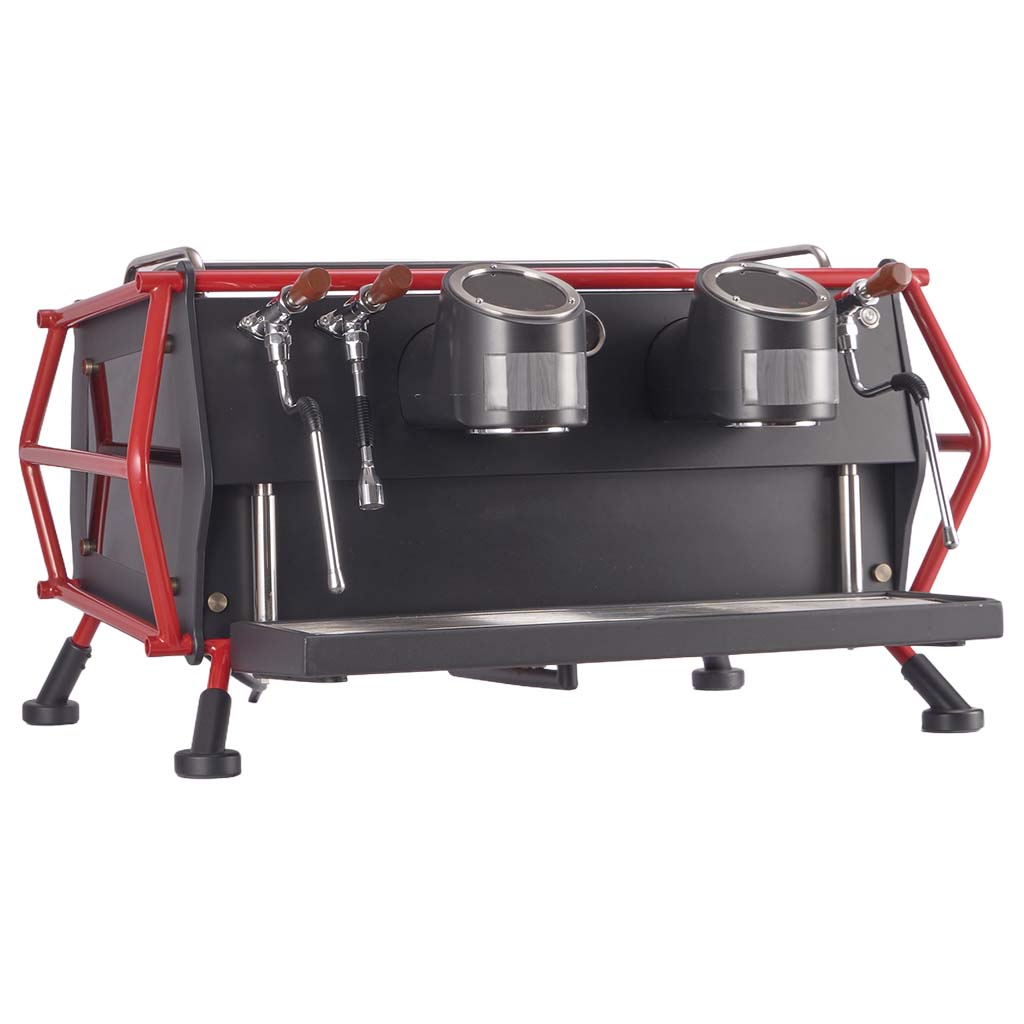
We had a unit on the test— the KY-T33 semi-automatic commercial espresso machine — and we did the dumb, brutal test buyers never get to see: just keep the water running, no puck, no mercy.
2,000 ml of water pulled straight through.
Up to that point, brew temperature held at 92°C. Flat. Boring. Exactly what you want during a real rush.
Past 2,000 ml, yeah, it finally gave in — temperature dropped 3–6°C. That’s physics, not failure.
But here’s the part that matters for your business: it climbed back to 92°C in 5–13 seconds.
Not three minutes. Not “wait for the next ticket.” Thirteen seconds, tops.
In a café, that means: a stupid-busy brunch window, someone hammers milk drinks back-to-back, and the machine briefly breathes hard — then snaps back before the next cup hits the drain tray.
That’s the difference between “spec sheet stable” and “actually stable when money’s on the line.”
If a vendor can’t show you a curve like the KY-T33’s, ask yourself what they’re hiding.
The Math Nobody Talks About
Temperature drift won't break your machine. It won't trigger a warranty claim. It won't show up on any error screen.
But it's draining your profit every day:
- Drift means remakes. Every remake wastes beans, milk, cup, and time.
- Customers don't complain — they just don't return. You blame location, pricing, marketing. It's your output.
- Training costs double because senior baristas are compensating for the machine with "feel." When they quit, consistency collapses.
- You open a second location and can't replicate the first one's success because the machines don't match. Franchisees start complaining.
Flip it around. A semi-automatic commercial espresso machine with solid temperature stability means: a trainee can pull a shot almost as good as the head barista. Staff turnover doesn't wreck your taste profile. Ten locations all taste the same.
That's not magic. That's equipment reliability doing its job.
How to Protect Yourself When Buying
A few practical moves.
Don't get sold on "PID controlled" printed on a brochure. PID is a good start but implementation varies wildly — like two cars both having automatic transmission, one shifts smooth and the other jerks. Make the supplier prove it with real-world data under load.
High volume? Dual boiler. Period. Don't cheap out on a single-boiler system thinking you'll upgrade later. You'll pay the difference in service calls and lost customers.
Put temperature stability in the purchase contract. Not vague promises — specific numbers. How many consecutive drinks, what's the max allowable fluctuation, measured where. Test at acceptance with a thermometer at the group head. Fail = reject. Coffee machines are production equipment. Buy them like one.
FAQ
Q1: What is PID, and do I need to understand it?
You don't need the engineering details. Just know this: PID is a technology that keeps water temperature precise. Machines with PID are more stable than those without. But PID alone isn't enough — sensor placement, heating power, and boiler design all matter. It's like ABS in a car: necessary but not sufficient.
Q2: Is dual boiler always better than single boiler?
For commercial use, yes. Dual boiler physically separates brewing from steaming, which is the foundation of temperature stability. Single-boiler (heat exchanger) systems work for low-volume, milk-heavy menus where consistency isn't critical. For specialty cafés or chains, dual boiler is the minimum.
Q3: How do I test if a machine is temperature-stable?
Ask the supplier for a live demo: 10–20 consecutive shots while measuring water temperature at the group head. If fluctuation exceeds 1–2°C, the machine can't handle load. Don't trust the display — that's often boiler temperature, not what actually hits the coffee.
Q4: Can temperature instability be fixed?
Usually not, because it's a design limitation, not a defect. If a machine has low thermal mass, underpowered heating, and poor insulation, temperature drift is baked in. Choose right before you buy. Fixing it after is rarely possible.
Q5: Why do chain operators care so much about temperature stability?
Because chain value depends on "same taste everywhere." If Store A brews at 93°C and Store B at 90°C, the same beans taste different. Customers notice. Temperature lock (preventing staff from changing settings) and stable hardware are the foundation of chain standardization.
Q6: Does water quality affect temperature stability?
Yes. Scale builds up on heating elements like a blanket — heat can't transfer properly, and sensor readings diverge from actual water temperature. Regular descaling and water filtration aren't "maintenance tips" — they're essential to keeping temperature accurate.