




Walk behind the bar of any serious specialty café and you’ll notice something intentional. The center stage is almost never occupied by a super-automatic. Even during a chaotic morning rush, the hero is a high end commercial espresso machine metal-bodied,pipe-exposed,portafilter-loaded,and unapologetically manual.
It seems counterintuitive. Super-automatics promise speed, consistency, and minimal training. Yet the most experienced baristas still reach for semi-automatics. Why?
The answer isn’t “the machine isn’t advanced enough.”It's that the barista refuses to become redundant.In this post,we'll explore the philosophy behind this choice-and later,show how a T5 temperature control espresso machine like the KY-T33 redefines what a premium commercial espresso machine should be.

1. Why Baristas Resist Super-Automatics: The Quiet Cost of “Dispossession”
From an owner’s perspective, automation sounds safe: fewer variables, lower training costs, predictable output. But for a career barista, a fully automated workflow creates deprivation of agency.
A super-automatic hides every decision. Place the cup, press a button, collect the drink. When a guest says, “This is too bitter,” the barista has nothing to adjust. They can’t change contact time, pressure, or temperature. The only honest reply is: “That’s what the machine decided.”
That helplessness slowly erodes professional pride. Over time, the barista becomes a machine attendant rather than a flavor creator. In contrast, a professional high end espresso machine puts the barista back in charge—where they belong.
Ask why: If a workflow strips away every decision, can it still be called craftsmanship?
2. Semi-Automatic as Instrument, Not Appliance
If espresso were music, a super-automatic would be a player piano—mechanically correct, emotionally flat. A high end espresso machine for cafe use is closer to a concert instrument. Silent until touched, it responds only to pressure, timing, and intent.
Every step in a semi-automatic workflow invites interaction:
-1.Distributing grounds teaches the hand about density.
-2.Tamping reveals resistance and uniformity.
-3.Starting the pump is a conscious choice, not a default.
-4.Watching the stream—thick like honey versus thin like water—predicts flavor before the first sip.
That tactile feedback loop is irreplaceable. It transforms a technician into an artist.
Ask why: If flavor is subjective, shouldn’t the person shaping it have full control?
3. Coffee Beans Change Daily—Your Machine Should Allow Correction
A common misconception: coffee is a fixed commodity. In reality, roasted beans are alive and reactive.
Freshness shifts: Newly roasted beans trap CO₂; they often demand shorter ratios or larger doses. As they rest, solubility drops and grind settings must adapt.
Environmental changes: Humid weather causes beans to swell; grind size tightens. Dry air does the opposite.
Roast variation: Even identical origins taste different across batches.
A locked-in super-automatic executes the same instructions regardless of these changes. A commercial espresso machine with precise temperature control, paired with a quality grinder, allows the barista to respond in real time—tightening or loosening the grind, adjusting yield, or shifting temperature to protect clarity.
Ask why: If ingredients change daily, shouldn’t the equipment leave room for human correction?
4. Milk Texture Is Physics—and Physics Requires Feel
Espresso extraction blends chemistry and physics. Milk steaming is pure physics—and pure feel.
Super-automatics typically limit steam pressure and inject wet vapor. The result is coarse, unstable foam that breaks down quickly and limits latte art to basic patterns.
A T5 semi automatic espresso machine, by contrast, offers controllable dry steam. The barista opens the valve slightly, listens to the pitch, watches the vortex, and decides when to drop the tip. That micro-interaction creates silky microfoam suitable for advanced patterns and refined mouthfeel.
Ask why: Can any preset program replicate the moment a barista knows—by ear—that the milk just turned perfect?
5. Bar Rhythm: Parallel Workflows and Breathing Space
Observe a skilled barista during peak hours: grind, distribute, lock the portafilter, start the shot, pivot to the steam wand, finish the pour. While the espresso extracts over 25–30 seconds, milk reaches 60 °C—perfectly timed.
Most super-automatics force a serial workflow: brew, then steam. A high performance commercial coffee machine enables true parallel processing. Dual-group configurations allow one side to pull a dark-roast Dirty at 92 °C while the other extracts a light-roast SOE at 94 °C—simultaneously.
This rhythmic flow gives the bar a sense of breath rather than mechanical repetition. Guests don’t watch a box hum; they watch a craftsman work.
Ask why: If the machine dictates pauses, who is truly leading the café—the barista or the timer?
6. Why Owners Still Choose Semi-Autos: Retention Through Mastery
For operators, the long-term ROI of a professional espresso machine for restaurant or café use depends on people, not just hardware.
Super-automatics hide cause and effect. Staff never learn extraction theory, never read flow rates, never diagnose a leaking gasket. Skills plateau; turnover rises.
A semi-automatic is an open textbook. It forces the team into Golden Cup thinking: dialing in grind, tasting for balance, understanding pre-infusion. It also builds diagnostic ability—recognizing a fast shot as a grind issue or a leaking portafilter as a gasket problem. That competence makes a venue resilient and desirable to work in.
Ask why: Would you rather rent button-pushers, or develop technicians who protect your brand?
7. The KY-T33: A T5 Commercial Coffee Machine Built for Collaboration
After thousands of hours behind commercial bars, one truth became clear: baristas don’t need a smarter machine—they need a more honest one. That philosophy drove the development of the KY-T33, a T5 commercial coffee machine designed around a simple idea:
Stable baseline. Open control.
The KY-T33 is not engineered to replace the barista. It exists to remove machine-side noise so the barista’s choices actually determine the cup.
What Makes the KY-T33 a Benchmark Best High End Commercial Espresso Machine
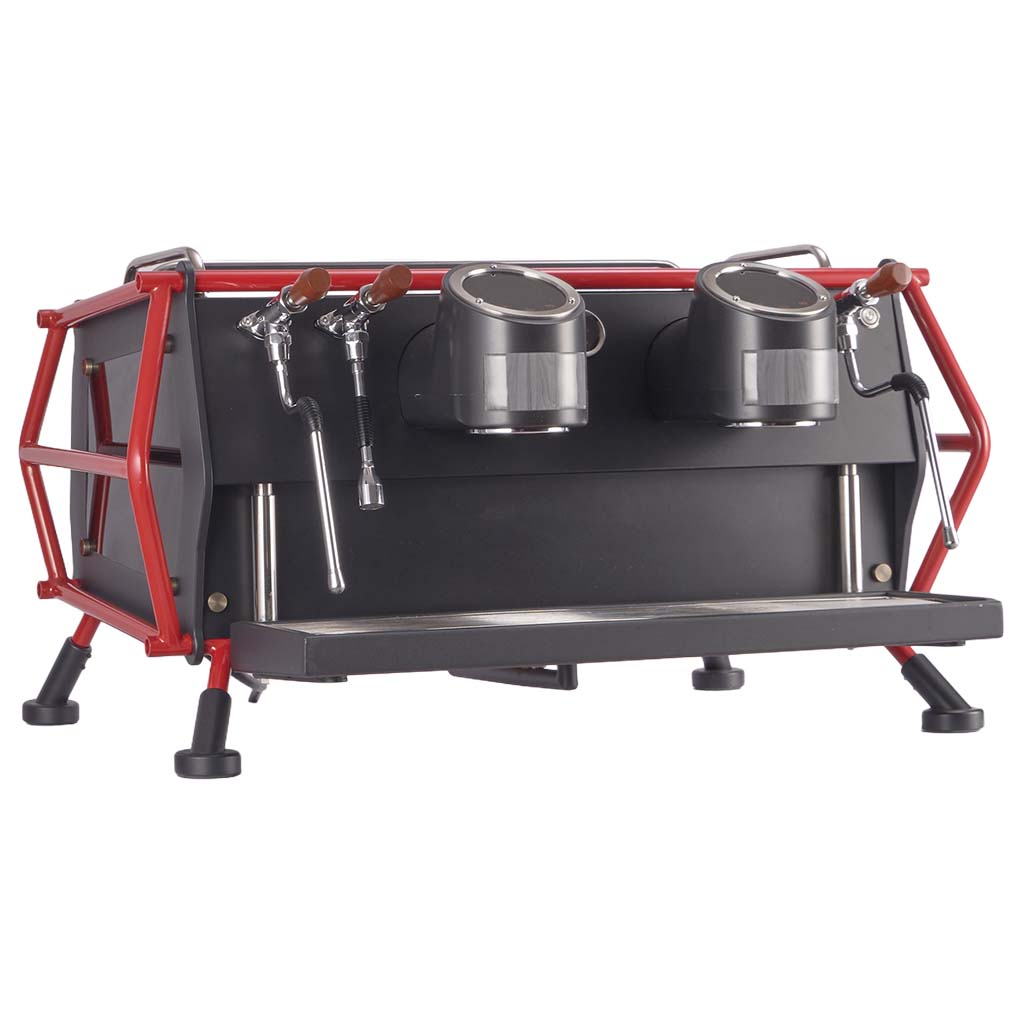
T5 Control Espresso Machine Logic
The T5 system governs pressure curves and thermal behavior. By delivering linear 9-bar extraction and adjustable low-pressure pre-infusion, it minimizes channeling while leaving yield and cutoff entirely to the barista.
Commercial Espresso Machine Temperature Control Done Right
Independent PID-controlled boilers decouple brewing from steaming. Even during back-to-back shots in a morning rush, group-head temperature remains stable. Shot 50 tastes like shot 1—a critical requirement for any premium espresso machine for coffee shop environment.
Steam Performance for Professionals
Dry, high-volume steam allows precise aeration and rapid heating. Baristas describe the KY-T33’s wand as “communicative”: gentle on opening, powerful through the middle, and clean at shutoff. This feedback loop accelerates learning for new hires and enables complex latte art for veterans.
Dual Group Heads :Saturated group with active heating
Independent group temperatures support mixed-menu cafés. One group can focus on chocolate-forward dark espresso, while the other highlights acidic, floral single origins—without compromise.
Durability and Serviceability
A food-grade stainless chassis, copper lines, and logical internal layout reduce downtime. Combined with a structured maintenance schedule, most issues are resolved without external service calls.
Daily Output Fit
Designed for venues averaging 150–400 cups per day, the KY-T33 fits specialty cafés, hotel lounges, and upscale restaurants seeking a best espresso machine for cafe deployment.
In short, the KY-T33 is not a high end commercial espresso machine because it automates everything. It earns that label because it stabilizes what should be stable—temperature, pressure, steam quality—so the barista can focus entirely on what should never be automated: flavor.
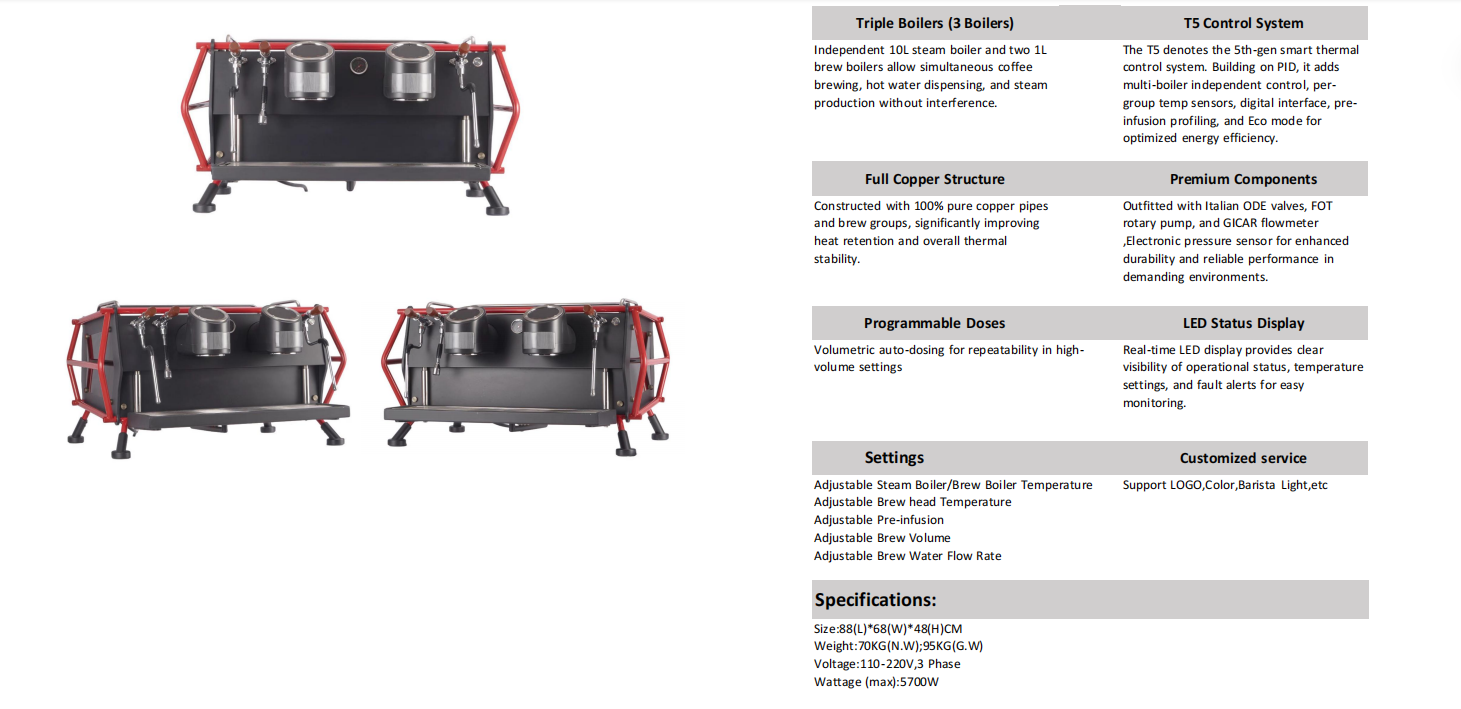
KY-T33 Quick Spec Sheet (T5 System)
Conclusion: Machines Should Serve People
Professional baristas prefer semi-automatic machines because these tools respect their judgment. Software cannot yet match a trained palate interpreting a living ingredient. Speed without flavor is a poor trade for specialty coffee.
A premium commercial espresso machine should never try to replace the person behind it. It should quietly handle thermal stability, pressure consistency, and steam quality—then step aside. That is exactly what the KY-T33, as a T5 semi automatic espresso machine, was built to do.
In an era of total automation, the manual lever and the portafilter remain symbols of intention. Guests can make pod coffee at home. They walk into your café for a cup shaped by hands, decisions, and a machine honest enough to let the human lead.
Your café, lounge, or restaurant deserves equipment that reflects that standard.
The KY-T33 is ready when you are.