




If you‘re choosing an espresso machine for a café, or budgeting for an upgrade, one question is almost unavoidable: how many group heads do you actually need?
It sounds simple. But it’s where first-time buyers most often over- or under-spec. Buy too small, and you can‘t keep up during the rush. Buy too large, and the extra cost and counter space take years to earn back.
The answer isn’t “more is better” or “just enough.” It depends on your menu, your peak throughput, your staffing plan, and how you see the next two or three years of growth.
Why Group Head Count Is the Core Procurement Variable
In the world of commercial espresso, the group head is the production unit. Each additional group means one more simultaneous extraction—and one more barista station.
A two-group machine has two groups that can work at once. If your menu is built on double shots (the norm in modern specialty cafés), a two-group means two drinks can be made simultaneously. A single group means one.
But the real driver isn‘t “how many drinks per day.” It’s how many drinks you need to produce during your single busiest hour. Daily volume is a reference. Peak throughput is the decision variable.
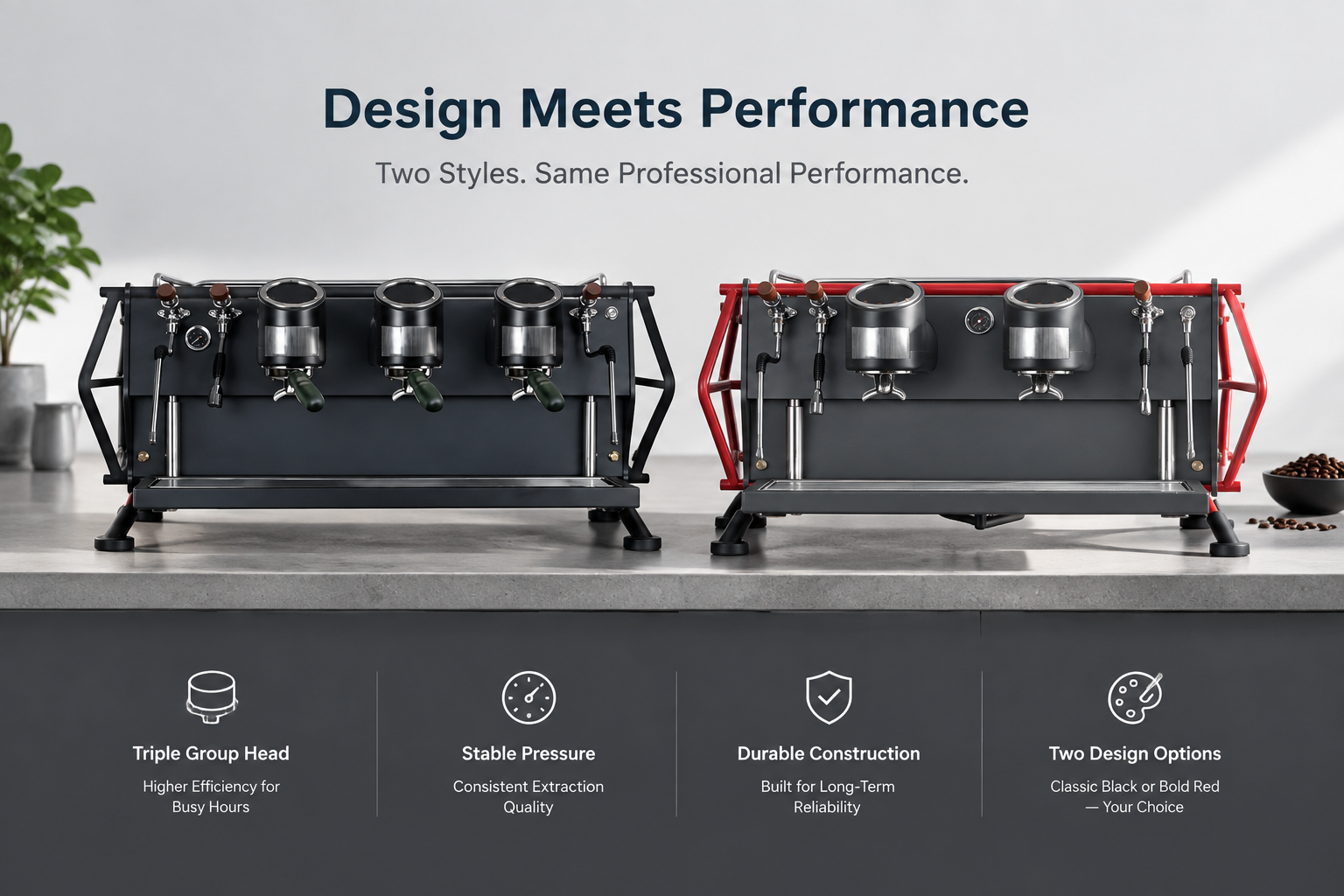
Single, Double, Triple: What Each Really Fits
Single Group
The single group has a clear lane: low-volume, or space- and power-constrained operations.
Who it fits: coffee carts, pop-ups, office coffee corners, small specialty shops where filter and cold brew lead and espresso is secondary. If peak-hour output stays under 10 to 15 drinks, a single group is sufficient.
For coffee carts, a single group is often the only realistic option. Most outdoor venues offer 110V power. A double-group commercial machine typically needs a dedicated 220V circuit. Forcing a double-group onto a cart means bringing a generator—and its noise and weight become new problems.
The single group‘s limitation: one operator station, one grinder. Once the barista has to manage milk steaming and extraction simultaneously, the rhythm breaks. You can’t add staff to increase output during peak.
Double Group (2 Group)
The double group is the mainstream choice for independent cafés. Almost every serious conversation about commercial espresso configuration lands here.
Who it fits: independent cafés doing 100 to 300 drinks per day, small chains, hotel lobby coffee programs, bakeries with a strong coffee line, restaurants where coffee is a meaningful revenue category.
The double group’s core advantage is the two-person workflow. Two groups mean two baristas can work the bar without colliding. Steam wands sit on each side. One barista handles extraction and milk on one side; the other manages output and cleaning on the other. The rhythm doesn‘t need choreography—once the team learns it, it flows on its own.
On capacity: a trained barista working alone on a two-group can produce roughly 30 drinks per hour at peak. Two baristas working together can reach around 60 per hour. More aggressive numbers come from equipment spec sheets, but in real operation, baristas also handle orders, restocking, and cleaning—all of which pull down effective output speed.
Another practical advantage of the double group is boiler capacity. Two-group machines typically carry 1.8 to 3.7 gallons (7 to 14 liters) of steam boiler capacity. That matters if your menu is milk-heavy—the difference becomes obvious during the morning rush.
The cost: 220V single-phase power, usually a dedicated 30 to 50 amp circuit. Older buildings may need a panel upgrade. This is the most commonly underestimated line item in the procurement budget, potentially accounting for 25% to 40% of true year-one cost.
Triple Group (3 Group)
A triple group is not “a bigger double.” It’s designed for extreme peak throughput and redundancy.
Who it fits: high-volume shops doing 250 to 500+ drinks per day, drive-thru cafés, university food courts, large hotel banquet coffee programs, roasteries with retail bars that need to brew different beans simultaneously.
What a triple group really sells is, to a large degree, redundancy. Lose one group on a double, and you‘ve lost 50% of your bar. Lose one on a triple, and you still have two running. For a drive-thru or hotel breakfast that cannot pause during morning rush, that math is the decision.
A triple group also supports a more complex workflow. You can dedicate one group to single-origin or decaf while the other two handle the core menu. During peak, all three can run with two baristas coordinating output.
The cost: a footprint of 38 to 45 inches (97 to 114 cm), consuming serious counter space. Power requirements are typically higher; older buildings almost always need an electrical upgrade. At least two grinders are needed to feed three groups, sometimes three. If peak hour stays under 60 drinks, the extra group rarely pays back.
A Quick Table: How Many Groups for Your Café
| Group Count | Peak Output (per hour) | Daily Volume Reference | Typical Scenario | Power |
|---|---|---|---|---|
| Single | < 15 drinks | < 60-80 drinks | Coffee cart, pop-up, office, small specialty shop | 110V/220V |
| Double | 30-60 (1-2 baristas) | 80-250 drinks | Independent café, hotel lobby, restaurant | 220V single-phase, 30-50A |
| Triple | 80-150+ drinks | 250-500 drinks | High-volume shop, drive-thru, banquet service | 220V, higher amp |
Compiled from
This table is a starting point, not an answer. At least three more variables shape the decision.
Three Variables Buyers Often Overlook
First, what your menu leads with. If the menu centers on filter, cold brew, and Americanos, with espresso as a side act, you can be conservative on group count. If milk drinks dominate, steam power matters more than group count—two-group machines typically carry stronger steam boilers, and that’s not something a single group can compensate for by “hiring another person”.
Second, how many baristas you plan to put on bar. A single group supports one operator. A double supports two working in parallel. A triple can accommodate two or three. If your staffing plan never puts more than one person behind the machine, a triple is waste.
Third, whether your space and power actually allow it. A triple group has hard requirements for counter depth, back-bar clearance, and circuit capacity. Confirming these before signing a lease matters more than choosing a brand or model. The cost and time of upgrading electrical service in an older building can change the entire procurement decision.
Procurement Advice: Buy One Size Up, Not One Size Down
If you‘re torn between single and double, or between double and triple—and space and power allow it—choose the larger machine.
The reason is simple: the espresso machine is the hardest piece of equipment to “upgrade” in a café. You can buy another grinder. You can add water treatment. You can even rent an ice machine temporarily. But replacing an espresso machine means re-wiring, re-training, and possibly days of closure. If your business grows and the machine hits its ceiling in year one, the “sufficient” machine becomes the most expensive mistake.
A 20% headroom is a reasonable buffer. If your peak forecast is 40 drinks per hour, a double (60-drink capacity) is safer than a single (15-drink capacity).
Why the Semi-Automatic Double Group Remains the Specialty Café Baseline
Back to a more fundamental question: once you’ve settled on group count, what type of machine?
If your goal is maximum speed and minimum labor cost, a super-automatic is a rational choice. Convenience stores, office coffee corners, and QSRs operate on a logic of “consistent, fast, and not dependent on a skilled operator”.
But if your brand is built on coffee quality and experience, the semi-automatic double group is infrastructure. It lets your people control extraction, lets the bean‘s flavor be fully expressed, and makes the craft behind the bar a visible part of the value.
Group count determines your capacity ceiling. Machine type determines your quality ceiling. They need to match. Neither should be sacrificed for the other.
Read More: Semi-Auto vs Auto vs Super-Automatic Commercial Espresso Machines: Which Should You Buy?
Ready to Make the Decision?
Choosing an espresso machine isn‘t buying a piece of equipment. It’s setting a physical boundary for your operating rhythm over the next two or three years.
If you‘re evaluating espresso machine configuration for a café, or planning procurement for an upcoming project, Huazell offers OEM/ODM support for semi-automatic commercial espresso machines—from group head configuration and boiler systems to exterior customization. Based on your shop size, menu structure, and power conditions, we can help match the right machine spec to your operation.