




Most distributors don't lose money because they paid too much for a grinder.
They lose money because they bought a machine that looked cheap — then let burr swaps, downtime, warranty claims, and missing spare parts quietly eat the margin.
A commercial grinder isn't a consumer gadget. In B2B, the price is driven by three things: burr size, feature set, and order quantity.
A 64mm timed/weighted-dosing grinder commonly sits in the $130–$200 ex-works range.
74mm timed dosing: $240–$320.
83mm: $350–$420.
98mm: $450–$580.
Important: these are rough evaluation ranges for planning, not fixed quotes. Actual pricing moves with MOQ, burr steel, branding, certifications, freight, and raw-material costs. The same grinder can quote differently in March and September.
Order 300 units and the factory prices one way.
Order 30 units and the math changes. Tooling, motor sourcing, QC hours, packaging, and certification paperwork all get redistributed across the units.
So when a buyer says "this one is $20 cheaper," they're often not comparing suppliers. They're comparing the first row of a spreadsheet.
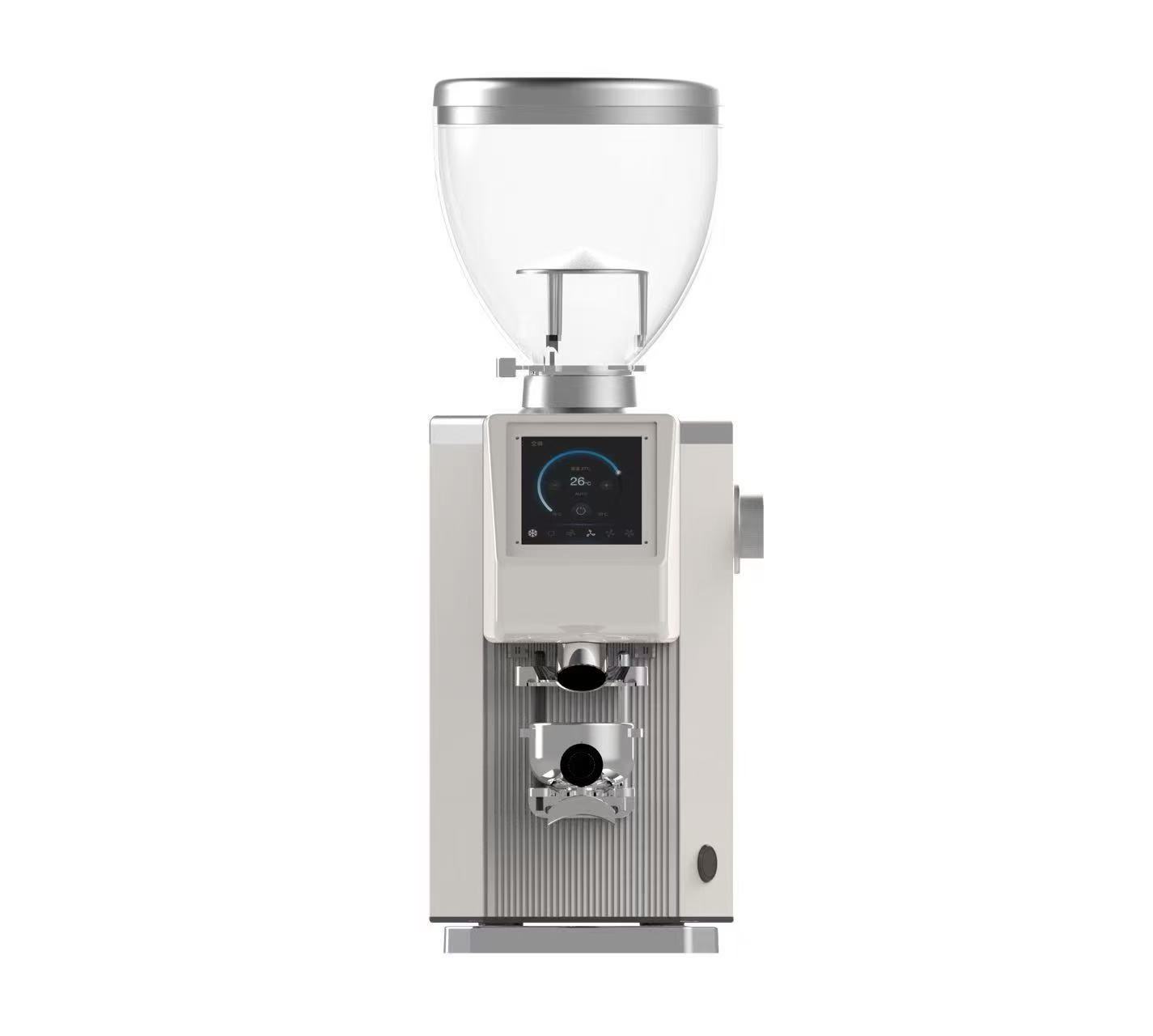
1. Purchase price is the entry fee, not the total cost
The real cost of a commercial grinder looks like this:
TCO = machine price + burr replacements + calibration labor + downtime + warranty claims + spare-part inventory + lost repeat business from inconsistent shots
In the $130–$580 B2B band, two machines may be only $30–$80 apart on the PO. But for a café grinding 6–8 kg/day, that gap gets flipped several times over three years.
2. Why a $135 grinder can cost more than a $235 grinder
A lower price doesn't automatically mean bad quality. More often, cost was moved somewhere else.
Burr base material
Entry-level 64mm units often use 420 stainless. It's cheap and corrosion-resistant, but wear resistance is average. Step up to oil-quenched hardened steel, then Chromoly or tool steel, then TiN/DLC coatings. If you want the full picture, start with our before negotiating specs.
Motor duty and dosing logic
A $135 machine may have an intermittent-duty motor. During the morning rush, RPM drops and dose weight drifts. The barista won't explain metallurgy — they'll say "this grinder feels off." Motor duty, dosing type and retention are covered in our .
Burr platform and throughput
64mm is not 98mm. If you're matching grinder size to café volume, read our before locking the SKU list.
QC and after-sales
Spot-check factories and per-unit-test factories are different businesses. One protects margin. The other creates 6 a.m. support calls. Supplier auditing is its own skill — see .
OEM program maturity
If you're a distributor building a private label, the factory is your product team. Burr life, spare parts, manuals, and firmware policy decide whether your brand looks premium or disposable. Our explains where most private labels break.
3. Rough commercial coffee grinder wholesale price bands
These are ex-works/export planning numbers, not retail:
- 64mm timed/weighted dosing, 420 stainless, 300+ units: $130–$200
- 74mm timed/weighted dosing, hardened steel / better motor: $240–$320
- 83mm timed/weighted dosing, commercial platform: $350–$420
- 98mm timed/weighted dosing, high-volume platform: $450–$580
Small trial orders price higher. Container-level orders compress unit cost but don't automatically improve lifecycle cost.
4. Burr life: don't ask "how big", ask "how many kilos"
Everyone quotes burr diameter. Few ask:
At my customer's roast profile and daily volume, how many kilos before this burr set drifts?
420 stainless wears faster. Hardened steel lasts longer. Chromoly/tool steel last longer again. Coatings reduce wear but raise replacement part cost. The right metric is cost per kg ground, including labor to swap and recalibrate.
5. Serviceability is distributor margin
A grinder that takes 90 minutes to disassemble costs you twice: technician time and café downtime.
Good commercial designs share boring features:
- burr carrier comes out without stripping the gearbox
- adjustment ring holds calibration after hopper removal
- control board is one connector, not six loose plugs
- wear parts are 4–5 SKUs
- manual says "turn, align, lock" instead of "return to factory"
6. Spare parts separate a quotation from a partnership
A distributor with 300 machines in the field eventually needs burr sets, adjustment rings, switches, chute seals, and control boards.
If the factory says "old model discontinued," you eat the complaint.
If the factory stocks wear kits for 5 years, you sleep.
Ask before ordering:
- How many wear-part SKUs?
- What's the burr MOQ?
- How long after a model refresh are old parts available?
- Can you ship service kits, not just full machines?
- Are boards/firmware backward compatible?
7. TCO example: 64mm timed dosing
Café: 6 kg/day, 5 days/week, 50 weeks = 1,500 kg/year.
|
Cost item
|
Low-price 64mm ($130)
|
Better 64mm hardened ($235)
|
|---|---|---|
|
Purchase
|
$130
|
$235
|
|
Burr swaps, 3 yrs
|
5 × $28 = $140
|
2 × $45 = $90
|
|
Swap + calibration
|
5 × $35 = $175
|
2 × $35 = $70
|
|
Downtime / complaints
|
4 × $50 = $200
|
1 × $50 = $50
|
|
Warranty handling
|
$80
|
$25
|
|
3-yr TCO
|
$725
|
$470
|
The cheap unit saved $105 upfront and cost $255 more over three years.
But office / convenience / low-volume sites? The $175 machine may be correct.
Lifecycle value is a function of daily kilos, not slogan-level "premium vs cheap."
8. Buyer checklist
- Burr base: 420, hardened steel, Chromoly, tool steel, coated?
- Life in kilos at light/medium roast?
- Dose drift after 30 min continuous service?
- Pricing at 50 / 200 / 500 units?
- Lead time stable across seasons?
- Wear-part MOQ workable?
- Exploded diagrams and service videos available?
- Old-model parts supported after revision?
- North America / EU / Middle East documentation handled?
9. The point isn't "buy expensive"
In the $130–$580 range, a $40 gap can mean:
- 420 stainless vs hardened steel burrs
- intermittent vs continuous-duty motor
- spot-check vs per-unit QC
- no spare parts vs 5-year wear-part commitment
- fails Saturday 8:30 a.m. vs three years without a service call
Walk into the factory asking:
At my order volume, my customer's daily kilos, and my market's compliance rules — how much does this grinder cost me by year three?
That's how distributors stop buying boxes and start protecting margin.
HUAZELL doesn't pitch "cheap commercial grinders." We spec platforms by burr size, duty cycle, serviceability, and spare-part continuity — because distributors aren't reselling cartons. They're protecting bar service, brand consistency, and reorder rate.
Frequently Asked Questions
1. What is the total cost of ownership of a commercial coffee grinder?
Total cost of ownership includes the purchase price plus burr replacements, calibration labor, downtime, warranty claims, spare-part inventory, and lost business from inconsistent grinding. In B2B, the cheapest unit price often has the highest 3-year cost.
2. What are typical wholesale prices for commercial grinders by burr size?
As rough ex-works planning ranges: 64mm timed dosing is about $130–$200, 74mm about $240–$320, 83mm about $350–$420, and 98mm about $450–$580. These are estimates, not fixed quotes, and vary with MOQ, burr material, certifications, and freight.
3. Why can a cheaper commercial grinder cost more over time?
Lower-priced grinders may use lower-wear-resistant burr steel, intermittent-duty motors, loose adjustment rings, spot-check QC, and no spare-part program. Those gaps show up later as burr swaps, downtime, warranty claims, and barista recalibration time.
4. Which burr size should a B2B buyer choose?
Choose by daily grinding volume and service style, not by marketing. 64mm suits lower-volume sites, 74mm suits busy cafés, 83mm suits high-throughput espresso bars, and 98mm suits batch/filter or very high-volume service.
5. What should distributors ask a grinder manufacturer before ordering?
Ask about burr base material, expected kilos before drift, per-unit QC, wear-part SKUs, spare-part MOQ, model-refresh parts support, firmware/board compatibility, and market documentation for North America, Europe, or the Middle East.
6. How often should commercial grinder burrs be replaced?
There's no fixed calendar interval. Replace burrs based on kilos ground and visible performance drift — inconsistent dose weight, coarser grind, slower output, or higher retention. Track kilos per burr set so replacement becomes a budgeted cost, not an emergency.
7. Is a more expensive commercial grinder always better?
No. A higher-priced grinder is only better if it reduces your actual cost drivers: burr swaps, downtime, calibration labor, or warranty claims. For low-volume sites, a basic 64mm unit may be the correct business decision. Match the machine to daily kilos and service style.
Ready to spec a grinder line that protects your margin?
If you're evaluating 64mm, 74mm, 83mm, or 98mm commercial grinders for your next container — or building an OEM program and need honest guidance on burr material, spare-part continuity, and pricing bands — talk to the HUAZELL team.
We don't push a "premium" story. We help distributors match grinders to real usage, serviceability, and 3-year cost.